What We Learnt At The Oxford Print Fair

Etch To Their Own

Three weeks later and we have to call the Oxford Print Fair a success. With 900 people through the door (that we managed to count), 20 happy sellers, one happy gallery, an extremely busy coffee shop and leaving Oxford a little bit more full of print it is easy to say it went well!
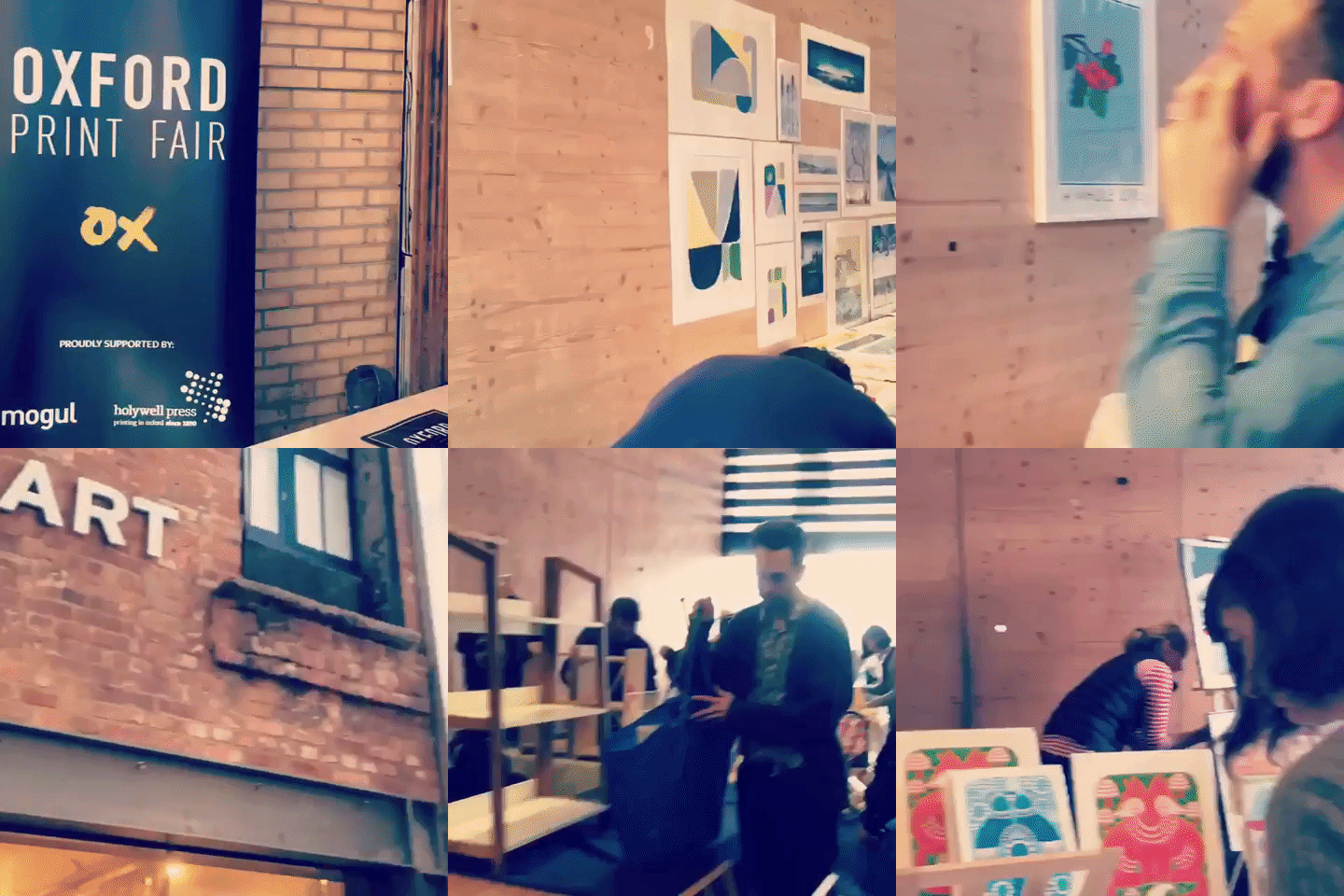
a very speedy look at the Oxford Print Fair

But what did we learn? While Forecast Events has been running the Manchester Print Fair for years, this was the first one which Mogul has run, and the first outside of Manchester. While we were obviously in safe hands, here’s a few things that we learnt along the way.

Print people are nice people

We were absolutely stunned by the sheer loveliness of everyone involved. The artists and printmakers were completely chilled throughout the day — despite the threat of rain and joining us on this first adventure into Oxford. The general public providing endlessly lovely feedback on their way out, happily to sharing a peek at the print they found that was perfect for them.

Even with the best promotion in the world, someone will tell you they didn’t know your event was happening

With hundreds of tweets, Instagram posts, a Facebook event and being listed on every major events site for the local area — and being linked to in the Times style section — not to mention the venue being one of most prestigious galleries in the city, some people just missed it.

With this there’s always more we can do with the time we’re given. Next time we will have the advantage of people knowing such an event can exist, as well as a newsletter to alert people.

If you missed out on the Oxford Print Fair, then sign up here to hear about the next one.

Happy to talk

It’s notoriously hard to get anyone to speak on camera. There is something fundamentally worrying about having your image captured in a way where there’s not much scope for editing yourself beautiful.

So at the Oxford Print Fair I set about recording interviews with all but one (shy) artist. I invited each over to our interview bench where we discussed their practice, the print fair and how they ended up there. We’re currently editing these into bitesize chunks to be released over the coming month. Naturally, we’ll let you know when each artist interview is coming up.

When you take away the camera, and you’re suddenly in radio or podcast territory, people open up very naturally. This is one of the reasons that Mogul always records our research interviews without a camera — a camera asks people to perform, and a microphone lets them be more natural.

The right partner makes the dance easier

We’re completely indebted to all of our partners for the event — if you work with professionals, the day tends to go smoothly.

Our print partners Hollywell Press, for providing us with banners, posters and hand-outs made it easy to talk about the event on the day, and provided something obvious to draw passers by in with.

Modern Art Oxford were fantastic in providing such a venue, and helping clear out the usual clutter from The Yard where we were stationed before the event, meaning we had expanses of wall space for our artists to put up their print!

And of course, Forecast Events, whom none of this could have happened without.

Every event is a networking event

Not only was the Oxford Print Fair a wonderful event in itself for letting the public meet and buy from the artists directly, but it also brought together a huge number of creative people. As a place to meet people and network with brilliant creative minds, the print fair was a win. I’m certain we weren’t the only ones going home with pocketfuls of cards!


There’s loads more to say about The Oxford Print Fair, which we will come to soon — including artist interviews and news about our next event! If you missed out, remember to sign up, and if you’d like to talk to us about being part of any future events, get in touch with us online or by email: chris@wearemogul.com

I Spy With My Iris

Etch To Their Own

I had a lovely time at the print fair last weekend (I’m the tall one trying to not get in the way too much, but still a little bit). Not only was there loads of artists and printmakers in the sense that you might expect, but there was also Hurst Street Press — a publisher of innovative writing.

I was lucky enough to record an interview to Shoshana, one of the founders of Hurst Street Press, at the Oxford Print Fair. Sadly it’s not ready for release yet, but once it is I’ll share it with you in these pages!

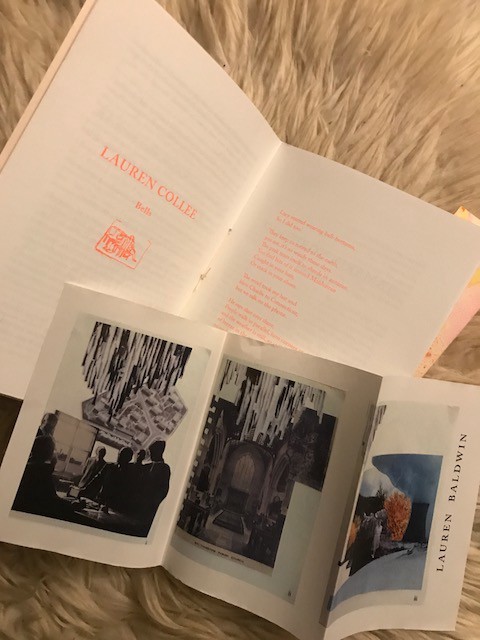
I picked up a copy of IRIS II at the fair. I was really excited to see that they’d brought it along as I’d scouted them out previously online.


The journal is full of wonderful multi-disciplinary works — lovingly riso-printed (amongst other techniques!). This is another literature-as-object items that has it’s value rolled into the way it is presented. See our discussions on NOX by Anne Carson.Predictably, I picked up this issue rather than either of the other two.


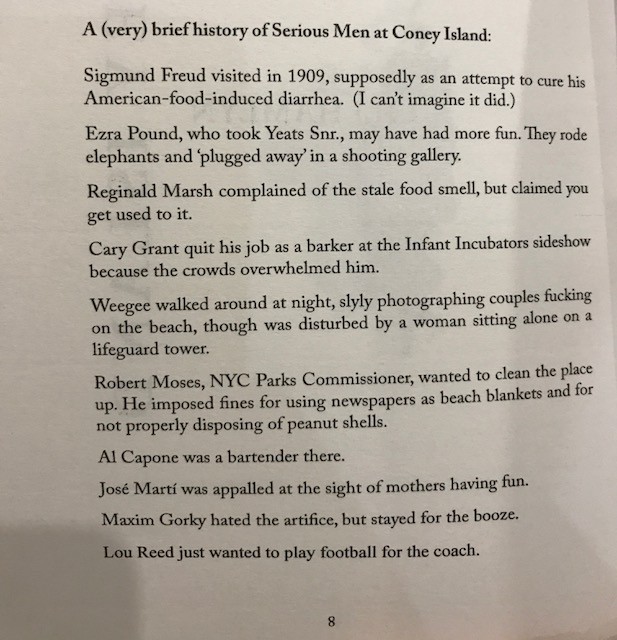
Predictably, I picked up this issue rather than either of the other two because the second piece mentioned Ezra Pound. I present, A (very) brief history of Serious Men at Coney Island:


And obviously it’s wonderful. The writer, Lauren Baldwin, does that thing I love of connecting a known point of culture/literature and offers it directly to the reader. Here the serious men are reviewed at the funfair, each existing in a kind of literary fan-fiction sense that satirises their seriousness — while also ringing true. Each section reflects the writing or expression of the person as they exist in culture and as such is a jolly satire.


I got a shout out, with Eminem.


Sealey’s collection Ordinary Beast official goes on the “to buy” list with:


This Week’s Song is:


Ambient Hour: Episode 21


Thanks for reading Etch To Their Own. TGIF. As always, it was written by @CJEggett, and proofread by no one. Kick back, have a drink, maybe one of the only types of wine available. Sorry I haven’t rabbited on so much in this one, but I believe I have been part of an experiment. Please get in touch if you have spotted a typo. Please get in typo if you’ve spotted a touch.

Passing Sentence

Etch To Their Own

I very happily spotted a few Fitzcarraldo Editions’ books out in the wild this weekend. There’s something very pleasing about a publishing house with such a high hit rate (for me) that I can generally trust that anything white on blue will be of interest.

So I picked up Zone by Mathias Énard, which consists of a single sentence over it’s four-hundred-odd pages.

It has a particularly European sensibility about it — the kind of mandatory romanticised memories of attempting to bed foreign girls in a foreign city in a less than appealing hovel do crop up. But even then, the writing is magnificent.

To address the form: it is either exceptionally well edited in this translation (by Charlotte Mandell) or we’ve never really needed a full stop in literature. The way the language rolls has the natural rhythm of poetry — to have each thought connected rather than separated makes the transitional leap important and often obvious. This natural flow is even more impressive when you can, quite naturally, distinguish between connected thought and clauses within other thoughts.

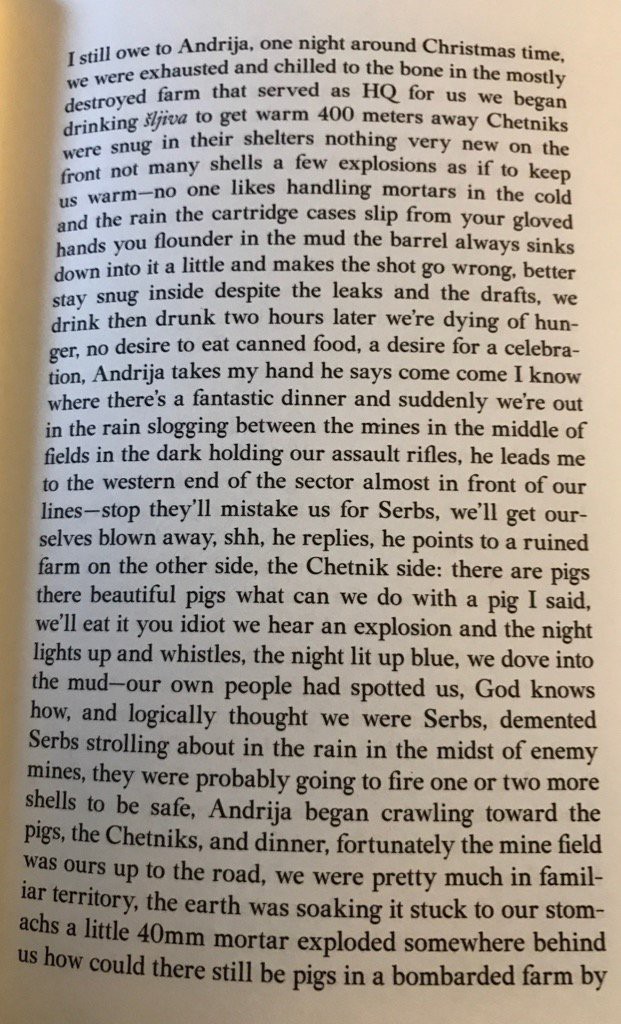
Here’s a taste:


The book does cheat a little however. There are numbered sections, chapters, episodes. These make for a kind of break in the story that you would expect — and kind of goes against it being a single flowing sentence. I don’t know if this would ever be a problem for anyone, but I thought it was best to let you know that you can take a rest between introspective retrospective dwelt on against a train window.

The story itself concerns a man, an ex-secret serviceman on his way to Rome to sell something interesting to The Vatican. And the stories that roll out of this, naturally, concern war and sanguine lies in the area surrounding the mediterranean which is the titular Zone of the title.

As you can see from the excerpt, it has all the beautiful, earthy fumblings you’d expect from a novel almost exclusively about memories, and memory is nothing if not a fumble).


This


You will have seen this wandering around the internet this week — even a dear friend of mine who doesn’t really do reading or poetry or similar pursuits took a moment to DM it to me to say it was worth checking out.

We could say that’s the power of a Kaveh Akbar Tweet but it could just be that it’s a cracking poem that feels like it connected with everyone all at once. Here’s medical history by Nicole Sealey:


Thanks for reading Etch To Their Own. Today it was a little early as a stole some time from my employer (myself) to write this in the cafe of Modern Art Oxford, which will host our first event — The Oxford Print Fair. If you’re in the city, please swing by, it would be great to see you irl. As always, this was written by @CJEggett in circumstances beyond his control (life). Please get in touch about typos by email or tweet. Please show this to your friends, if you think they deserve it. They can sign up here.

Static

Etch To Their Own

This week has been a little light on my eyes running up and down some poetry. The best thing I’ve read this week has been a dear friend’s dissertation for their MA, but I’ve missed out on the good going on in the world of literature.


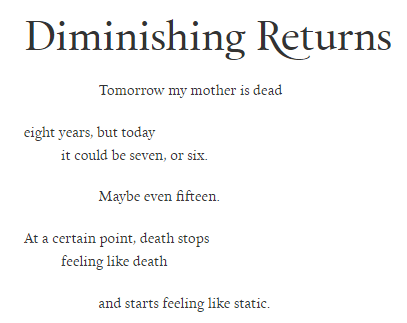
But, that said, I did see this in Rust + Moth this week: Diminishing Returns by Kieran Collier. Here’s how it starts:


You can read the rest here. It is a little too sparse to repeat completely in your inbox.

The poem takes on a few of those concepts we all have to deal with in the grief that we all individually find ourselves (however universal or connecting the act of grief may be).

Here the concept of static is mentioned, that there’s a reduction in the quality of grief. I know that I was disappointed in myself when I ran out of tears for tragedies in my own life — and I mean that literally. There is a point after a great shock where the tears are simple, soothing, and flowing freely. But this stops with an almost biological kind of certainty.

Maybe I should have been better hydrated.

I’ve personally always thought as memory in the same way as the tapes I used to make, and record over endlessly. After a time, there is a ghost in the recording, a hum of the original thing, but you may have lost the fidelity along the way.

Every time you play back a memory you have to recreate it. You have to stage the play every time you want to think about those you miss in your life. And that’s a lot of work, the more you skip in each set up and rehearsal, the more you forget about the details of the reality.

That’s how I interpret the comment of static here, that the grey areas of what you thought you would always remember start to fuzz and fray.

There are times in the distance of grief where you have to accept that your grief will never be understood, and that the worst damage of it is that you will never be able to make this person exist for someone else. You can’t force someone into reality, you couldn’t even with surgery.

You have to accept that you have this lonely little feeling of a broken connection to the way the world could have been, and move with the stream of the world as if everything was indeed fine.


Sometimes honesty is the best policy when it comes to writing acknowledgements.


Thanks for reading Etch To Their Own. Remember to dress for the job you want. This newsletter was written in a newsletter-like form, not scrambled. As always, the typing was done by your boy @CJEggett — and he’s so sorry about the typos. It was inevitable that it would go this way. But what I really want to know is, is this sponsored content?

The Oxford Print Fair & Getting Your Assets In Gear

Etch To Their Own

This weekend is Mogul’s first event. In partnership with Forecast Events we have brought the incredibly successful Manchester Print Fair (save the date!) to Oxford.

On Saturday the 9th September, at 10am we open the doors of The Yard at Modern Art Oxford and let the public in to meet and buy from 20 printmakers. We’re open until 5pm, and there’s a huge range of techniques and styles on show — and there’s even a chance to try your hand at letterpress.

The Manchester Print Fair has been an established event for many years, with a huge turnout and an engaged community around it.

But this new print fair had to start afresh. And how do you get people talking about an event like this, when it’s been untested in this city?

You give them something to talk about, naturally.

So between Mogul and Forecast Events, we decided we’d find a few things for people to talk about. Here’s the brand assets we put together for the Oxford Print Fair:

To begin with, we developed a series of marks to represent the fair, and naturally the OX stood out. We picked out a few of these, and you’ll see these parts of the visual identity appear online and in the newsletter, (if you signed up!)


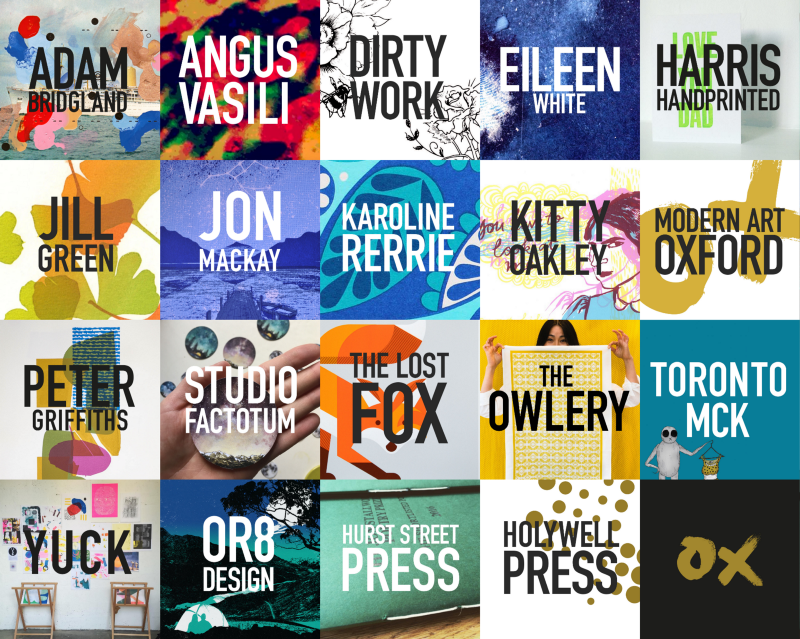
We asked all the printmakers attending the event to, if they had time, contribute their version of the event’s OX mark. Some of these are stunning, and it’s really a testament to the quality of the artists that they could take such a simple and open brief and give us back something so lovely.


Then we decided that we needed something clever, to help engagement on Instagram, Twitter and Facebook.

We’d already been introducing the artists one by one, with beautiful shots of their work, tied together with a similar style, typography, and making the use of galleries on social media.


But we needed something more.

So we enlisted Ste Beed, animator and general good egg, to create an animation which we could use as a promotion video across social.

And as you can see, all of these things have made for interesting engagements — sharing and talking about the print fair, giving a chance for the printmakers to interact and feel good about doing so.

At the same time, with our print partners Holywell Press, we designed and printed our event banners and event handouts, where we gave everyone involved in the running of the event a little shout-out.

Paul Jarvis from Holywell Press looking pleased with their work.


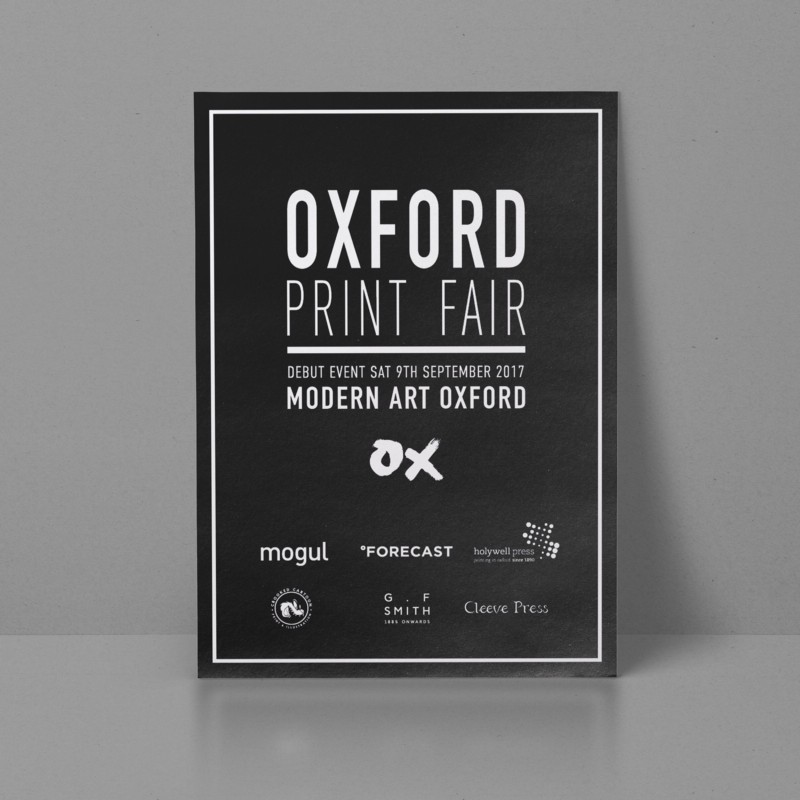
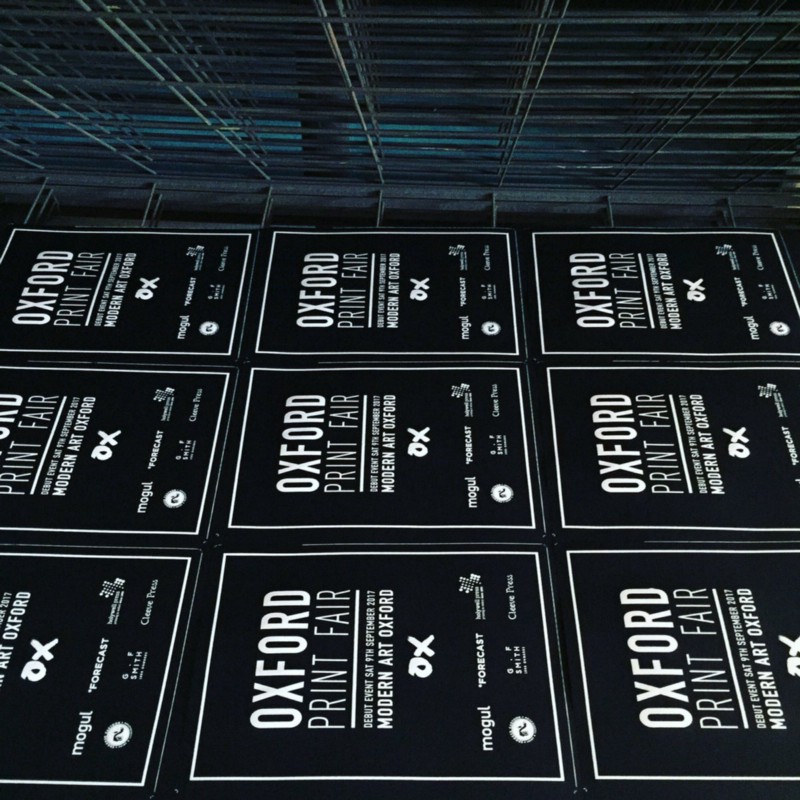
In addition to this, we would be missing a trick not to produce our own posters, using traditional screen printing techniques.


With G . F Smith, the legendary paper supplier, providing us with the materials for Alex from Crooked Cartoon in Manchester to print our beautiful design on, this was a match made in heaven.

Screen-printed posters on G . F Smith Paper on the drying racks

It becomes simple to talk about something, when you have something to show people — when you have something you’re proud of to show off. And this is the simple, direct joy of having all your branded assets lined up.

Working with Mogul can bring you these little bits of joy, because there’s nothing quite like having a way to clearly express yourself, and what you’re doing.

We pride ourselves on giving you a way to make your work, organisation or event important to everyone around it. We approach everything we do with a genuine curiosity and base all of our work on top of a solid research and discovery process.

If you’d like to be as excited as we are about the Oxford Print Fair (9th September, 10am-5pm at Modern Art Oxford, by the way) for your next campaign or event, then get in touch. We can give you the assets to make shouting about what you do, natural, easy and obvious.


Mogul is a brand and identity studio. Our work is founded on research and discovery and we bring our genuine curiosity to everything we do with our clients. If you’d like to talk about your organisation, drop us an email on hello@wearemogul.com
A Process To Kill Doubt

Etch To Their Own

Richard Clarkson Studio

Most of the time, it’s easy making business decisions. It can come down to what will make you the most money, give the company the most value, or provide a set of improvements across the board that just has to help somebody.

But then there are the tricky decisions too — the ones you put off because it’s a big question, or it’s a matter of how the company is perceived.

You know it’s difficult to look at yourself objectively, that’s why we sort-of-squint in the mirror before leaving the house to convince ourselves that we’re more George Clooney than Danny DeVito. It’s the way a lot of people and businesses get through the day-to-day confidence of existing — “we’re a good company, we help people” your office might say to itself before you unlock in the morning, if indeed the walls could talk.

And that’s one of the reasons these perception issues get pushed aside. If you have to do a confidence trick on yourself, or your business to get going — you know you’re not the best judge of whether the company is really holding up its values or not, or even if it has any!

But sometimes you realise the brand is getting tired (you’re embarrassed to hand out your business cards), that your customers don’t understand what you do, your staff aren’t proud to be doing the work they do, and that your brand name doesn’t contain as much value as you’d thought.

It is usually for one of the above reasons that a tricky perception decision is on your desk in the first place. You know you need something, but it’s hard to pull the trigger with so much doubt around the subject.

When it comes to this, the more self-aware business owner will get in touch with someone like Mogul to discuss their brand, their values, their communications — however it might exist in their head — because they want someone to come in and kill the doubt.

So, that’s what we do. We have a process to kill that doubt.

It’s not revolutionary. It’s just a lot of conversations and a great deal of telling the truth.

Our process involves a series of careful, discrete stakeholder interviews — that are shared with no one outside of Mogul — to provide a sense of what the business is about in a way that lets everyone have a voice. We like to take in all aspects of the process, this means everyone from the board to those on the floor, to supplier and customers.

We build this into a brand report, to let you know where you are right now as a brand.

This means, that instead of squinting in the mirror, or pushing aside the idea because it’s difficult to understand yourself and your company without what feels like a great deal of introspection, you now have a view of how you are perceived.

What you do with this information ultimately comes down to you. We provide recommendations, and we usually encourage businesses to formalise their values and brand guidelines with us at least. In some cases we design communication tools and language for front line staff can help them do their jobs better, and in the boardroom the business values can be expressed clearly, or we work with marketing teams for giant campaigns full of big ideas and clever uses of the brand. All of this is about making the lives of everyone in the company’s life a little easier when it comes to talking about themselves.

Making a decision when you’re informed is easy. That’s why it’s easy to make business decisions where there’s obvious upsides, or a clear reward. Making yourself informed about the perception of your business can make what seem like painful choices riddled with doubt simple and obvious.

Get in touch if you need your doubt killing.


Mogul is a brand and identity studio. Our work is founded on research and discovery and we bring our genuine curiosity to everything we do with our clients. If you’d like to talk about your organisation, drop us an email on hello@wearemogul.com

Understanding The Blueprints

Etch To Their Own

I got very excited when I read Nicole McCarthy’s poem featured in The Shallow Ends yesterday. Aside from it being a visual poem, it’s also bold and allows re-approach and reconsideration, it’s called [i miscarried a watermelon] and here it is:


We can compare the rigid structure of the building design, blueprint, with the rigidity of the lines an their structure. Both are highly intentional, one for the division of someones (or more than one person’s) into the appropriate chunks which make up the functions of our lives — and the other is an autobiographical version of the same. This is the compartmentalisation of life displayed in both ways, the floorplan doesn’t give us much to think about the point of the bedrooms or any other function of the home — and how they are connected by the flesh that lives in them. Equally, that structurally taut repetition and structure of the lines themselves also suggests a similar kind of separated experience between each line. The fact that letters were miscarried seem unrelated to the more obvious and emotionally powerful meaning of the “i miscarried” itself.

But like the reality of the house, not the design, there is the flow between lines and rooms. There is an exchange here creating heat, as well as a remnant of that heat being left behind. With a poem like this, it’s hard not to think back to our recent exploration of Omar Sakr’s These Wild Houses. There, Omar made the body a house, a location, and here Nicole does something similar, but with a different sense of the past. Here, the house-body is a personal past, and not necessarily inter-generational in the same way. Instead, the house is haunted by the realities of a life lived — this especially becomes apparent when paired with some of her work from Public Pool.

And this kind of memory-in-place is a way of showing us how we keep our memories attached to spaces — even if they’re conceptually ourselves, but that you can only rely on a ghost of the reality being stored there. This unreliable memory that exists as a kind of argument against the place it’s stored reflects the way he can hold on to only so much.

Speaking to Nicole over Twitter I learnt that this poem in particular is part of a longer story about a woman who visits a masseuse, who worked out each knot of trauma and abuse. I think we can see in all of the visual works how this might interconnect the various statements presented, and how their localisation and the body-as-home concept is fully explored.

Nicole McCarthy has just finished her MFA from an experimental interdisciplinary program through the University of Washington. The collection is not out yet, and is currently sitting with publishers — if you’re one of them I would like you to hurry up and publish it, so I can see the rest. You should follow Nicole on Twitter over here.


The White Review is running a Kickstarter campaign to publish arts criticism. Between the White Review, and it’s owners Fitzcarraldo Editions, there’s been few better places for new stuff in print. Think about sending them a couple of quid to try this out.


Today’s song is something new from WeAreCastor:


Thanks for reading Etch To Their Own. There was a lot more to say, but I didn’t manage to say it before something else got in the way. As always, Etch To Their Own was written by @CJEggett and proofread by no one. If you would like to get in touch you can reply to this email, you can tweet me, you can send me a print out of this where you mark your own squiggly red lines under my typos in your own blood. Whatever works best for you. Where do you see yourself in 20 years? I love you all (again), but I might never get to say it to your face. I sell stale copies of this over here.

Falling Backwards

Etch To Their Own

I spent a small amount of time with a section from Anais Duplan’s Mount Carmel and The Blood of Parnassus.


And I wanted to look at this, and unpick a little of what makes it real — and how it, and works like it, deal with transition and metamorphosis.

I think in this snippet we’re brought in to this transitory state simply by “we are falling backwards through space” — because we all know that’s how that goes. When Alice falls down the rabbit hole in visual adaptations, she tumbles for a while before gaining the slow serenity of the fall, checking the cupboards on the way down, wondering about how far she’ gone before almost falling asleep.

And that’s the kind of “falling backwards” that frames this is how we know we’re on a trip, like in a dream, where the world and what is around us can morph without reason. Anais (read this bio) gives us a clatter of experience as we fall through. Given the context of the paragraph, we’re asked to rearrange it all as the poem implies the damage done by a fall, a crime for which a portrait is record of, the opera interrupted by a supernova brightness of a million iphones and the Falstaff/Town Hero both conspicuously present (Falstaff is in several Shakey plays, but the last he only exists as a report of his death, and the town hero who made the brave choice to let others die seems to connect kind of reversal. Maybe Henry is dead.)

The passage reminded me of both Blake Butler’s Sky Saw, and a much earlier novel/poem/experience called The White Hotel by D M Thomas.

Sky Saw is an entirely abusive book. It completely crushes you on every level. There are no handles to grip the thrust of the book with and steer it towards understanding — and as such you have to accept it as an experience. Actually, that might be a little unfair. There are handles, but those handles become other appendages when you’re not looking, and then they’re part of you, and then you’re a room, but it’s also a ur-mother figure — and someone has to go out there and fix the great flesh that covers the sky as a dome. Not you but you might see one of them crash to earth as a crow, or a charred lump that might also be another place.

The White Hotel is a sexy Freudian romp (feat actual Freud) with Babi Yar thrown in for good measure. Nothing like as threatening as Sky Saw — yet it does do something magic with the acceptance of reality being immediately changeable and dreamlike. A lot of the novel is our hero’s fantasies of Freudian fucking, speedy pregnancy, strange transportations from one place to another, and the suggestion of a second sight being discounted for an option for the cause of her pain by the good doctor.

All works rely on the transmutation of person to place to action — and this causes some kind of stock taking for the reader as we go. In many novels when faced with these things we have a little set of post-it notes labelled things like “metaphor”, “memory”, “dream”, “magical realist expression of reality”. In these works however it’s an effort of exertion against submission to make sense of it. But submitting is the answer, as the more we let wash over us the more we can pick up of the natural flow, letting the unimportant flourishes pass us by for another time


Here’s another snippet from Anais. It’s wonderful:


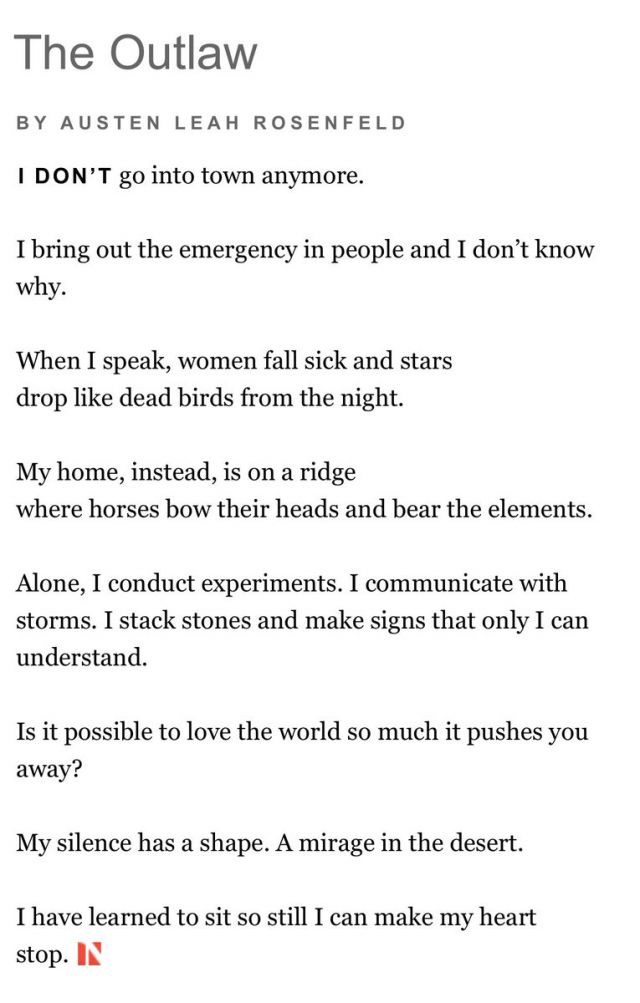
Equally wonderful is this by Austen Leah Rosenfeld:


Anyone not marking down “I bring out the emergency in people and I don’t know why” in their little book of excuses as to why they don’t really want to their next work social function is really missing a trick.


Today’s song is an ambient mix by lowlight of “ambient by non-ambient artists”. It’s a bit of a long slow hug from a friend. Or, if you want a quick fast hug from a friend, you can try this byJohn Martyn.


Thanks for reading Etch To Their Own. I am sorry this kind of went nowhere, but hopefully you enjoyed the flow. Sometimes you’re having a bad day, and on these days you just need to remember that if you don’t have your hand in the biscuit barrel, you won’t get any biscuits. Unusually, I am still trying to work out who wrote this one — but we know it was proofread by no one.

Grand Designs

Etch To Their Own

I’ve spent my free time this week round Omar Sakr’s house. I mean, not literally, but metaphysically. These Wild Houses is a poetry collection that plays with location and identity, and the metaphor of the house — the home — as a person, a body.

Omar invites us into his house with the banalities of domestic decoration — setting out these rules of himself as a space in that familiar way of visiting someone’s home for the first time. Like everyone who own odd, strange and compromised homes — there are the warning of “mind your head” and “watch your step” — you know, our little way of saying that the natural way you inhabit your own home might not come so easily to strangers.

This kicks off another theme in the book — the house as a public and private space — that fact that you can be invited in, the fact that “I am breakable — never / mind the wallpaper claiming otherwise”. This is the idea that even the presentation of ourselves that we choose might not be for all our guests, that, in this context, that wallpaper wasn’t for you.

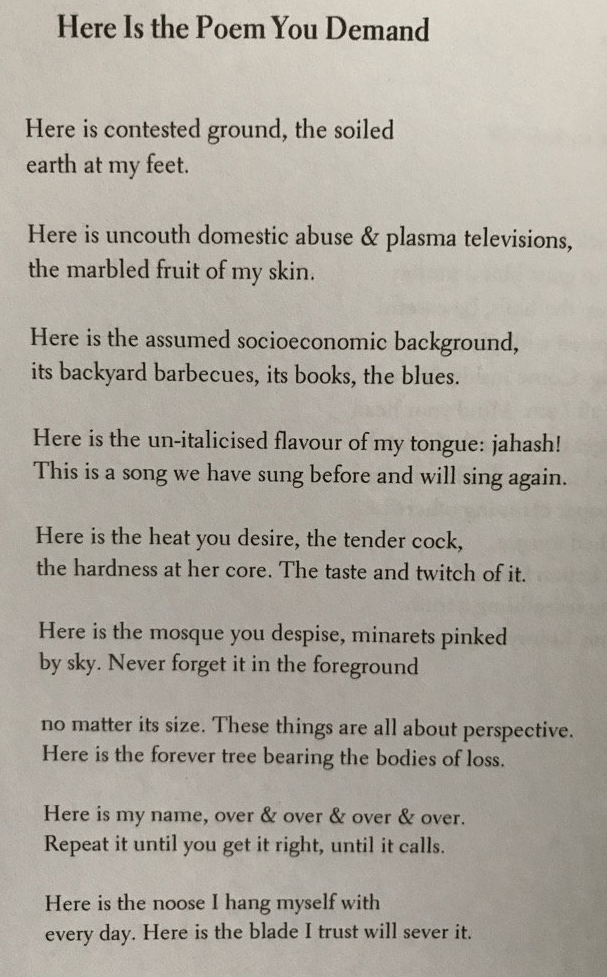
“here is the un-italicised flavour of my tongue: jahash!” (italics, er, mine) is possibly the best line on presenting foreignness in text I’ve read in some time. The poem Here Is The Poem You Demand is the way in to another part of the identity we are exploring — it links those lines of the name, and the song to be learnt by thick tongued — and says in the linking that there is real praise here, but also a sly kick out at the assumed “authenticity” presented by the stat-line of our queer Muslim Arab Australian from Western Sydney, from a broke and broken home.” The scene is set here, for us to examine our own assumptions and voyeuristic tendencies (a readership of peeping Toms I suppose, given the house context).


The next poem, interacts with the previous directly. Landing shows us how the strain between generations can present it’s own kind of fetish of legacy, or the rejection of it. The older generation speaking as prophets, able to keep the fledgling feathers of their heritage in a way that the poet is confronted by. They almost taunt him with his lack of understanding of the breadth of their loss: “You do not know what it means to take, / to rip your roots from clay and craft them into sails // ready for the sky”.

Equally, the poet resents the uprooters. How much could they have really carried with them? How much did they leave behind, that he, now, cannot inherit, cannot use to furnish his home.

The collection weaves between the tragic of the living and the dead — the grief, the absolution of sin being buried as a newborn — and the more personal building of bricks and mortar.

In Not So Wild we understand that the boys in their budding selves, leave the creek a little less tame each time they visit: “we left them each time a little less tame, naturalised, shaggy with weeds, brambles, the occasional thorn and cobweb.” They leave as freer boys, but it is implied that they have an effect on the location too — do they tame their environment, as it makes them wild? Do they bend it to their will a little in the trampling of brambles. This seems to throw up the idea that the locations inhabited by the poet and himself as a location have a kind of balance. We see the same in a later poem Comin’ Out The Station the gaudy brokenness of hedonistic commercialism (linked with the sexual encounter there) balances with the building of a self image of the gentle haircut the poet will receive, where his identity is built from what he is already made of — chiselled out rather than reflected of the neon. But both inform the identity, both are the reality.

In This Girl, This Country we see a deconstruction of the woman as land/wildness/fertile hills trope that is scattered across most of literature. It’s of particular note, the idea of two girls together is a national park — and their independence is “an indigenous council meeting in a stolen house” — which is to say, there is no maths of the status quo that will make these women human. In Election Day we are reminded, “just water those damn flowers.”

Omar delivers all these with that rush of language and held breath (Call Off Duty, a great example of this) in addresses to various people in his life or those who have left it. I suppose we all receive our post at home, it’s the return address we write on if we want to get a reply.

The house, the body, is a central exploration of the collection — and the tensions and conflict that are presented throughout are where we draw our vibrations from. I would suggest picking up a copy, or at least having a browse of rightmove.


Today’s song is Suicide Dream 1 by How To Dress Well (Live on KEXP). I wrote a whole novel while listening the Love Remains album. It was a pretty miserable novel, surprisingly. But try Lover’s Start from that album if you want to hear him in his more upbeat moments.


Thanks for reading Etch To Their Own. It was gently shuffled into place by @CJEggett and proofread by no one. If you spot a typo, let me know. If you think I’m wrong, please also let me know — but, like, tell me why. Did I Mention I Am In The Advertising Business Now? I’ve spent some time on the fun end of a microphone this week and I must say, I don’t sound as bad as I had hoped — although, of course, I eat every 3rd word Marjorie. Send people here to subscribe. Send people here to pretend it’s 2014. Send yourself here for a bonus poem. And finally, send someone here if they like thinking about hands.

what it means to survive if you have to eat others to do it

Etch To Their Own

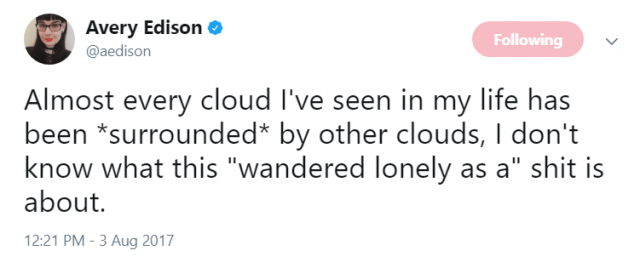
So it seems like GIVING GODHEAD by Dylan Krieger might be in contention for the best thing of 2017, according to Thomas Simmons of the Boston Review at least. I have to admit, I didn’t know there was collection to be had until today.

We’ve seen Dylan before, with her powerful rush of language. It tends to flow out forcefully, a little like ETTO favourite C A Conrad. The review will probably send yourself skittering over to Amazon to scratch away at that order button — but, until it arrives, revisit: Spring broke half a nation state away.


This week (3rd August) saw the 80th Birthday of Diane Wakoski, apparently. There are so many poets I haven’t read, and Diane is one of them.


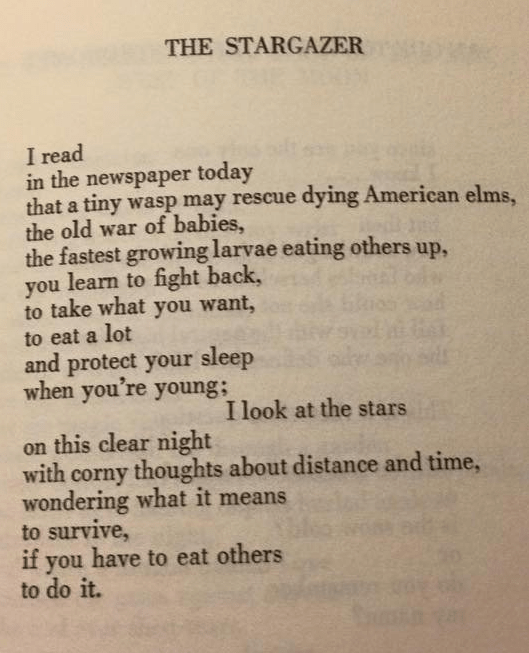
The Stargazer is one of those poems that starts with the kind of banality we often think of as below a lot of modern poetry. Of course you read the newspaper, but the poem is from a time when expressing these small normal moments was a kind of tearing up of the traditional framing of poetry. Reclaiming poetry for keeping next to the kitchen sink (with the drama you see).

It then opens up into the saving of something great and old — and then savagery of survival in youth. A hooked linking line between the dying American elms, and the corny thought — which turns out not so corny.

I briefly scratched around and enjoyed this quote pulled from her essay The Blue Swan: An Essay on Music in Poetry:

“first comes the story. Then comes the reaction to the story. Then comes the telling and retelling of the story. And finally . . . comes boredom with the story, so that finally we invent music, and the nature of music is that you must hear all the digressions.”

Which I love, as it’s the opposite of Blake’s version of the formation of poetry. Blake’s version is to have the divine idea, the dance, then the music, and then, as the pen is placed to paper, these things drop away. As our buddy Ezra said “Music begins to atrophy when it departs too far from the dance… poetry begins to atrophy when it gets too far from music.” In both Blake and Pound here they seem to suggest that you move away from inspiration — whereas Wakoski suggests a reapplication of music once you’re bored with the ebbed inspiration.


Sam Rose has three lovely poems in Bindweed this week. They’re great, as always.


Trump’s full address to the boy scouts.


Today’s song is Vessels — Vertical


Thanks for reading Etch To Their Own. I’ve done this for as many weeks as I am years old, and for nearly as many days as I have been free. Remember jokes? They were good weren’t they? We’ve met before, don’t you remember?It’s very easy to run away with things in your head, dreaming of some perfect world in which you’re the sun, rather than the meteor diving into it. Etch To Their Own was written by Christopher John Eggett, who likes to see his name written out from time to time. If you like what I have been doing with my Friday evenings, please tell someone about this newsletter — or send them to the medium archive. If we all need therapy, lets go together, it’ll be fun.