I joined Mogul officially on the 3rd of July 2017, buying in to the business, taking a 40% stake, and saying farewell to the safety of my long term employer. Here’s a little bit of what it’s been like.
I have worked with Mogul before in a freelance capacity — at first just helping out a friend, and then, later as the projects got bigger, with larger more dedicated work on the content, SEO and technical consultancy side of things.
I have been here 4 weeks, and my first month has been better than expected.
It turns out that what I believed to be true, was true: if you speak to the aspirations of those you want to work with and for, they start to share those aspirations.
And that’s our job at Mogul in part — to give back to organisations the idea that they’re doing something interesting, important, inspiring — not just churning a machine that produces money for them.
Although, of course, what we do makes the machine a little more efficient — because everyone understands what it does, and why it does it.
Developing an idea from a mad spark into an inch of reality is exciting, as is the very measured and careful crafting of questions for our research and discovery interviews.
All of it comes from a natural, genuine curiosity — a place I am happy to be spending most of my time inhabiting for the last month.
The reality of working under your own steam is that everything you produces something at the other end. You can see the direct result of everything your turn your hand to, and as such, it allows you to own your work in a way that has no guilt associated with say — trying to unpick a problem while on a run, or thinking of new ideas for a client in the off hours.
Ultimately, the first month has been an absolute joy especially in finding that if you give yourself to something, you get something back.
We’re running a few fun projects over the next few months — the first of which is the Oxford Print Fair.
The print fair is being hosted by Modern Art Oxford on 9th September, showcasing 21 artists and print studios from across the country. Artwork is available for purchase direct from the creators themselves.
Prints range from large, intricate work and bold posters to smaller items like cards and postcards. There’s even some fun textile work too. Come along to meet the artists (and us!)
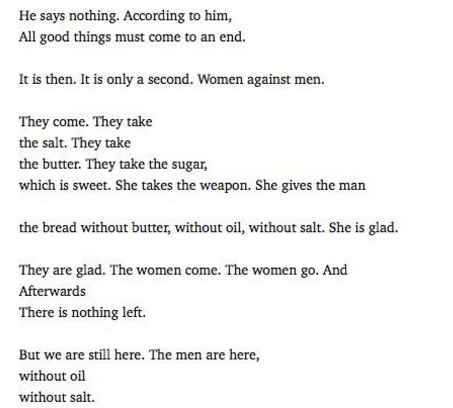
Max Ritvo died one year ago this month. A poet who went to Yale, and continued his work after in an MFA knowing that his life would be shortened by bone cancer, died on August 23rd last year. His poems are filled with direct and life-giving imagery, even this — Afternoon, which starts with the line “When was about to die / my body lit up / like when I leave my house / without my wallet”.
Here’s the rest:
The poem does what a lot of his work seems to — takes those unimaginable moments and connects them with those mundane shocks we experience every day. With lightness and beauty his work wanders through topics like god, death, loss and so on — and plugs them directly into everyday experience, the grand to the minute connected.
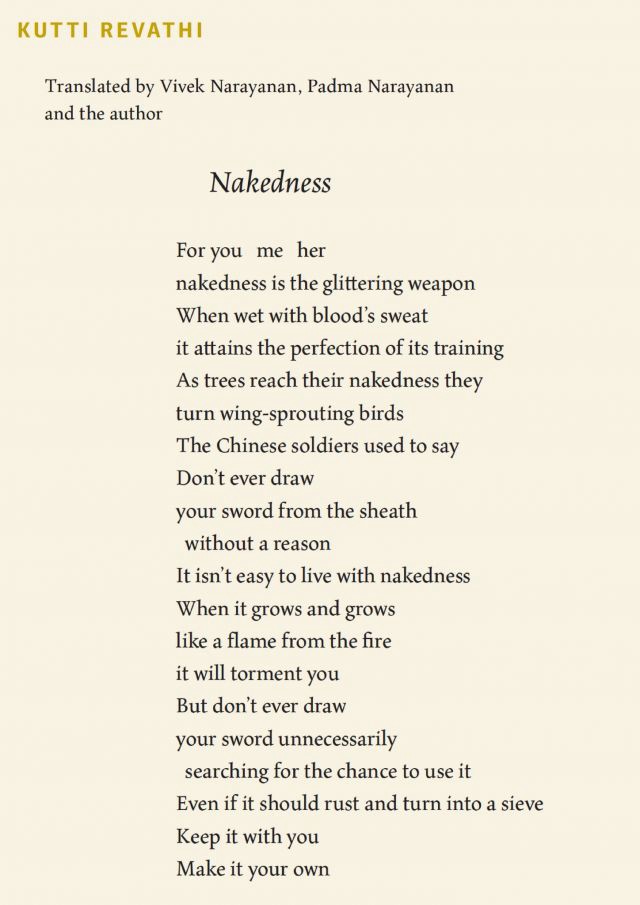
Talking of making one thing another — taking the alien and making it understandable — how about this translation. Warning, nudity:
As you know, I love a little ritual. And you don’t get more ritualised than the natural order of planting and tending of plants. I think it’s especially interesting when meaning is ascribed to things that may, in reality, not have required a spiritual aspect — but developed one over repetition, misinterpretation, and a will or their to be a connection. With this in mind, enjoy a little bit of ritual from Sharon Telfer over at Spelk.
Thanks for reading Etch To Their Own. I would deliver this by hand if I could, but my shoes are wet and I cannot put up with the chorking. Anyway, you would hear me coming an it would ruin the surprise. Someone said that I should look for a grant to do these professionally, I showed them this cartoon. I’ve had some odd dreams recently. Etch To Their Own is known as ETTO for short, and has been getting shorter as the poems get longer it seems. This week, much like the other weeks, it was written in a rush by @CJEggett. Please tell your nearest mutual follower on twitter about this newsletter, and you will be visited by the spirit of well spent anniversaries on your next one.
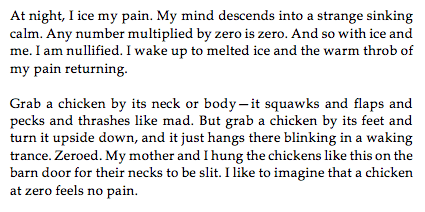
I felt really lucky to find this as it articulates everything I’ve ever wondered about pain in the context of medicine. She articulates ideas about those questions about pain you get from doctors (and in her case, her father) where you’re unsure if they are asking about additional pain on top of the pain you’re already feeling — or as a whole — or compared to the worst pain you know — or anyone has known.
Eula’s pain is unimaginable to me — but the articulation of it has that irresistible persuasive tug that you can find in the work of Anne Carson. So reasonably taking a step forward each time, navigating a little love and the huge distance we face even when we should be sharing something fundamental. Like pain.
The prize is a massive $20,000 — which obviously makes it really competitive. You get TWO entries as well, which is a really nice way to not worry about which particular 100 words ever being worth $20,000 if you have competing drafts!
You will also be unsurpised at the top highlight — the potential hamlet of Fuckley.
This week’s song is less a song, and more of a couple of sides of spotify playlists.
Minor Literature[s] has presented us all with is a mixtape full of fun, abrasive things. I’ve only managed to make my way through the “Metal” side of the mixtape, and hope to get to “Wood” soon.
Thanks for reading Etch To Their Own. I hope you’ve found a way to apricate recently. You’re my favourite sort of people. Etch To Their Own is written by @CJEggett almost entirely crosseyed with tiredness and proofread by no one.
This week Kaveh pointed out that it was Tintern Abbey day, to barely no fanfare. It’s an abbey I visited last year, and completely forgot the poem in the presence of. I couldn’t even string the opening verse for my cycling friends who were so desperate for a bit of culture during their break from the hills before their sandwich arrived. It opens like this:
Five years have past; five summers, with the length Of five long winters! and again I hear These waters, rolling from their mountain-springs With a soft inland murmur. — Once again Do I behold these steep and lofty cliffs, That on a wild secluded scene impress Thoughts of more deep seclusion; and connect The landscape with the quiet of the sky. The day is come when I again repose Here, under this dark sycamore, and view These plots of cottage-ground, these orchard-tufts, Which at this season, with their unripe fruits, Are clad in one green hue, and lose themselves ‘Mid groves and copses. Once again I see These hedge-rows, hardly hedge-rows, little lines Of sportive wood run wild: these pastoral farms, Green to the very door; and wreaths of smoke Sent up, in silence, from among the trees! With some uncertain notice, as might seem Of vagrant dwellers in the houseless woods, Or of some Hermit’s cave, where by his fire The Hermit sits alone.
There’s more, as you know. Anyway, those snippet that start this are what I forgot.
Honestly, it would be nice to remember the right poem at the right place for once.
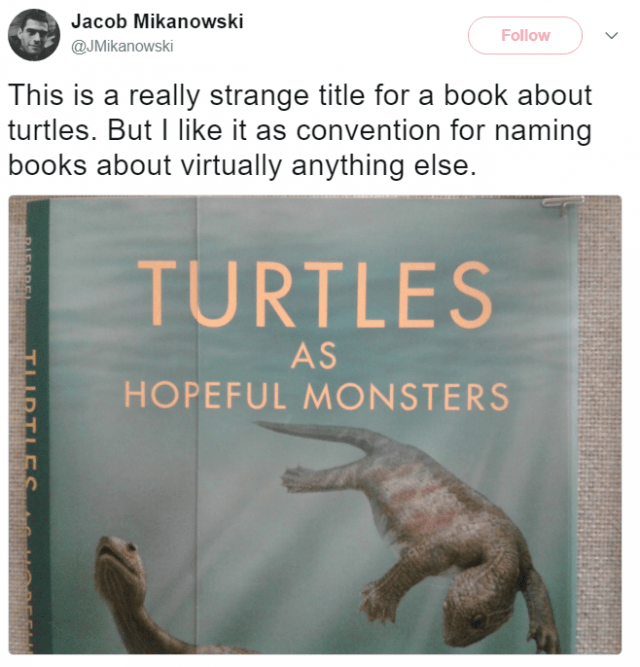
I have found a naming convention for my series of memoirs:
Our dear friend Hiromi Suzuki has three new visual poems to play with in 3AM magazine. As usual they offer you a few contexts in which to approach them.
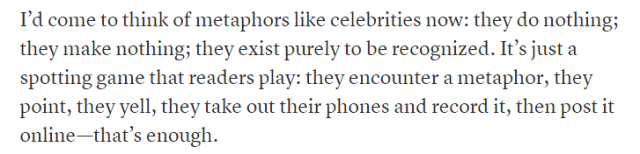
When it comes to owning a thing, nothing really beats owning your own space. Except when that ownership is a form of oppression for others. In this article in the baffler, the concept of ownership is discussed, as well as a powerful case put for the death of the metaphor. In a sense, is there any sense in making metaphor ion the world can offer you only uncertainty and misunderstanding — after all, isn’t the silent agreement of metaphor that we understand the world in a shared way, that that metaphors are a show cast by or against it?
Apparently today is national nude day, which I celebrate every day and assume you do too. While noticing this fact I was made aware of Laura Berger’s work.
This week has been really good for short stories. Jennifer Fliss offers us Towels — which expresses a whole human existence lined by soft and starched towels.
As someone who grew up on a lake, I must say I am identifying hard with the catfish here — eve though I am more of a carp soul.
Thanks for reading Etch To Their Own. It was written by @CJEggettand your adventure ends here. I am sorry if this doesn’t reach you until Saturday gee em tee. The very lovely and kind @Writersamr took me out for what is known as, “the drinks” in these parts. Here’s some pretty visuals based on weather data. Yeah, all those stars drip down like butter. This is me very much getting out of the way.
C A Conrad is a poet whose work caught me from the first page of a book I picked up in the excellent English language bookshop, St George’s, in Berlin.
I briefly exchanged emails with him over whether he was ever going to get around to recording a reading of the entirety of The Book Of Frank. He asked why I would want that, maybe to listen to in the car? Not that he had a car, but some people might want to, right? (He also said something nice about my writing, which probably made my 2012 — and you can read my younger thoughts here).
The Book Of Frank is that kind of longer narrative poem where you can try and piece together the whole through the shards of a broken kaleidoscope — while you can gather a general impression of the overall arc of the poem, it’s often more interesting to wallow in the strange imagery of each individual poem itself in the 131 of the book.
Later works, such as — A Beautiful Marsupial Afternoon — which I feel is a kind of sleeper cell of a book that is less consumed critically at the time of reading, but instead plants deep and interesting ideas about process that slowly bloom into a powerful love for the book and it’s author.
Each poem is accompanied by the ritual that was used to make the writer present enough in the world to write the poem. These rituals are strange, bodily things, that if you try aspects of you’ll soon not be able to untie from the world. Maybe we should all be spending our time on rituals to make the world more real.
Andrew Ridker, over at The Paris Review, talks about C A Conrad’s work this week, in a kind of biographical retrospective that should give anyone not familiar with him some deeper insight into the poet’s background.
Thanks for reading this week’s Etch To Their Own. Sorry it’s only a mini one. I have read less poetry this week than I have for some time, I guess that is because I own all my hours and I am probably panicking about using them for making cash somehow. I will get back to it when I understand the balance of my life a little better I suppose. Thank you for understanding. As always Etch To Their Own was written by @CJEggett — a man in search of praise as good as this one day. I miss you all very much. I hope to be at the beach tomorrow bright and early, searching for haikus in the rockpools.
Poetry has to grab me these days. I have to instantly interested, a turn of phrase is all that’s needed to draw me in, but once done I can settle with it. I need a hook is all I’m saying.
The Book of Frank’s particular hook was the inclusion of the line:
“Where’s my son’s CUNT?!”
On the first page. Thus hooked I purchased and ploughed on.
A camp tales of abuse, debasement, metamorphosis, fear, sex and psychosis these short sharp poems wander jumps from theme to theme like the poem itself is on a pivot — each side showing you a new facet with its fully developed rollercoaster of nastiness, the degradation of the human soul and the like.
This culmination of 16 years of work (we only read the wheat of course) is actually a display of the roughness of life.
Like all work produced over a number of years — and maybe all long poetry in fact — the author only offers up little slices of the whole at a time. Each poem is a solid representation of the moment but as the moment and the persons are so varied and changing, those around Frank anyway, there is a lot to take in. Only after being given each sordid polaroid we’re able to build our whole Frank-flick-book. Importantly each snap catches change in action — the animation actually only offers us the dimension of time.
“He read the metamorphosis, just for kicks” We’re told. This joke (the sneering quality of the line) makes light the Kafkaesque nature of metamorphosing characters — a fundamental support to the whole collection. We come to expect a kind of “knowing” change quite early on. Frank’s mother grows tentacles as he realises how involved in his life she is. Frank grows crows for hands. In the beginning Frank seems to be at the mercy of these changes, yet, slowly, he begins to take a grip of the rudder and enjoy the changes.
Frank searches for a metamorphosed version of his sexual-abusive father in the shape of a transsexual — Frank kneeling for a kind of knowing abuse. He takes this and, eventually passes it on.
And this might be at the centre of it. Frank is in control in many ways — he absorbs all the horrendous parts of the world around him and owns them completely. Frank seems to be the victim for much of the extended poem, yet he manages to become part of the oppressive chaos around him.
To say this is about the degradation of the human soul is, in reality, a little much. Frank is dammed from birth to be mis-labelled, over-labelled, abuse. As much as we like to pretend there is a grace to fall from in reality the soul is something with its snout firmly in the corpse of another.
This last week we’ve been blessed with a short story from J A Field: People Are Everywhere. It concerns that kind of quiet neurosis, restraint and internal retellings you see in a certain kind of modernish novel, something like that looming threat and self doubt undercut by absurdity
It’s the kind of middle-class/first-world concern that wriggles around inside a lot of us in our weaker moments. It’s that fear you have for having something, and the possibility of losing it. It shows a paranoia about the world held even by those who are helping — the protagonist here seems scared of children despite working within some kind of social care context.
Maybe it is this working with somewhat “damaged” children (or children at all) that gives her this internal distrust of reality as it exists outside her skull. To our protagonist at the start of the story others aren’t legitimate — that her point of view is the single, tangible, canonical version of the world. And this might relate to the un-relatable views of the children she might be surrounded by. There’s something alien about the way children see the world, and something wild that doesn’t conform to the expectations of society in general — naturally transgressive they represent everything she’s trying to hide from.
This, and the entirety of Rounds, is pretty much my favourite piece of music (maybe ever?) It’s from a time in my life where I was trying to re-centre myself after tragedy. It’s good for getting balanced out.
Today was my last day of working for someone else — hopefully forever! Sadly someone has been plagiarising my CV already however, especially the “I am good at nothing but I can carry you”. The new business is just getting set up, you can find us a We Are Mogul. Don’t worry, this newsletter won’t become a linkedin spam mailer. Although, do email me if your company needs someone to think very carefully about how it is seen!
Thanks for reading Etch To Their Own #25. I’ve drafted this early, but will send it when I come back from the pub. Anything that follow comes from then: it’s simple. I love you all as much as you might expect, for other it might be more so. I am not that drunk, or that sober, but I thank you for reading this over and over.
I actually don’t know if it continues from this point on, or ends there. It’s enough to get my preorder however. I enjoy this kind of back-and-forth implied by the left and right aligned halves of each line. The tabbed spaces suggest a breath or a pause, and that back and fourth suggest that kind of exchange in this description of a birth that wouldn’t be entirely out of place in Hesiod’s Theogony (a kind of who’s who of Greek deities and, inevitably, their awful and powerful rituals associated with their forming).
The violence of transmutation, the exchange between one side of the page and the mother and the child — some ritual magic, some attempt at infanticide, some nurturing, has something of Echidna about it (the mother of monsters) whose childrens’ births were extremely violent. But on the other hand there is joy, sweet music — although it may be from the womb, and therefore be tinged with the sadness of exile
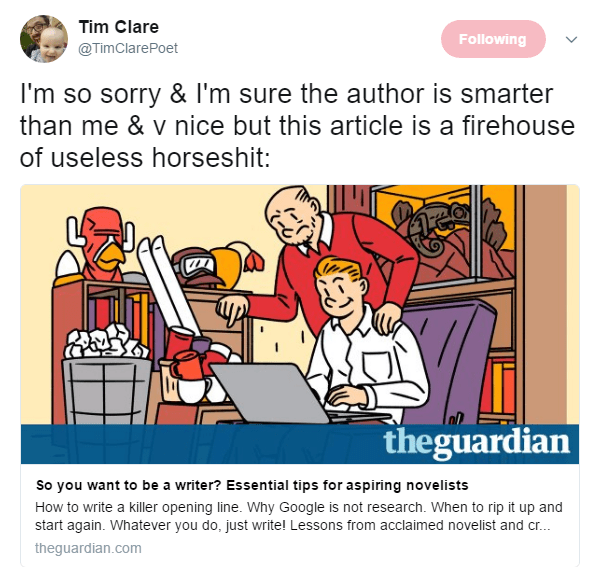
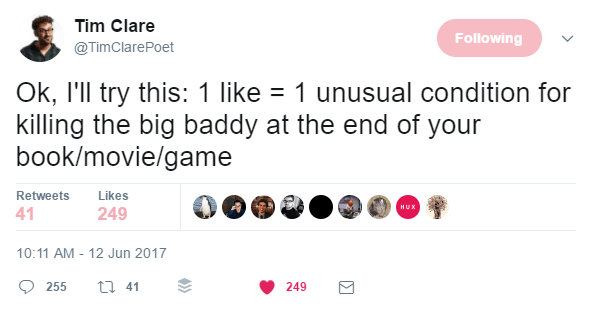
Sorry to feature Tim Clare for two weeks in a row, but I am afraid it’s a little bit unavoidable, especially when Death Of One Thousand Cuts comes back tomorrow (point your podcatcher here), and he’s been talking about bad writing advice. Here’s a dissection of writing-a-novel-advice that didn’t quite hit the mark:
The original article can be found here. As Tim’s thread suggests, it’s filled with all sorts of rhetoric that sounds like good advice, but it barely applicable because we’re left without examples of what is really meant and how it could be applied.
More annoying for me is the fetishization of the difficult labour of writing throughout the piece, the language of it suggesting that there’s little between, say, building a house and writing a novel. I am sure Colum McCann is an excellent writer and tutor, but I think this might have been written with a low-hanging deadline.
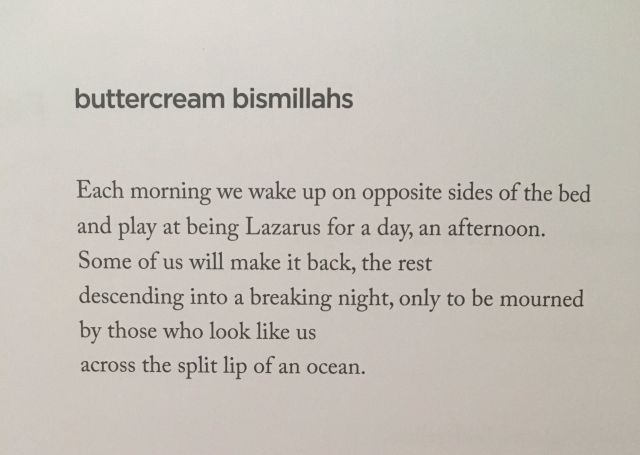
How about a little domesticity from Momtaza Mehri:
And Marianne Moore’s England has been floating around twitter recently (for me at least). Despite her closeness to Pound (I think I have a book of their letters to one another) I don’t think I’ve read her work to a serious extent. Something I decided to correct immediately after reading this:
ENGLAND
WITH its baby rivers and little towns, each with its abbey or its cathedral; with voices — one voice perhaps, echoing through the transept — the criterion of suitability and convenience; and Italy with its equal shores — contriving an epicureanism from which the grossness has been
extracted: and Greece with its goats and its gourds, the nest of modified illusions: and France, the “chrysalis of the nocturnal butterfly” in whose products, mystery of construction diverts one from that which was the object of one’s search — substance at the core: and the far East with its snails, its emotional
shorthand and jade cockroaches, its rock crystal and its imperturbability, all of museum quality: and America where there is the little old ramshackle victoria in the south, where cigars are smoked on the street in the north; where there are no proof readers, no silkworms, no digressions;
the wild man’s land; grass-less, links-less, language-less country — in which letters are written not in Spanish, not in Greek, not in Latin, not in shorthand but in plain American which cats and dogs can read! The letter “a” in psalm and calm, when pronounced with the sound of “a” in candle, is very noticeable but
why should continents of misapprehension have to be accounted for by the fact? Does it follow that because there are poisonous toadstools which resemble mushrooms, both are dangerous? In the case of mettlesomeness which may be mistaken for appetite, of heat which may appear to be haste, no con-
conclusions may be drawn. To have misapprehended the matter, is to have confessed that one has not looked far enough. The sublimated wisdom of China, Egyptian discernment, the cataclysmic torrent of emotion compressed in the verbs of the Hebrew language, the books of the man who is able
to say, “I envy nobody but him and him only, who catches more fish than I do,” — the flower and fruit of all that noted superi- ority — should one not have stumbled upon it in America, must one imagine that it is not there? It has never been confined to one locality.
I have so much love in me for: “in which letters are written not in Spanish, not in Greek, not in Latin, not in shorthand but in plain American which cats and dogs can read!”
Today’s Song is an “old” cover of The Weeknd, by Dillon. Not sure why I looked it up again, but I love the stripped back cover and the very youtube video which includes the artist probably checking something on the laptop that everything being recorded into and kind of almost, for a moment, forgetting that she’s mid song. It’s dreadfully endearing:
Okay. I’ll be the one to say it. It’s been too hot for poets. Books are boring aren’t they. This was swept up in the laziest way possibly by @CJEggett, and transmitted to you with about the same amount of care and attention. I can’t help it, it’s who I am. I thought I was going to include something about humming in here because I have a few thoughts about it, but I didn’t, because it’s too hot. To this end, I would like to offer one of my family heirlooms to you, a joke my Grandad used to tell:
“What has one wheel and hums?”
“A wheelbarrow full of manure”
If that hasn’t put you off, I would really appreciate you telling one person who might put up with this sort of thing about this very newsletter. It’s really the only way I can think of validating myself.
This week has been dominated by a couple of re-readings of Motorman by David Ohle. Motorman is one of those books that really attempts to push against the boundaries of accepted language as a sort of political act. To resist by taking apart the safe language we use every day that acts as a confinement for thought, and making things a bit strange.
But there’s not all the much written about it, aside from the introduction to the 2008 edition by one of our besties, Ben Marcus, and a handful of blog posts scattered about the internet. I’d like to put together one of those “Reading…” style books where I can ramble on about the themes and notions in Ohle’s work. And put together a wicked index.
So far I’ve been re-reading and making lists on the language in the book. A list of foods eaten in this strange post-capitalist-ecological-mismanagement world (crickets, cherry-water, grubs, snipes, popcorn and on), and a list of ailments and surgical maladies faced by our hero, Molendenke (removed lung, 3 additional hearts, infested with slugs when the moons are up — and so on). The foods are almost invariably gross, except for those consumed for entertainment, or not as part of a meal and point to some colossal failure of farming. The maladies seem more of a psychological problem, a set of “improvements” for quantity over quality — safety over vitality.
Ohle explores the idea of freedom by “making-strange” as in, to experience actual liberation, one must be able to break the stale language we use ever day. Our hero suffers metaphorically, and literally, from the effects of stifling rules of language — and works within a society set up to reinforce the high walls keeping him away from freedom.
It’s #BloomsDay — that is to say, the day where we celebrate one of the trinity of Irish literature: Joyce. Joyce’ Ulysses takes place on a single day (16th June, today, of course) and gives us the lodestone of modernism. While enough has been said about Ulysses (so I won’t add any more) I do like Jane Smiley’s comments that there is a small industry around the work designed on helping us mortal get to grips with the depths of each and every reference.
Okay, one thing I like about Joyce and Ulysses, he went to Italy to write it. He left the city he was writing about to take part in an act of writing home. It’s something I think about a lot. Do you really have to be absent from a place, a person, to be able to write it?
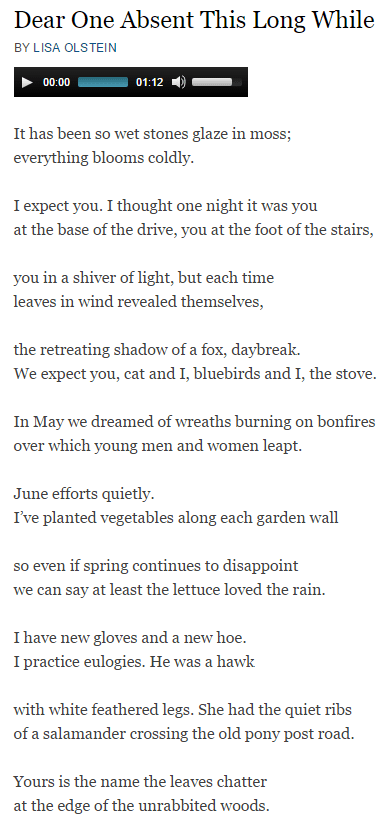
I have a bit of a softness in me for the re-articulated pastoral. The kind of things that would put me off usually, are nicely undercut — the companionship of animals undercut with the companionship of the stove and odd twists in the language like “June efforts quietly” and “unrabbited woods”.
As always, when politics get in the way of people’s lives they become confused and stop talking about important things like poetry, and instead, pretend to have an opinion on boring an unimportant aspects of life, like economics and long term survival of the nation-state in which they reside.
But still, there has been a few pieces worth looking at this week, between the political seepages.
Owl is another great piece of writing published by Spelk. Taj Tanaka weaves us a flash fiction about the moral troubles of encountering a distressed animals, and the stories we tell ourselves to make it okay to withhold mercy.
There’s something really Murakami-like about the writing. That kind of gentle pinching at half mused-at threads, and then the snipping them into the relative whole of the piece. It’s that kind go writing that feels like a negotiation that writer is having with themselves.
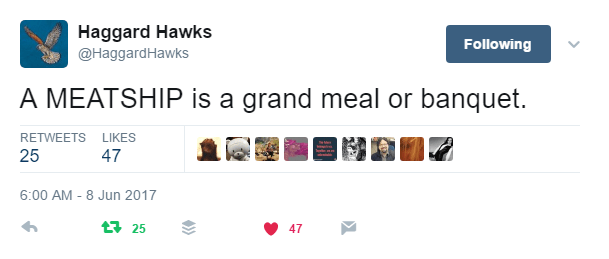
If you don’t already — please go and follow @HaggardHawks on twitter, and sign up to the newsletter. You’ll have your feed peppered with wonderful snips of language, such as:
My well-known fondness for found poems and other “constructed” poems is well known by now. This week I have a poem generated through picking out the best lines from someone’s Duolingo session! It’s called My Sister Goes To The Institute, and is probably best read on twitter on that link, but here’s the last panel:
Anne Carson, my living fave, might have a gender, or not, or several. This is an interesting little look at gender presentation in her work and life. As I have commented before, we can all follow Charlotte Shane’s fine words and start any discussion of Carson with:
“I love Anne Carson’s work dearly though I suspect I am too stupid for it”
Thanks for reading Etch To Their Own. As always, this was written by Christopher John Eggett and he is a scruffy as ever. Despite the fact there are plenty of people here, this newsletter remain unproofed. This weekend I am in Wales, near that bookshop that started all of it. Also, as I always like to say, please get in touch if you have anything you need to get off your chest and lodge into mine.








 C J EGGETT | Writer & Game Designer