Plow Your Bones

Etch To Their Own

Olga Tokarczuk’s extremely metal titled Drive Your Plow Over The Bones Of The Dead is a murder mystery of sorts. Set in a remote Polish village on the boarder of the Czech Republic, atop a plateau, it fairly gently presents a string of bodies to our hero — Janina an old woman whose understanding of the fates of people in the world is set in the bedrock of astrology and a deep love of William Blake, where the title of the novel comes from.

The setting is lushly described, threatening and dense. The events of the story spring from the disappearance of Janina’s two dogs, and the human bodies that keep turning up.

Janina, who doesn’t like to be called that, is at first called across to another neighbour of hers — one of the only three who stay for the winter on the plateau — finding him dead. Mysteriously he has choked on a deer bone, one that he had caught in his snares in the forest. Mysteriously there are deer all around his house, seeming to watch him.

This revenge-disney scene is one we’re treated to repeatedly throughout the murders, suggestions of foxes luring our fur farmers to the woods, or beetles devouring a corpse almost immediately. Janina has a deep affection for animals, believing that hunting should be treated as murder and that, with the later bodies found in her town, that the animals are the perpetrators of the crime. After all, the stars say it.


The Blake influence and the astrology leads to a wild kind of proper-nouning — we are treated to someone being a Person with a capital puh, discussions of a Blakeian Fall and other ideals held out in the fashion of the time which is: if it is important, capitalise it. These are markers for the times that Janina heads off into what she believes to be the Truth — compared to the moments she is less sure about the world and herself.

Olga provides the reader with lovely images through Janina, someone who wants to leave her body sometimes, and becomes a kind of jellyfish self


These moment of fancy are the real treat of the book, which keeps you reading between the nuisance of bodies coming up. The writing is one of small ideas expressed well, and the way that we observe the uncertainity of our protagonist throughout small and sometimes seemingly meaningless part of her life gives a fly on the wall effect. Of course, we also get to be part of her visitations from dead relatives, her secretly-naming each person in the village and town, and her interesting Theories.

There are parts of this novel where one might suspect the protagonist is a witch, or in some other way capable of creating the world around her in the shape that she wants. Her remoteness and the way that she uses the stars suggests that this might be the case on several occasions. And this might be part of the centre of the book, the fact she is treated as an outsider means that she is not meant to have any power upon society, and if she were, she would be a witch.

Equally, her interpreting the planets and the companionship of Dizzy, a translator of Blake, shows how their way of seeing the world (loose, interpretive), and how it buts up against the traditionalists she is surrounded by. There’s no real room for someone like her in their world and she finds endless friction there.

It’s a strange, wandering, whodunit, with endless charm — but you might forget to ask the question of who dunnit really.


This week’s song is Slow Show by The National.


Thanks for reading Etch To Their Own. It was written by @CJEggett who is extremely full of delicious squid and quite brown and fat at the moment, like a turkey getting ready for Christmas. Although I am unsure if they feed turkey’s delicious pygmy squid. I’ve been on holiday somewhere warm and once volcanic, but can’t wait to hurry home to some drizzle and nippy winds. ❤
Baby, I Don’t Care

Etch To Their Own

I have returned to Chelsey Minnis this week, to give her some more attention than I did while at a wedding.
 
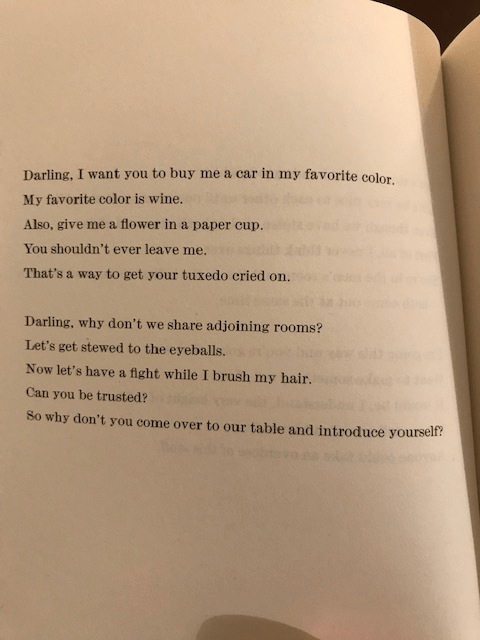
Baby, I Don’t Care is one of the best books of poetry I have read this year. It’s completely of itself and feels a little like a self-help guide. Chelsey created the book by ambiently (or directly) lifting lines from old films on the Turner Movie Channel. As such every line is a kind of proposition, a demand of someone else, or an expression of the current power statuses held in the room.
 
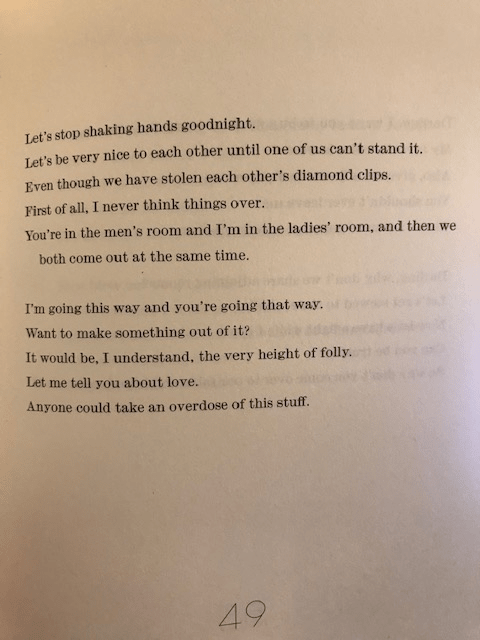
The way that each poem is addressed to someone — because they are resown lines of dialogue — presents a manic tone throughout. In my favourite poem in the collection, Romance, you can see this manic tone at its most fun:


The off-handed phrasing allows the real meaning to be implied between the hyperbole — and still does everything a poem about love or falling in love, or indeed enjoying the idea of falling in love with someone else mutually as a game, is supposed to do. It still says “we were meant to meet,” and: “this is risky and dangerous” and: “we will likely be rewarded with something exciting possibly ultimately painful”. Here the speaker in the poem, which is almost always a woman, is advancing the game with lines that play with the current boundaries while also offering their own kind of paradox to unpick. Sharing adjoining rooms, a favourite colour being wine, slightly impossible thing that would disarm.
 
The entire book is like being repeatedly disarmed, but on a different theme for each section as the collection wanders through all the major milestones of life.


Visual Verse very kindly judged my poem to be one of three lead poems for their 5 year anniversary issue. I’m quite pleased with what came out in the allotted hour time. See me here.


Rosebud has something a little romantic up in Sixth Finch, over here. She is exploring the longer side of love this time — and the way that everything is bartered for a built over time.


This weeks’ song is Romance, by Beth Gibbons. Because this seems to be the theme.


Thank you for reading Etch To Their Own. It was written by @CJEggett and he doesn’t know what’s put him in this mood either, if it’s your fault please make yourself known. It’s been another scruffy one, but then, when hasn’t one been scruffy? I am off on holiday in a couple of hours, think of me when you’re at work and I am struggling to enjoy some nice sunshine and a swim ❤

More Than Wild

Etch To Their Own

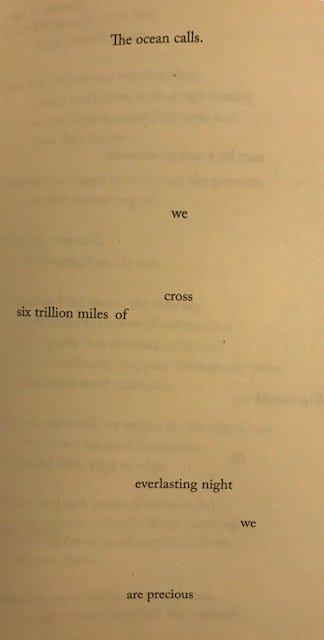
Wilder, by Claire Wahmanholm, is a poetry collection of post-civilisation world-building where all agency is removed from the survivors. The poems are glimpsed out of an incomplete view of the world (there isn’t a complete world to view anymore) and fragments (which have a little bit of an intentionally fragmented Sappho about them).


This view is one where everyone is made a child by the disappearance of them, seen here in The Witch and Poem After All Of The Children Have Disappeared.


Part mythic and part eco-death, the poems take in a rural landscape turned against the people who want to live on it. Repeated drownings, Woolf-like walkings out into the finality of water, and the making peace with it abound.

They use nostalgia, relaxation tapes, treatments, to hold back the sense that there isn’t anything in the world that looks like a future anymore. The poetry becomes prose poetry as the collection continues, as if the loss of some kind of innocence makes for the death of the line-breaks dancing down the page. It is stark in its earthy expressions of grief and loss, and toward the end comes to conclusions of an existence that is about existing at all, rather than with some greater goal.

Through these poems Claire builds a complete world where the earth hates humans back. It reminds me in part of David Ohle’s Motorman, and the way the environment seems to be throwing itself back at the people within it and the surface-skimming presentation of each weird element.

You can pick up a copy from Milkweed here.


Salo Press have their first chapbooks up in their Flirtations series. I’ve asked to see them as they look particularly ace — more to follow.


I am back on the Anne Carson Interview scrounge, and this is a good one — including the liquid library.


This week’s song is I’ll Drown by Soley


Don’t tell me that I never bring you a cheerful issue of ETTO :)


Thank you for reading Etch To Their Own. This week it was written with man-fluish hands by @CJEggett. Hear the song of my people. You can probably already sing along. Extremely spooky. I am finding it hard to leave good feelings alone, and not just slip into them as if they are my real life — nice to be able to have an entire life of daydreams to wander off into of course.

In the room the women come and go, talking of Michelangelo

Etch To Their Own

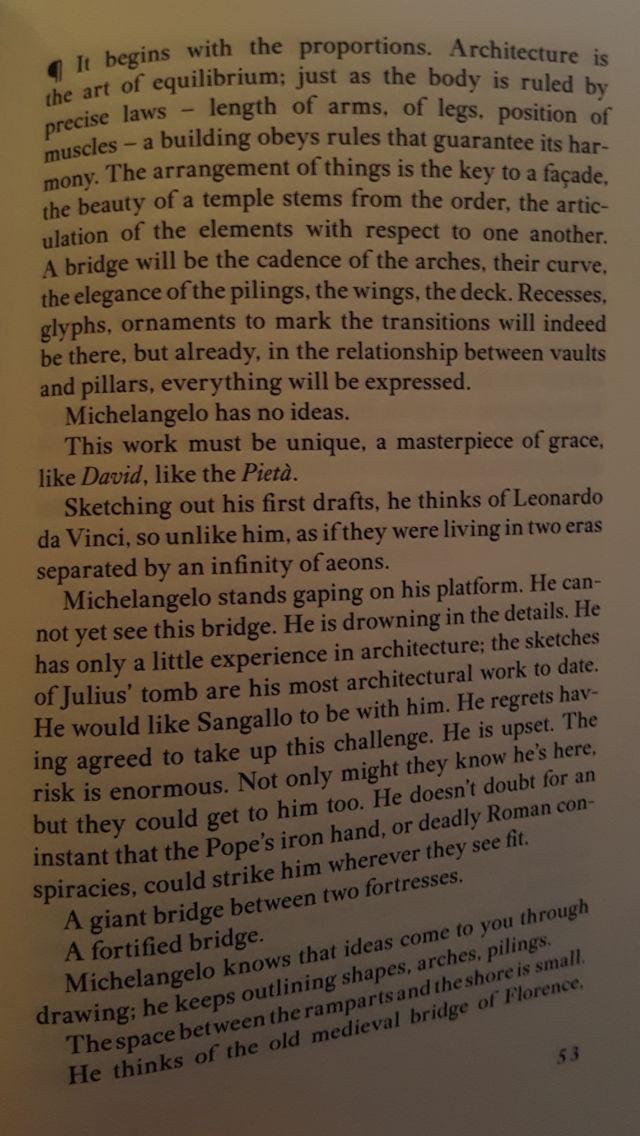
Mathias Énard’s Tell Them of Battles, Kings, and Elephants is a kind of tragic farce of stuff. The story is one of Michelangelo, yes, that one, and his trip to Constantinople at the request of the Sultan to design him a glorious bridge.

The sculptor feels rejected by the pope and overlooked by his people — so takes a journey that could be considered treasonous in order to fulfil this brief. He makes notes, lists of objects, descriptions and movements. This listing of the passive visible objects are part of the metaphor for his struggle to realise the bridge he has been enlisted to build and his inability to possess a dancer he has taken a fancy to. This is mirrored in his poet companion, who falls in love with him, and is unable to see him as an unpossessable object. And Michelangelo is the same in viewing himself — as much as his life is rich and full, he becomes a statue himself when approached by beauty.

Here’s some snippets:


The story is one where you can feel the objects in a scene being moved around, everything has a heft and can be tracked around a room, through a street. This physicality is undercut with the eventual epilogue of destruction.

Pick up Tell Them of Battles, Kings, and Elephants.


I was recommended this interview with Murakami in The Guardian today. Alongside this quote from the piece:

When I was in my teens, in the 1960s, that was the age of idealism. We believed the world would get better if we tried. People today don’t believe that, and I think that’s very sad. People say my books are weird, but beyond the weirdness, there should be a better world. It’s just that we have to experience the weirdness before we get to the better world. That’s the fundamental structure of my stories: you have to go through the darkness, through the underground, before you get to the light.

The interview goes into some depth about how Murakami’s understanding of his own work is a way of building a meeting place for him and the reader. It’s an exercise to creating a meeting place for him and the reader to share a feeling — without too my analysis of the symbolism of any of his writing.

Pair with me previously discussing idealised ages with reference to The Years by Annie Earnaux.


This week’s song is Hotel Yorba, by The White Stripes, chosen my my travelling companion this weekend :)

Propositioning

Etch To Their Own

Dear reader, I am writing this to you from a wedding of one of my oldest friends. As such, it will be short.


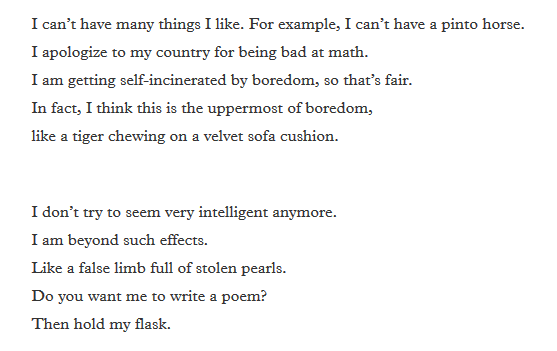
You will probably have seen this explode over your tweet feed, but there is an incredible interview with Chelsey Minnis. Emily Berry discusses the ins and outs of Chelsey’s work here.

There is a particularly good reading of Propositions — a poem built out of overheard lines from trashy old movies of a certain era. The reading starts at 1:37 and includes wonderful lines like

“it’s either a rowboat proposal or a murder”

and

“Now, I am going to tell a very long, very dirty joke,
this could be hard on your pocketbook”

and

“You do the praying and I’ll handle the dice”

The way that each line has some striking demand of another, which says less about the other than the person speaking — which I suppose is all speaking — is the proposition, every one of them has a demand of possession in them. There’s no proposal without saying “hey, here, let us cost each other a great deal”.


Also have a taste of some older work by Chelsey, in Granta.


This week’s song is Seasons, again.


Thanks for reading Etch To Their Own. I need to go back to a party ❤

Freshening Up

Etch To Their Own

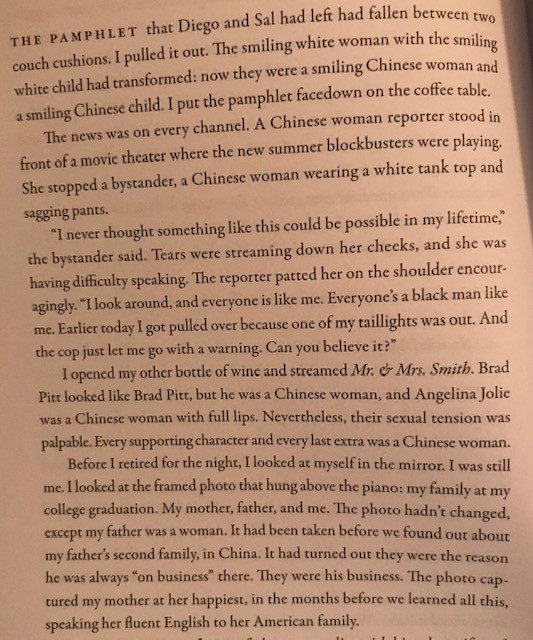
This week I have been particularly interested in Rachel Khong’s The Freshening, published in The Paris Review. It’s a sci-fi tale of Americans vaccinating themselves against race. The Freshening itself in the story is an event where government agents visit your home and inject you with a serum which changes the way you see the world. It makes you see everyone like you — so in the case of our protagonist, as an Asian woman. Once injected she sees everyone as an Asian woman, including her father, people on television, Christopher Reeve as Superman.
 
 Here’s a little snippet:


What I like about all of it is this exploration of tension — the desire for it at least. There are amusing complaints that there is no one looking at her butt at the gym, or that people find their spouses less attractive because they look like themselves.
 
While her grief for her mother is being processed, the lamenting the loss of her mother’s smell — “there’s nothing on earth that smells like her any more” for example, she has feeling of erasure of her own culture in the world around her. When everyone looks like her, including superman,
 
The story doesn’t give us answer of course, it wavers like its characters about whether such a thing would be good or not. Our protagonist is nudged into having a party where a new drug is to be taken, one that lets you see the world as it was before. Our protagonist is confused, the new world they live is is certainly better, but she still misses the old one.
 
Which is the through line with her mother. Her mother who was somewhat cruel, cold, difficult to elicit praise from — and was the only real connection to her heritage. Ridding the world of perceived diversity, in this case, causes a break in history — making the foreignness her mother felt less valid, less valued because she herself is less able to feel the difference her mother felt.


This week’s song is Towing The Line by Ben Howard. Bit new for me as I’d previously disliked most of his output, it’s grown on me.


Thanks for reading Etch To Their Own. This is me enjoying your poetry when you send it to me to read immediately after writing it. Chickens should be decent too. If I was meant to send you something, don’t worry, it is happening very soon, and then you will wish it hadn’t! Here is a thread of things I did. I am going to be old again soon, so I apologise in advance if I run out of steam — hopefully there’s somewhere for me nearby that isn’t a scrapyard. I have some work coming out in Bone and Ink on the 19th November — one is called Essay on Islands while another is called The Sexual Content of Torture — which shows at least, they have a broad taste in subject matter.

Stop me if you’ve heard this one before, before

Etch To Their Own

This week I have been spending most of my reading in Poetry and Poetry Review — the poetry magazines for people who like others to know its poetry they’re reading.

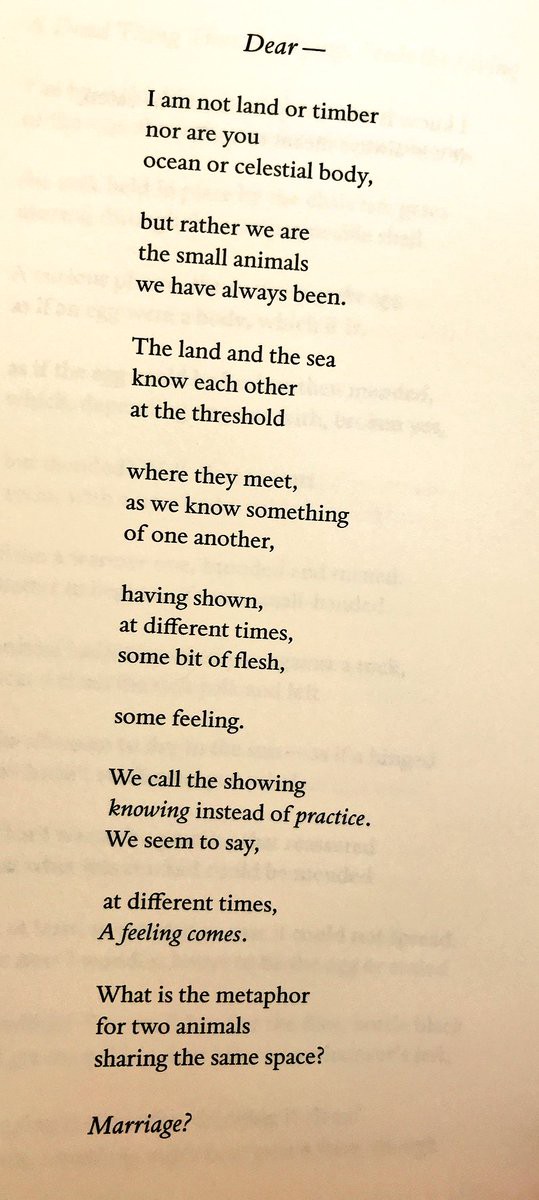
Donika Kelly in Poetry offers us Dear- which you can read in full here, or below:


(Big fan of whoever at the Poetry Foundation decided to include the hyphen in the url of the page)

The poem takes us through love that is negotiated through a sharing of space. The idea that like some very old gods there are patterns of people — small animals really — meeting in rhythms that form a practice, that form love through an expression of borders and positions.

These are unarticulated with words — only the statements of scale — to be unlike the ocean because they are not metaphors but small things making motions on repeat.

Here is how I
become a tree
[ ]

and you
[ ]
a body in space

Here there are no words for what they are becoming, because really, they cannot become a tree — there is no way to express a body in space without resorting to metaphor.

You can imagine here that these spaces are for the motions and positions, for the practice of love through meeting in rhythms and making the small ritual actions that signal anything larger than being small animals at all.

And “at different times” — saying that our small lives build love accumulatively. It is the layering of our actions which gives us the meaning we see in the world. Often we expect the world to present us meaning pre-packaged, because we are so used to everything being so laden. So here, with the frank admission that sometimes we have to start small and work at something tells us that we are part of the way meaning is made out in the world, between on another.


Speaking of repetition, Tim Clare interviewed Ross Sutherland this week on Death of 1000 Cuts, and Ross had some really interesting things to say about how repetition adds meaning into things in a way that is unexpected at first.

(There’s about 8 minutes of waffle at the start, I am sure Tim won’t mind you skipping)

To paraphrase from memory:

Ross would use things like reworking the Fresh Prince intro into a looping poem that, at the start, would seem funny and familiar and as the same words were repeated each time they would come to be less funny. And then, after the crowd realised he wouldn’t stop looping and reciting the words, it would become funny again.

And then, Ross says, at some point you realise that through this repetition the repeated words or ideas morph into something else, as if they become the most important metaphor for anything in your life, a key stone for understanding all.

There’s lots of other really good stuff in the interview but I liked the idea that, like the poem above, that even something as simple as repetition can push meaning into anything.


I have also recently been working on putting together a full length poetry MS, sort of titled The Essays, using that kind of interesting “essay” format that I have been playing with. If you have no regard for your literary health, and would like to have a read of it for me and provide a little bit of feedback, please let me know.


Today’s song is a lovely bit of piano from Yann Tiersen called Porz Goret. Listen here, enjoy his earrings.


Thanks for reading Etch To Their Own. Sorry if you’ve heard this one before. It was written by @CJEggett, and he would love you to let him know about any typos. He would love to read whatever you’re working on, or just enter into a ongoing ritual with you. If you couldn’t find the meaning, then maybe you need to read it again ❤

That if it weren’t for the poems lifting you up

Etch To Their Own

Rosebud Ben-Oni’s recent column in Kenyon Review uses the idea of a “conscious poem” — a poem that knows it exists to ask questions about how poetry comes into existence at all. When is a poem a poem? When you finish writing the last line, the first draft, the first word, the thought, the feeling of the thought, the moment in reality that makes you want to write the poem. You could already be living in a poem and not know it.
 
 And then, as always, off into string and field theory so we can consider how language can be like a universal force in the same way gravity is. I like the way that this comes out because it starts with a scattering of ideas and “aren’t we all dust” but quickly moves towards a creator myth. Imagine the aliens know exactly what they are doing, we’re asked.
 
 And this is reflected again in the anaesthetist — who she asks what it’s like to share time with someone losing it. She writes about her hunger for more time, the “remember to bring me back” going through her head, and these all seem a little like prayers.

“That if it weren’t for the poems lifting you up, would each year obscure the sky a bit more until you’ve forgotten it was there to begin with?”


As I Have Accidentally Put Two Hands Up by Heikki Huotari in Third Point has some powerful turns of phrase, such as his “bones button on the wrong side” suggesting wrongly-conforming at a fundamental level.


Reading again, you could take the title to be the raising of hands at the request of the police. The supplication gesture of the palms, and not just the raising of hands to answer the question dually. The teachers call, demand the answer and this I suppose is the same play with authority.
 
 The presented idea here is — there are two ways he can answer the question, or that in answer in both ways he is showing the truth of himself.


Now I’m Bologna by José Olivarez is littered with lines like “people are overrated. give me avocados” and “It’s not so bad being a person” while navigating a discussion of Italian heritage, and how we make who we are. Bologna, the place, is the pun here; he is where he is from as well as what he does and what his parents do.


This is a finding the self through where you’re from kind of poem — which in this case the poet looks at how their experience is one that is seen in terms of the economic value they bring the place they immigrate to. This is the life of their parents, to work in car factories, to dream of a better life within the one they have — to be Lamborghinis. This is a dream that fits their identity, which is then changed by their son who works in a sausage factory. This play of who holds the car keys on a shared identity between generations is one that is deeply aware of the external view.


Thanks for reading Etch To Their Own, I am looking forward to a long sleep. It was written by @CJEggett with well-meaning hands. I am sorry it’s late, you can blame Sammy as she took me out to dinner. A secret painting. Very good twitter thread about poems which might teach care. I care for every one of you in verse and in prose.

How Can A Book Read Another Book?

Etch To Their Own

Letters from Max, published by Milkweed, is an incredible expression of grace. The shared correspondence between Sarah Ruhl and Max Ritvo is a moving portrait of not just how writers sharing their work and lives with one another as a community of craft building, but also how the writers become the text for one another.
 
 Max Ritvo, whose Last Voicemails we covered here, was a poet with a huge heart and a startling and daring turn of phrase, often his work is like reading only the best lines of poems you love. It’s just the illuminated path through the poem-woods to the meaning, nothing else in the confusing dark.
 
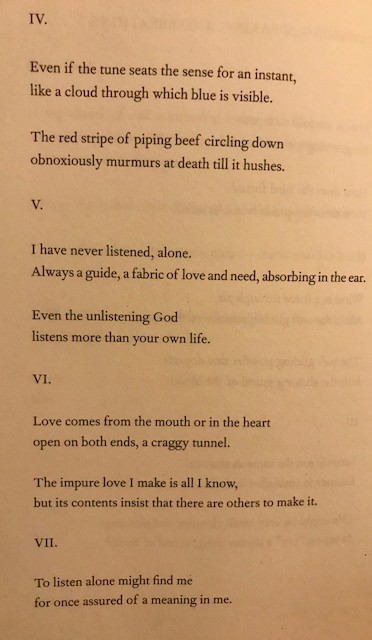
 Sarah Ruhl, playwright, and apparently shy poet, begins her relationship with Max when he applies to join her playwriting course. Quickly the teacher/student dynamic falls away and Max’s illness returns. Soon, as friends, they exchange letters — and then poems, the first for Sarah “since you are a prime mover in the poem” is Listening, Speaking and Breathing:


Here I love the way the poem is so obviously for someone, directed in the declarations: “you are not silence”. Letters from Max is about being seen, or being read. There is powerful tenderness in the way these two writers read one another and become connected through their work by putting one another in it. There’s little better than being the addressed person in a poem, other than having the addressed poem read.
 
 As such there is no conversation between two writers which is not collaboration. It’s a series of world building about soup and the afterlife, a little world bending with action — a spontaneous public reading, writing the themes of someone’s life into your play.
 
 And that’s what it reminds us, that we are often looking at the world like hungry things looking for something to sustain us. Often we enter the world in search of a way to make something more than we had at sunrise. Here though we are treated to a guide to kindness. A guide to kindness that lets us see that the way to have more of yourself at the end of the day is to have spent it giving yourself away to others.
 
 Max writes in a letter about a concept of the Good Max which lives and moves at the same time as him, in the same space, but is a little bigger, like an aura of a shell. And when he is good, he filled that space. He knew that all he had to do was to be good to others to be able to grow himself into Good Max, to become that person for the time of his goodness. I think this is the driving philosophy here, to be greater for what you give away.

Buy yourself a copy from Milkweed here


Our Hannah has a book coming out. Full length and brimming of cleverly moving stories of absent people. I’ve read most of the stories in it and it’s ace.


This, by Henri Cole, turned up in The Paris Review:


This week’s song is Death by Made In Heights. I think it’s the breakbeat that does it for me.


Thanks for reading Etch To Their Own. I wrote to Sarah Ruhl to tell her how useful the book has been to me recently, reminding there are ways to be graceful. Somehow I think that letter was better than this one. More direct. I am a little run down and aching, but extremely happy for the good things happening around me. We’re approaching a funny time of year for me, and it creeps up despite being an unmoving date. I always wonder why I get deeply sad this time of year — or rather, just “why am I like this now?”, and then I remember where we are, and that is bad in itself. Still, the world is full of good things ripening all around me ❤

The Superior Form

Etch To Their Own

It has been a busy week where I, dear reader, have not been reading enough. This is bracket week, where I tell you things between brackets instead of a proper close reading/jolly jaunt into literary wheat fields.

I am currently working through the Tor.com book (which is excellent, I am particularly enjoying The Water That Falls on You from Nowhere by John Chu — a story about a future/world where it rains on you from nowhere when you don’t tell the truth. The joy of that story isn’t that it’s a great conceit, but how it’s used by people in a terribly real way, for example, expressing an opinion in a way which is true to you means you can demonstrate how dry you are to the person you’re arguing with) and Olga Tokarczuk’s Drive Your Plow Over The Bones Of The Dead (which is an absolutely gripping rural noir whose William Blake influence is a joy to see threaded through. It’s got something of a-real-novel about it that feels really refreshing to me at the moment, I am ready to be dragged along with the plow).

But neither are finished enough for you. Olga is out next week, so I hope to have her solved by then.


So, because I have so little of other people’s writing for you this week, you can have some of mine. Enjoy one of my slightly polished-up warm-up-exercise pieces. This one is a bit of a farce written in high spirits. I remember being snowed in when writing it, and I was a little giddy for that.


The Superior Form

They’d found it. They’d found the words, finally. They slipped together like the teeth of a zip, the hands of lovers or another metaphor that we don’t really need any more because we have the words. They were perfect, and only a few lines.

It was a small statement.

For years they had tried. They tried getting children to do it. After all, they were on the lip of the snowy hill of language with their sledges ready to careen down and splash into the mucky pile of bodies in the slush. Like the rest of us already have.

For years they had tried prose, very long prose. They thought the more there was of it, the more powerful it might be. That didn’t work, and people died making it. Tragic, really, as those people never read the words in the right order.

The scientists, who do this sort of thing with ink-splotches on their lab coats, worn with contentedness — un-ironed and un-ironic — would try all sorts of form. Third person, naturally, then first, then second — and everyone thought it could be second for a long time, so they wrote another long prose attempt in second person and it sold very well, but really it was a complete failure except in the fact that it makes a satisfying sound to drop.

They tried just using very short words, just long ones, just Latin roots, just Anglo-Saxon roots, they did a lot of rooting and didn’t really get anywhere with it. Everyone had already decided it would be in English as that would be most convenient.

They should have known from the start. It would be a couple of lines of poetry.

It was funny really; they tried all those different languages, weird attempts at providing tension in a line through complex weaving of metaphor, rhyme, assonance. Someone even started talking about strophes, but everyone else thought that even this didn’t need to involve a discussion about strophes.

They had tried poetry. They tried with children, as mentioned, and they tried with very old people, thinking that somehow someone so soaked in language for all those years would be able to give them the words they needed. This soaking wasn’t the reason for wrinkles in the end.

Maybe it was still about liminality, they thought, and they had a conference about it where they invited all sorts of clever people — like linguists, philosophers, architects. It was good fun by all accounts, but they didn’t find it over that long, expensive weekend.

They asked the dead — they asked Hemingway what he thought through the Ouija board and he just asked for another drink, which shouldn’t have a been a surprise, but as it was on television with millions of people watching it felt very dramatic. Many people wondered why they thought he would know. Why not ask someone who has been dead for a very long time? And more importantly didn’t use a loaded shotgun like a couple of drinking straws to get the last slurp of milkshake from the bottom of the cup.

Obviously they asked women, eventually.

When they found it, bliss spread. The government started printing it on everything. On the sides of buses, on receipts, beer mats, the tag in your underwear.

The words fixed it — pure peace and grace and love in the soul of the reader.

The first week was chaos; the bumper stickers caused a few crashes. Mostly amicable except for the few who died swerving under a lorry’s wheels while trying to read the words in giant white type on father-Christmas red, on the tarpaulined side of the vehicle.

Still, there were words now that would make everything feel better.

Soon people became accustomed to it, and you would hear people mumbling the lines under their breath as they waited in a frustrated queue for something awful. They sang it from the terraces — and then realised that maybe peace kills a bit of the competitive edge required for Premier League football, and as such, they’d either have to stop saying the lines or stop football.

As the words spread across the world people agreed to stop killing each other quite so much and read some poetry instead. Although, of course, there was really only one poem worth reading now.

The scientists had a very long party and went back to work trying to grow a heart inside an animal that had room for an extra one. Someone commented that this was kind of the same thing, in their national newspaper column, which now ran full-page reproductions of the words with sponsor’s logos in the corner instead of adverts.

It was decided in the end that it had been a very good thing to have discovered these words, but that the world wasn’t actually that much better for it. People continued to die, go mad, and lose a hand at the mince processing factory that wasn’t caught in time and so, maybe, somewhere, someone ate a little bit of that hand in their spag-bol. The world wasn’t better on any fundamental level, but they felt better about it.

Some were disappointed in this, that it didn’t really fix anything material, but as one of the very clever people said on Newsnight, “what did you expect? It’s just poetry.”


This week’s song is Stand Up by Hindi Zahra. I’ve no idea where this came from, but here it is :)


Thank you for continuing to read Etch To Their Own. Normal programming should resume shortly ❤