Nothing You Do Will Have Any Effect On The Game

Etch To Their Own

Note: this book is pretty rough. I felt like someone had driven a truck through my brain, in a bad way, after reading it in one sitting. It contains mentions of suicide, self-harm, sexual violence, gore and so on. The review to follow reflects that while trying to stay as polite as possible, but do consider not reading if you think that it might be particularly upsetting to you.
 
 B. R. Yeager’s Amygdalatropolis starts with the casual consumption of hell; a disinterested, desensitized consumption of hyper-violent, authentic-seeming media. The protagonist lives at home with his parents, a shut in who shuts himself away in his room, experiencing the world only through 4chan style message boards.
 
 The book is told through the use of message board posts, traditional prose narrative, chatrooms, and occasional slips of authorial intervention — creatively dappled little Goya paintings of an online hell and it’s consumption of a person.
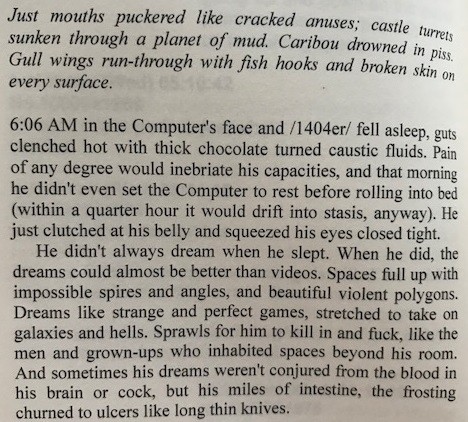

Because of the nature of the message board posts all providing the user the same name — /1404er/ — it’s difficult to assess the messages that are from the protagonist. Is he the one asking for snuff porn, or the moralising voice, or the pseudo-philosophical voice, or the one still learning, or the one asking how to drug a drink without breaking the seal of the bottle?
 
 Ultimately, it doesn’t matter.
 
 /1404er/ is a composite identity, having emptied himself out into the void of the internet subculture of hate — that is what washes back to fill his space. He arranges the world so he needn’t go outside. His sexual obsessions with death, gore and violence don’t provide him any waking gratification. These things, for a normal person, would be brushing against his fear of touch. But for /1404er/ this contributes to the perpetual motion engine that locks him away.
 
 As a reader we have to hold on to the reality happening around the protagonist, until those anchors cease to exist, and he is untethered. Throughout he is simply a vessel for the hyper-violent media to pour into and through.
 
 The collective identity that manifests into the physical is one that see nobility in some great shared work — in the accumulated effort of, for example, “doxxing” someone and pushing them to suicide. In a in a chat room, it seems to by the physical /1404er/ we are following who pushes the suicidal person to get some knives from the kitchen: “u dont have 2 do ne thing w/ them”.
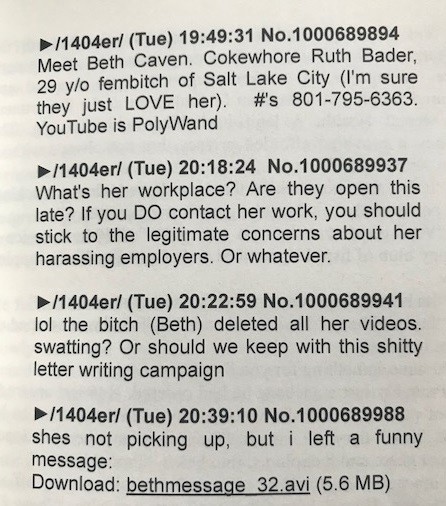

I have rarely wanted a protagonist to come to a horrible end so quickly. In truth he’s already at a horrible end from the start. He’s a teenager, we observe his mother leaving a 16th birthday cake outside his door, as she does with his meals, his deliveries. The mother comes to the door regularly to beg or parlay. His sharp tongue, and calming emails with articles about Hikikomori or adolescent psychology allow him to get away with it. There is a frustrating softness in the family around the boy, he has a remote IT job provided by his aunt, and his father is absent from parenting and his mother is always behind the door — except for one incident…
 
 Angela Nagle writes about such communities in Kill All Normies, her study of the alt-right in America, and identifies any number of similarities between that reality and /1404er/, but principally there is a cornerstone idea of amorality and that to have a feeling is somehow losing the game. Nothing can be shocking, even though the purpose of these communities to push one another towards shock. Caring about something is also a loss, so a solipsistic swirl is developed that pulls the actors in any of these dramas, real or otherwise.
 
 Like a lot of the nasty side of internet culture we’ve seen spill out into real life recently, /1404er/ typifies a terrible result of removing context from everything. This removal of context places it close to Blake Butler’s SKYSAW, with its location/body/object merging and strange detachment. The violence of the book reminds me more of something like The Heart Is Deceitful Above All Things by JT LeRoy, the violence and power exchanges and voyeurism — visceral — if still detached.
 
 Later, when he is finally alone, he is haunted to move about the house. There is some compulsion in him to exercise the ghosts through confrontation, as much as he could manage. He explores a game on his father’s computer, where the character is meant to farm, but is unable to because of the missing aspects, the strange unreal of it. Each task of interaction offers him the message: “nothing you do will have any effect on the game.” The haunting is pacified by mundane, childish thoughts, focusing on the wallpaper in his mother’s bedroom, or what he called his father’s dust — these are sensory memories (sight and smell) that linger with him from when he was in some way human, when he was a child. It’s hard to call these moments sad, but they are pathetic.
 
 The online world is one where we have reveal humanity to prove veracity — while at the same time using the anonymity as a form of protection. The posts in the novel show this, to be real you have to show a weakness, or accept the obscurity of a contextless existence. /1404er/ accepts the latter.
 
 You can buy B. R. Yeager’s Amygdalatropolis here.


If you’d like to read more about this book, then I suggest the 3:AM interview, here.


To cleanse the palate a little, enjoy this special valentines day story by Elytron Fass, The Love Cults of Laodicea.


Two songs today, Andrew Bird’s NPR TinyDesk, mainly for the first song, Are You Serious?


and then, also, Au Revoir Simone — Take Me As I Am.


Thanks for reading Etch To Their Own, written by @CJEggett who has a new website, let him know about any typos you spot, anywhere at all. As you may have seen, I recently spent some time with a friend being scanned in 3D and rendered. Enjoy my 3D lumps. Sometimes I don’t want to let go of my bag too. I’ve just realised I didn’t post last week’s very good newsletter on medium, which is why you should tell your weirdo friends on the message board to sign up here instead. It was tough to write this one, the book was compelling to read, but simply so disgusting and deranged and real feeling that it made me feel absolutely filthy inside my skull.
Undone, I’ve Made Today Warm

Etch To Their Own

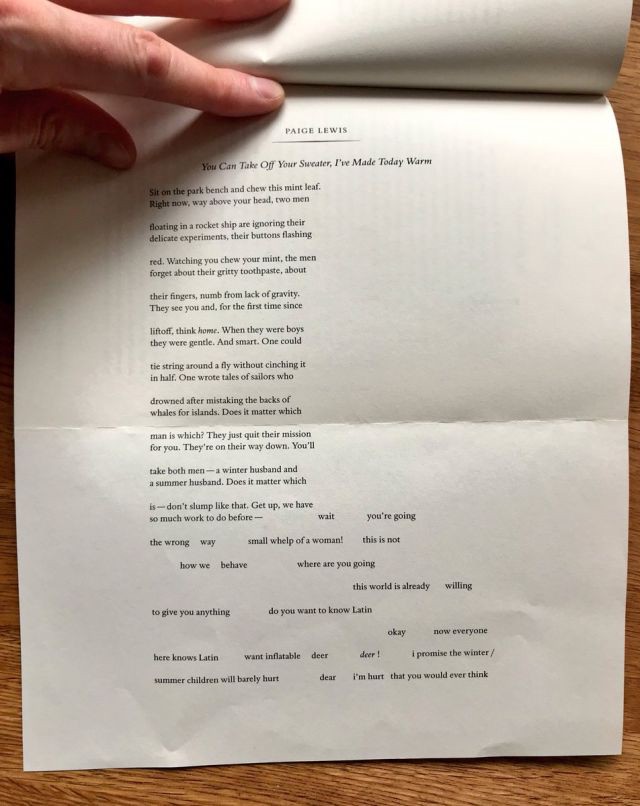
Earlier this month I had to buy a specific issue of Poetry so that I could read You Can Take Off Your Sweater, I’ve Made Today Warm in it’s full fold-out glory. I originally heard Paige Lewis read it on the Poetry Magazine Podcast, where it is explained that the poem is laid out to express the disintegration of someone’s power over the other.

(note: I posted this later than expected, and also, the formating is really not right on medium. Please read the real thing!)


(There’s another page, read it online here)

The poem shows the kind of possessive bargaining and rationalisation that the controlling player uses to try and coerce the other. The men, who have stopped their important work, and use useful toothpaste rather than mint (which you can plant to keep deer out of your garden, by the way) for her are part of the threat of putting someone else out — that the subject is being inconvenient by not complying. This threat is the subtext of the speaker’s point which is rounded on later in the lines:

stop

aren’t you known aren’t you
 known here

(note: in my quotes I have made bold the most relevant lines)

The idea that any change could lead to the destruction of the current identity, isn’t it better to have something, even if you don’t like it, than not? the voice says.

The voice also uses strange explanations to make the current world seem good enough, surely. The men, from space, are explained as good men by describing their boyhood kindness:

liftoff, think home. When they were boys
they were gentle. And smart. One could

tie string around a fly without cinching it
in half. One wrote tales of sailors who

drowned after mistaking the backs of
whales for islands.
Does it matter which

Except, even this explanation of the men’s formative kindness is about how kind and gentle they were in capturing a creature and keeping it captive, or how they wrote sensitively about other’s failures.

When the subject walks away, and the page falls apart, whimsical bargaining begins, demonstrations of power:

this world is already willing

to give you anything do you want to know Latin

okay now everyone

here knows Latin want inflatable deer deer ! i promise the winter /

summer children will barely hurt dear i’m hurt that you would ever think

i don’t glisten to you i’m always glistening

The power to make everyone know Latin is very Genesis — he said there would be Latin in everyone’s heads; and there was Latin in everybody’s heads. Whereas the offering inflatable deer seems to suggest the waning of power, reducing the offer — the slipping of what can be done to this person’s reality as they slip from having complete control over it.

My favourite lines might be those about glistening, a mishearing pun, the protestation that the subject is of course being glistened to shows the power over the subject disappearing almost entirely.

The poem ends with the central threat again, but inverted on the voice rather than to the subject — the threat that the world will be different and identity will be lost in the change. For the voice it’s the loss of power, that strips them of identity, the fact that they are no longer authoring the world.

how can you be certain that anywhere else will provide

more pears than you could ever eat

remember the sweet rot of it all

come back you forgot your sweater

what if there’s nothing there when you —

you don’t have your

sweater

what if it’s cold


Of course, this entire newsletter could have been me linking the Paige Lewis poem to Weezer’s Undone — The Sweater Song for a few hundred words. After all, if you want to destroy my sweater, pull this thread as I walk away — which is kind of like the structure of the poem, that unravelling of the lines into an undone pile.


Paige let me know that no, she’d never heard this song before.


Valentine’s day is coming up, meaning you’ll have to tell the people you’re already gripping tightly as you go over the Niagara falls of life that you wuv them ver’ much. Or someone else I suppose. Regardless of whether you’re sending a heartfelt sonnet dedicated to the left earlobe or right jowl of someone you’d like to ruin your life for, or desperately searching Tesco’s for something that will bloody do, can I suggest also supplying that special someone with one of Brittney Scott’s horrible valentine’s e-cards. Although, of course, this is one of the most romantic sentences ever written, so you could send that instead.

Also: Valentine’s day dinner ideas.


I recently discovered Joe Frank, by discovering that he had died. I discovered this through the excellent Radiolab tribute to him. This gives a very good flavour of what Joe Frank did on his radio show. If you’d like to explore his work a little more, there’s these longer pieces such as: Ascent of K2 (weird, one of the best examples of his amazing voice), From Someone Who Cares (sad, a little creepy), Odd Jobs (weird, violent).


Discipline of desire begins with the mouth


Thanks for reading Etch To Their Own, the internet’s premier knitwear culture glossy magazine. Masthead: just @CJEggett, who can’t see typos, but can see your lovely emails — reply to this email to receive your free digital copy of next week’s issue, next week. Sign up friends and family here, against the coming GDPR apocalypse’s regulations. To be in the presence of greatness unfurling. Read old issues of ETTO over here, if you’re a glutton for punishment.

After the world ends, you are going to fall in love again

Etch To Their Own

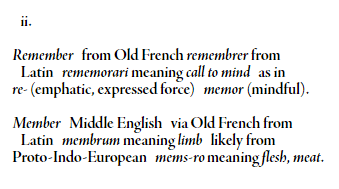
Notes toward an elegy, or what the books were for by Hannah Aizenman is a kind of broken-back poem, where the second verse leads us between the first and last through a wandering definition.


The first verse tells us that the books were for storing themselves, because they had their words stolen from them by some unnamed event. This idea of books as stored external knowledge, but for a person, is mixed through the redefinition of “remember” and “member” down from calling to mind (with force) through to flesh, meat — and to the third verse of the memories hands/bodies hold.

“Once I had to tell them do this, do this, do this.”

And now she doesn’t, like the books, she has had knowledge poured into her from somewhere, but is at a loss as to how it is useful. The way the poem uses the “looking up” of roots to find a different interpretation suggests she is reaching back before the event to find out what was really meant. That attempt to find the truth about something once it is too late is a common theme in elegy. And so the poem seems to be moving away from somebody or something, but not too anywhere, just yet.


As you may have seen this week, @mewo2 did some mapping out of the roots of words as they pass through various languages.


It’s nice, in the modern sense.


Cathy Ulrich’s This Love Will Destroy You is a post-apocalyptic “love” story about putting up with what the world gives you. It contains this fear of a future that is different — even if the one that is currently being experienced is also awful. Using the usual tropes of love stories, moments of touching, tenderness, openness, and subverting them, Cathy creates a strain between the promise of falling in love after the world ends — and the threat of falling out of it again.


As an aside, I always enjoy the horror of canned goods in the post-apocalypse.


This is the best thread on Mesopotamian text messages in absolutely ages.


In The Hospital By Chen Chen


There’s a real rhythm in this, as it modulates between the need to make a list — the grown up job — and the way each person’s relationship is expressed with the mother.


Two songs today, old ones again — both Bright Eyes — because I seem to be becoming a bit soft and soppy in my old age. Who knows what has brought this about. First:
 
 This Is The First Day Of My Life


And the slightly less soppy — Drunk Kid Catholic


Thanks for reading Etch To Their Own, I have been having a very confusing time recently, so I apologise if the newsletter has wound up on your doorstep asking if it lives there, or if indeed, you know where it should be at all. I may have been born right here in the doorway. I think it’s all the music actually, a very dangerous hobby. This The XX tinydesk is also very good, and I have somehow missed it for all these years.

Holiday to Hell

Etch To Their Own

This week I picked up my complete collection of William Blake and started looking for hell. I’ve been having a little wander round the idea of evil recently, thinking initially that finding a satisfying definition would be easy. The simplest version is that it is an absence of good, or simply to be bad. Both of which don’t really provide anything like the grander sense of evil that I was hoping to find. I was looking for the texture of it, the shape, something kind of tangible and describable aspect of it that didn’t rely on good as opposition.
 
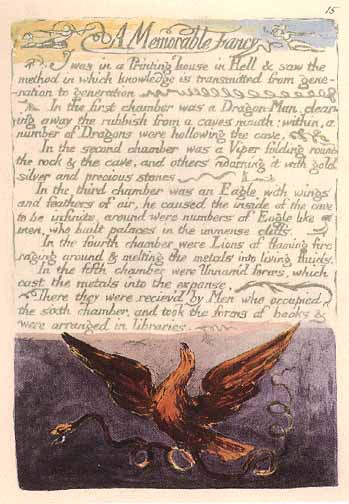
So we come to The Marriage of Heaven and Hell, by William Blake — you can see a PDF of it here.
 
The pamphlet is a post-French Revolution weekend away in Hell, and frankly it doesn’t seem that bad. It’s less grand than Dante’s trip, less torture, and more forgiving. There are sections which concern evil directly, suggesting initially that Evil is an energy of the body and Good the product of a well-flexed soul, before immediately conceding you can’t have one without the other.
 
I particularly like the trip to the printing press, which probably does the most architectural work in the pamphlet, offering you a few half-beasts to consider as Blake takes you through the creation process of the etching so that books can be made. These caves are considered to represent a limiting of perception elsewhere in the work — and the books created here are a way of widening it again.


The process described fits well with Blake’s feelings on inspiration — from Songs of Innocence & Experience — which suggest there is a process that follows: some expansive work or mundane experience, the expansion of the idea and adornment in your mind, the forming of the direct language in your mind, and then an unknown process between (where cherubs of inspiration disappear) which occurs immediately before the hand gets involved makes it reality and grounds it.
 
This is the acceptance of body and the soul, that they cannot be separated or treated as if one does the evil and one does the good. It is only through both of them that anything can be done.


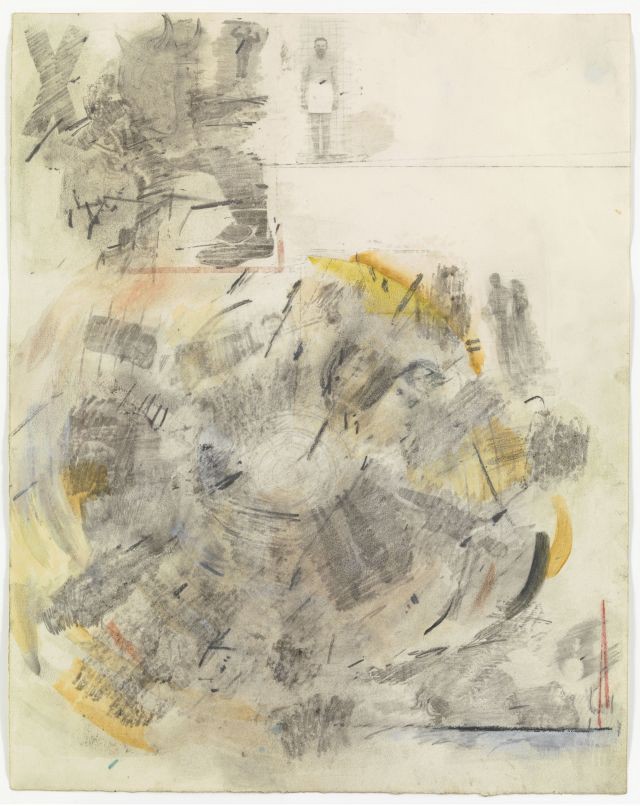
An aside, my favourite Rauschenberg work is his abstract depictions of Dante’s inferno.


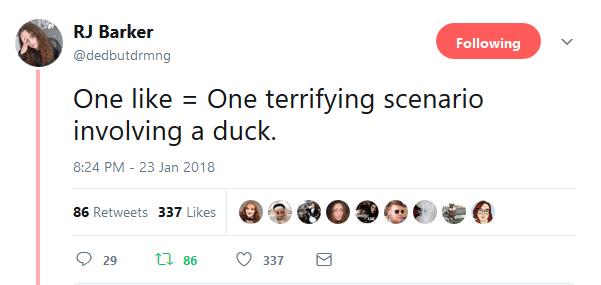
One like, one terrifying scenario involving a duck.


“Ah-ha! Books” — but not just I, Partridge


Not usually something we cover in ETTO, but comic book are something I sometimes enjoy. Here’s a piece on Kirby’s collage backgrounds.


I may have shared this before but here’s a straightforward interview with the often-difficult-to-parse Blake Butler.


This week’s song is not this, because this is hell.
 
 but is this boredom by Tyler the Creator. I think it’s the atypical structure of the song that does it for me.


Thanks for reading Etch To Their Own — it was written by @CJEggett with a heavy head. No, William Blake didn’t give me the answer I wanted about evil. If you liked this in any way at all, please send it to someone you love and tell them to sign up.

Canon, Liberated

Etch To Their Own

Liberating The Cannon, a new anthology edited by Isabel Waidner and published by Dostoyevsky Wannabe (under their Experimental mark) sets out to present the intersection of queer experience and experimental writing. The anthology takes its first cue from classism throughout, presenting experimental and literary work that deals with working-class culture at the same time as queerness. It is, most importantly in challenging cannon, ignoring the usual compartmentalising of queer (and working class) writing into low-brow genre definitions.


Opening the anthology’s set of stories is Juliet Jacques’ The Holiday Camp. The story explores this working class identity’s meshing with the desired queer identity of Sam. In seeing a drag act at the holiday camp, Sam wears his sister’s clothes as an emulative thrill, and is caught by his understanding sister who helps him dress up (poorly). They go out and the drag queen takes him home, in this moment we see how the sister’s working class help is challenged by the more experienced man, who helps Sam dress more effectively. Naturally, Sam is followed and abused on the way home — having to run to avoid being beaten. The confrontation with his parents and sister is one expressing the working class repression — love but a desire to not have to deal with it directly, simply an order from the father to not let them see Sam dressed as such. This kind of acceptance sets out the tone of nearly all the works in the anthology — as often stories about queer identity suffer from the same problem as Spiderman films, that we’re endlessly treated to the moment they were bitten by the queer spider as if that is the defining part of their identity. Instead, this collection explores queer people’s identities that are already possessed fully — and it is in the identities friction with the world that the narratives emerge. For example, later in the collection Sara Jaffe’s Baby In A Bar is about negotiating the possession of the child with her environment. As a gay couple, and she not the birth mother, she expresses a series of learnt tics to make her expression of having a baby seem more legitimate to those around her. Which makes all the more sense when she is directly challenged in the bar by a man who may have been following her.


Language and form is played with throughout the collection, including expressing the tyranny of grammar from ETTO favourite, Eley Williams.


The story explores the way that we use grammar and punctuation to help direct towards a shared reality, but as your remove these constraining elements it opens itself to interpretations — which might be subversive to those who hold power. This pairs nicely with Richard Bramer’s Neoliberalism, a story concerned with programming languages — and how moving from compiled to interpreted is understood by the protagonist, but not a certain kind of man. The theme continues in Bingo The Drunkman by Rosie Snajdr, a kind of re-articulating of a single statement — a kind of re-punning toward a truth — as if just playing with the language forces it into a new reality. Again, unhooking language from it’s formal, normalising ideas to display fluidity of meaning as truth.


In Waidner’s work in the collection we see the directness of which the political can be felt, and how identity is often constructed from pop culture and lives of our heroes — and easily imagined into ours to provide shape and structure. This, in comparison to the previous, uses structures to develop a sense of self. In A Girl Called Johnny by Victoria Brown, which both uses diagrams of locations and footnotes, to supply what seems like a clinical sense of the unrealness of objects that surrounds this particular self, we can see the negative of this. The description of women in the soft-core magazines follows up on this unreality, their setting and captioned bodies is alienating. The language is authorial throughout, and this isn’t a story told by the protagonist, who is turned into an object. Instead it it told with the voice of those who define history in footnotes and police reports.


These structures are what the collection tries to break through — to not really defeat the canon for the identities of the people who populate it (white, straight lads, mostly, I suppose) but because of the structures that are forced from the canon onto the rest of literature.
 
 You should buy it here.


The Awl is dead.
 
 If you don’t know what The Awl was, this will probably give you a good indication, and if that doesn’t, this will.


River Hymns by Tyree Daye. Nicely marked up.


Being lonely, in brain pickings.


This week’s song is King Krule’s Dum Surfer


Sort of nasty, sort of brilliant.


I made some garbage clothes, RTs appreciated.


Thanks for reading Etch To Their Own, we’re still here. I forgot to mention Judson Hamilton, who has something out on Dostoyevsky Wannabe — I responded to No Rainbow here. I hope I did okay with the gay stuff. As always, ETTO was written by @CJEggett, tired and tested and un-proof-read. If you got the subject line joke immediately, please feel free to let me know along with the pitches you sent to The Awl that got rejected. I am starting the planning of the next novel, and it’s going to be wild I think. I also feel it might be the last one from the big old wound in my chest — because even though I still pick at it, it does seem to be healing up.

Bluebeard’s Omelette

Etch To Their Own

I once watched a TV show about doctors, GPs, meeting their patients, filmed in the fly-on-the-wall style. It was supposed to show the real interactions between them, and give us a secret insight into the way doctors have to operate. Of course, it was designed to also show off the patients with humorous us approaches to illness amongst the more serious stuff.
 
I remember one particular exchange really well. It’s etched into my brain.
 
A middle aged man is having problems with his heart. He may be on medication, he may have left his medication in France, where he lives when not going to funerals. I may be mixing up this story with another.
 The Englishman, who is probably 50, old enough to have to trim his ears, speaks to a doctor who may be in her early thirties.
 
They discuss diet, and the pills he needs for his heart. She asks about fruit, as doctors seem to like to.
 
He says he eats a grapefruit every day, for breakfast.
 
And she tells him something, a fact that you, reader, may know, that grapefruit can increase your blood pressure and provide your heart with additional palpitations. A gift of a few extra beats. Or a jazz drum solo in the marching band really.
 
 And the middle aged man who might live in France is shocked.
 
He says he eats one every day, for breakfast. The doctor looks at him with a shimmering air of someone who might have just been told their patient hammers nails through their knees of an evening, despite advice.
 
But he has one every day. For breakfast. He says that he doesn’t use a plate, he says:
 
 “I eat it with my hands, over the sink, like an animal.”
 
There’s a lot going on here. Animals don’t eat over sinks. Why was this information useful for his doctor? Is the primal nature of his grapefruit eating meant to show his vitality, in contrast to his apparently abused heart?
 
None of this matters of course, because the look the young doctor gives the man is a perfect illustration of the that way women look at men in Margaret Atwood’s short story collection, Bluebeard’s Egg.
 
It quite old, ’83 I think. I’ve been working through it and particularly enjoyed the way that men are formed in the collection as a puzzle, impenetrable, not always evil — but always difficult.


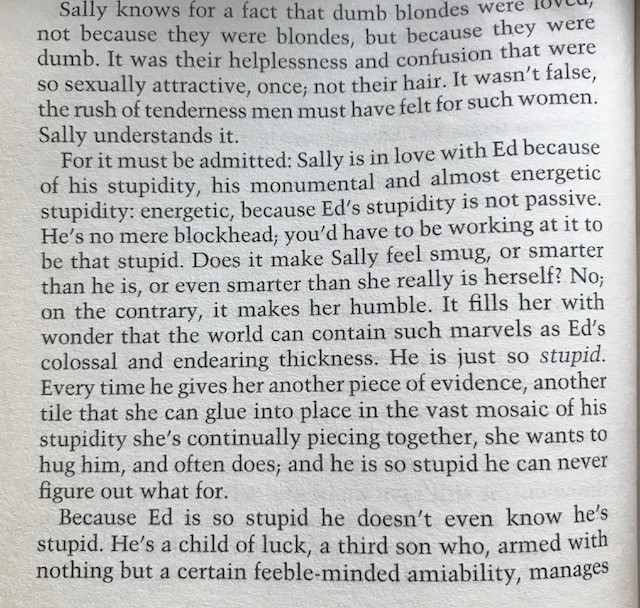
In Bluebeard’s Egg, the story this collection is named after, the inoperable stupidity of Ed, the protagonist’s heart-surgeon husband, is in part his charm and his implicit threat. Ed is so thick that he is easily objectified, placated, but impossible to have a narrative of the protagonist built upon. When Sally, our hero, tries to search for his inner life, she finds him uncrackable. In that impossibility of defined or shared narrative, Sally comes to the conclusion that he has the potential to hurt her when he finally does hatch from his metaphor.
 
Equally, in Hurricane Hazel, a story about the obligations of teenage relationships, Buddy appears to be some kind of sentient brick, unable to articulate an inner world at all and going through the motions because they are the next thing to do on some kind of societal level. Our protagonist, a girl much younger and deeply worried about straying from, at very least, a display of normal, goes along with it all until Buddy’s mindlessness turns him into a threat.
 
Both of the men are interesting to read as they aren’t representative of a societal structure, they are fully enveloped arms of it. Ed appears to be something of a tool for Sally to try and produce an ideal life, Buddy is more malign, but not by much. The men are like facets of some kind of great beast which the women in the collection are trying to scale — if they could only use the way this creature interfaces with the wider world, then their aims can be achieved.
 
It’s interesting to compare this to some of Atwood’s later work, like the MaddAddam trilogy, where some men retain this structural connection, but increasingly the theme is that there are “good ones” in the destruction of those structures. Not that the men in this later work aren’t difficult in their own way, but they’re not as obviously meshed into a power structure that’s in any way malleable.
 
The men in Bluebeard’s Egg however are good, in some way. Attractive, attentive, helpful in forming useful identity — but also uncomplicated obstacles or tools. Blunt. I think it’s this sympathy for the bluntness of the men in these stories that was somewhat heart-warming to me. They’re still human, just part of some machinery that these women get trapped in.


Hi new people, there’s a few of you. If this if your first issue of ETTO, then please: forgive me. Here’s how it works:
 
There’s usually a micro-essay splurged out near the top, then a snippet of poetry I liked from the week with a couple of lines about how I enjoy the structure or some turn of phrase dribbled around it. After that there’s sometimes a palette-cleanser in the form of a good tweet, then on to a song, and finally a sign off where I expose the worst parts about me. Don’t worry, that final part is not visual.
 
If you reply to one of these emails, I will usually respond to you. If you want to be slightly more performative, I’m usually happy to chat on twitter, I’m @CJEggett.
 
It would be great to know where you all came from to be honest.
 
If you’re someone who has a chapbook or collection kicking around, I’d love to read it. Equally, if you get something published somewhere, just let me know and I will try to include you in these grubby pages.


I have been listening to and “speedrunning,” Tim Clare’s “couch to 80k” podcast/course thing. I’ve been doing a few episodes a day, which is obviously cheating. Regardless, it’s nice to have someone literally telling you to do those silly freewriting exercises.
 
It has a very endearing style. There’s a part where you can hear crisis in his voice as he considers whether it’s “an” or “a” handkerchief for a slip of a second. There’s the reassurance that he really is in the woods — and not just very good at sound editing. There’s a bit where he gives you a ten minute exercise and drops the recorder into the empty pram that he’s now pushing around the graveyard so we have ambient noise to listen to — only realising that anyone who looked into the pram of the man marching around the graveyard to find just a phone recording might look a bit odd, after. It’s these moments of torture that really brighten it up.

I look forward to it getting going a bit more in the hope that I can use it to sculpt out the next novel with a bit of guidance. Give it a go if you feel like you could do with trying something different from your normal writing practice.
 
Listen here: itunes // soundcloud


I enjoyed this: The Gendered Garden: Sexual Transgression of Women Walking Alone in Cemeteries


I reawatched American Psycho recently. I am older than Patrick Bateman. Also, this.


This week’s songs were cropped from the absolute gift of being given a friend’s last.fm page, which captures the magic of the things he was listening to during university. For example:
 
 The Pains Of Being Pure At Heart — This Love is Fucking Right
 The Bronx — Minutes In Night
 Dananananaykroyd — Black Wax
 Feist & Ben Gibbard — Train Song
 Nouvelle Vague — Dance With Me
 Laura Marling — Ghost
 
Of particular interest is the clear switch from things listened to normally, say a full album, while doing something else or in company, to a scrambled mess that usually kicks in around 12:45 of single tracks (sadly it doesn’t record whether they were played them on repeat). We discussed that this looks a little like that maudlin search for a certain feeling late at night.
 
You can see this sort of thing over at Marc’s last.fm page. 2008–2009 it’s a real deep seam of forgotten things.


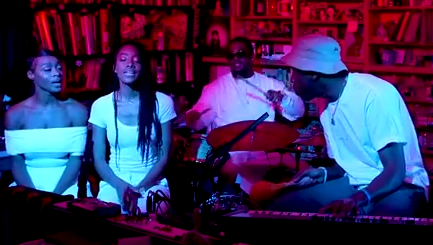
If none of that suits, I would suggest having a bash at this bit of the Tyler, The Creator NPR Tinydesk. I really enjoy the arrangement (particular the use of backing singers) and the way he conducts the band. Nice lights too.


Thanks for reading Etch To Their Own. As always, it was written by @CJEggett and proofread by no one. It’s been a good couple of months for me, as I now have two novels out with various persons related to publishing, and an experimental work out at a publisher too. It feels nice to have things in the wild that might come back with something. It’s probably a rejection note, but we collect those anyway and use them. If you liked this, you can keep it, but make sure you send a friend to sign up, or visit the archive. Thank you to the wizard, who brought us all here. Have some Ben Marcus.

Also, weirdly, I did a PAOM shop, if you liked my glitch art from a previous essay, and wanted to cover your body — you can now do both while giving me a small amount of cash. If you do buy one of these things, send me a picture!

Thanks for reading, it’s really helping

Etch To Their Own

This week is the full-year issue of Etch To Their Own. I’m really glad that I’ve managed to keep this going for so long, and that there seems to be a number of you actually reading it. 
 
 Making it public and regular was one of the main focuses of the newsletter, a way to make me less insane by giving myself space to write about things I care about. Capitalism, and the life we live within it, grind you down to be the the average version of yourself — a saleable entity.
 
 But this little newsletter has made a massive difference to my mental health, and enriched the way I spend my free time and given me an always-on back-burner project to be magpie-ing about the web for. A nice sense of purpose, a reason to write down the lines I like and make a note of who wrote them down the first time.
 
 Thanks for reading, it’s really helping.


To follow on directly, Tim Clare has been at the podcasting again. In truth, he hadn’t stopped, but this week there is a mega-long slice of pod about how to do writing resolutions for the new year. If you’re someone who has scribbled “write more” on the inside of their skull for the next year and called it a resolution, Tim has some very stern words for you.


And also some really nice ones too.
 
 A lot of it is about breaking your expectations into something that can really happen in a normal human being’s life. Intrinsic and extrinsic motivations are covered in quite a lot of detail, and advice on how to break up writing to ensure that it’s actually good. And there is a joyous bit near the end where he tells you that you’re free to run through the fields of literature however you want.


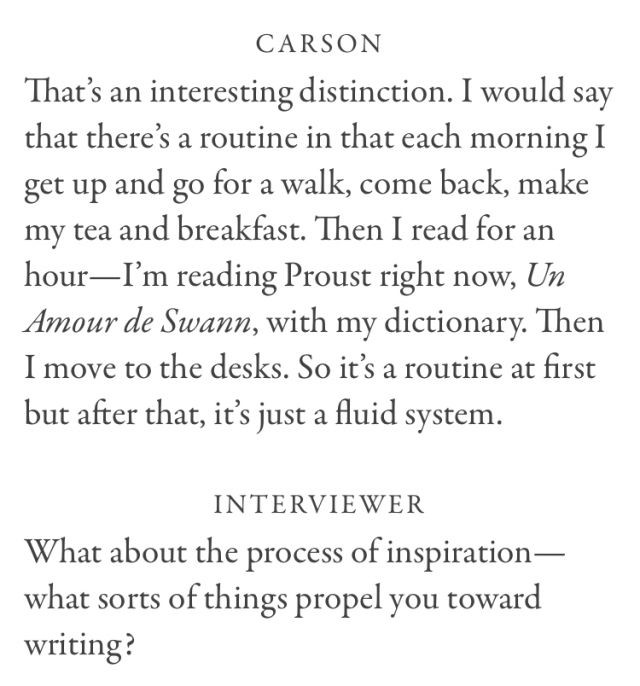
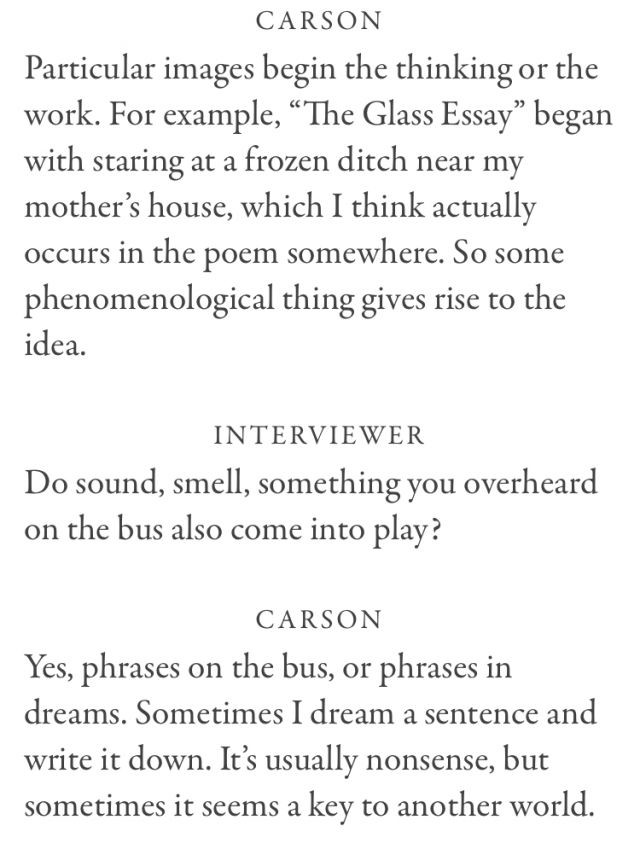
Very kindly, Santa slipped a Paris Review subscription down my chimney this year. Which means I was able to read the entirety of their Art Of Poetry piece with Anne Carson.
 
 Some interesting parts, aside from the moment where Carson suggests she calls herself evil to shock herself into some better thinking, they discuss her writing practice — which includes a scatty undisciplined darting between three desks she has set up in her studio.


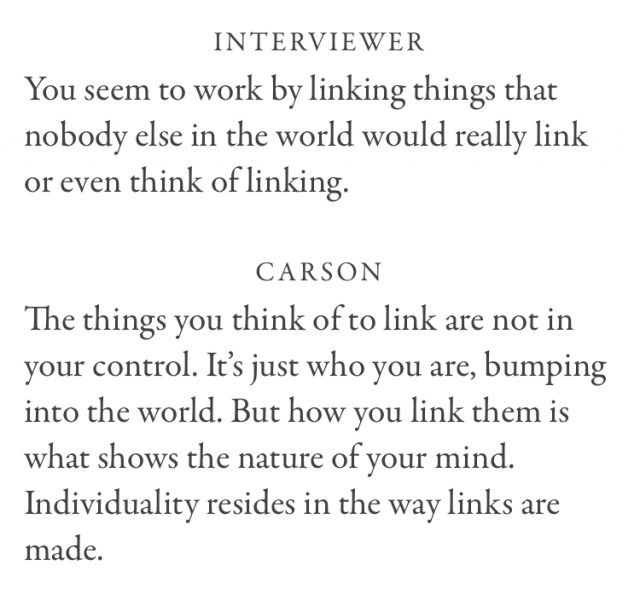
I love this way of working, as it pushes against so much of the writing advice that comes from the majority of the writing community. There’s usually talk of tidy desks, a space, avoiding distraction — but Carson’s way of working suggests just a life of nibbling away at things while whirling on the outskirts of a vortex, lazily reaching out to make a mark here, or add something relevant there. It’s a very pure way of working that suggests that there is no compromise in the things she produces, as anything that is produced at that time will be effected by everything else produced at that time.
 
 I say it’s pure, I suppose it might seem like chaos to some, but I feel a great affinity with it as it feels like how my head works. Everything is connected, even if we don’t see why, and the only thing we have that can change that connectedness is the slippery fireman’s pole of time we’re all sliding down.


I did a tweet thread about 2017, which, by all accounts was an absolute cracker of a year and I don’t think I’ve heard a word against it!
 
 In seriousness it’s been pretty good personally, terrible on an external and humanity-sized-existential-crisis level.
 
 The thread covers a few things from the year, those minor achievements. The biggest of course is that I managed to get you, yes you, to read this as often as you did. It’s an absolute thrill up there with the thrill of being seen or being heard.
 
 Ta for that.


Thanks for reading Etch To Their Own. It’s been a year, it’s one year old. It can probably roll over or do a backflip now. You would steal a snowstorm of static would you? ETTO would like to grow another 50 feet higher, this is also this weeks song. If you have any ideas for how we could, like, get more people to sign up, let me know! Me? I’m just @CJEggett. My proofreader? We don’t talk about them. Here’s a picture of your boss opening the folder labelled “disappointing nudes” that you have on your work computer for some reason. I think I’ve done this joke before. Send your loved ones to the archive, it’s only a Finnish Peninkulma away.

Two Thousand And Seventeen Etches

Etch To Their Own

I am going to write the first part of this week’s ETTO from memory. Rather than a “best of 2017” list, it’s just those parts that really caught the hangnail of my soul as I flicked pages. This, I suppose, is the list of things that will get added to the easily accessible part of my brain — along with Pound, Eliot, Carson, C A Conrad, Claire Louise Bennett, Max Porter, and so on.
 
 The most important line I have read all year is from the start of what seems to be an endless rise towards the heavens by Kaveh Akbar.

Here I am dying at an average pace

It sticks with me completely, and I say it to myself sometimes in moments of quiet, desperate sadness. I wrote about it very briefly here. Omar Sakr gave me something too — the concept of his italicised tongue — the perfect way to say it.
 
There are two houses — those made by Joyce Chong, in her endlessly drowning poems, and those by Nicole McCarthy who imprints her words over spaces like marking trauma on a map.
 
Which of course leads us to Hiromi Suzuki who gave us such a great deal of visual poetry this year.
 
Martin Glaz Serup decided to be be an actual gift — and turn himself into trinkets of modest pleasure — a set of red gloves.
 
Another line that lives with me is “maybe an eyeroll is the closest I get to god these days” about the boring tide of masculinity faced in a classroom by Stevie Edwards.
 
Rosebud Ben-Oni’s poem wasn’t just about horses in Iceland. It was also a bit about not being able to fuck people from your past.
 
 I am still

wondering what it means
 to survive,
 if you have to eat others
 to do it
.

The Pain Scale — which I remember no lines from particularly, but think about the ideas contained within often. The abstraction of pain, the faces, the father.
 
 Here is where is started writing a sort-of-academic book.
 
 I give my breath to a small bird-shaped pipe.


I have forgotten many good things from this year. There was a short story about a girl who had to go into the woods to kill a man so that she might join society properly. And there’s still that poem about fisting that I’ve not been able to recall. It’s easy to forget things, even especially powerful and good things that moved you far away at the time of reading.
 
 Say things, collect the data, before it’s too late.
 
 I do have something now, but I have not been brave enough to take the time to respond to it as I’ve been spending too long with the greedily alive.


I was going to put an REM song here that I’ve been singing snatches of all week, but then I listened to it and UP is really bad album.
 
 So I think we can put EL VY up instead to cover this week, because I’m the man to be.


Thanks for reading Etch To Their Own. It’s nearly been a year. Next year I will do better, smarter things for you, I hope. I will also be available for research and writing project — of any type. If you would like to try out an idea, then please let me know. ETTO was written by @CJEggett with a tired bent back and muddy shoes drying by the fire. It’s nearly over everyone, 2018 will be here soon, and everything will be better. Obvs…

A little sad thing that doesn’t reveal itself

Etch To Their Own

This evening I am being quick because I have to enjoy the party season and then climb on to a plane to take me to the rolling graveyards of Lisbon and Porto. Enjoy what has been an extremely good week for short poems and flash fiction.


NOTE: the party season was so good I forgot to publish this at the time… enjoy!


This passive-aggressive recipe by Vael Van Der Wuden is a jolly argument about the expressed value of family within a relationship.


A nice “poem brut” in 3:AM magazine by Kate Siklosi, and, coincidentally, great advice


A little dream from James Tate, that just demands to be read out loud as soon as you start.


I somehow want to say that this one is a little more dreamlike than a dream. A sci-fi wander about how we define goodness? Everyone Believes They Are They Good Guy by Cynthia Arrieu-King.


Patience, Patience, Hortense, and Wilbur by Meghan Phillips punches harder than flash fiction usually has time to do. A sad little thing that doesn’t quite reveal itself to be what it is until after you’ve finished it, and the dirt settles. Here’s the start:


This week’s song is Shark Smile by Big Thief. She said “woop”.


Thanks for reading Etch To Their Own, ask your ex-boyfriends to subscribe over here. It was written by @CJEggett and proofread by no one. Next Friday will be 50 weeks of this in a row, which is very much like a real number. I may also be on a plane, so it would really help if you could all move somewhere that would give me more time to scribble it out for you — or you could just set your clocks back a few hours.

A Project For A Trip

Etch To Their Own

I have been away this week, which usually means I get to do a lot of reading. Sadly, Lison and Porto are full of interesting things, so I found barely any time for it.
 
 The one thing I did read at any length was some Susan Sontag, a collection of short stories bought from the bookshop in Porto that is famous for being in the Harry Potter books (and maybe films, I guess?) — but not, as our taxi driver told us — where JK Rowling wrote every single book.
 
 The collection, called Stories, is something of an autobiographical wander through various aspects of her life and identity, but written with the kind of certainty of language which does make you wonder if it is completely ficticious.
 
 In Project For A Trip To China, Susan creates a series of lists of variables that can be considered for each aspect of the trip, a set of unknowns amongst a series of statements which cover her family’s relationships with China — and more general feelings about seeing and being seen in the country. She uses certainty of the language to develop a list in the way you might make a list of things you need before going on a trip, except this is a set of lists of things you don’t need to pack.
 
 The story takes you through some of the strange exchanges that had happened in and with the country, as if by exploring these she can find the answer to her own equation with China. The fact that Nixon went to China before her, and that there is a woman who had her right foot amputated onto her left leg seem to want to be weighed against “I forget I was concieved in China,” — an idea of being from a place you are not born in, in a way that is more than ethnicity and history.
 
 The reason there is so much shuffling of the unknowns here is because it is written before she gets there, she poses the idea of writing a book on China before she arrives because — possibly, reality will do the thing it does to all preconceptions when it arrives, and wash it away.


This is my last message to you before Christmas, which means it is probably worth giving you some games you can play over the festive period with whichever family you decide to become unconcious, festive balloons with.
 
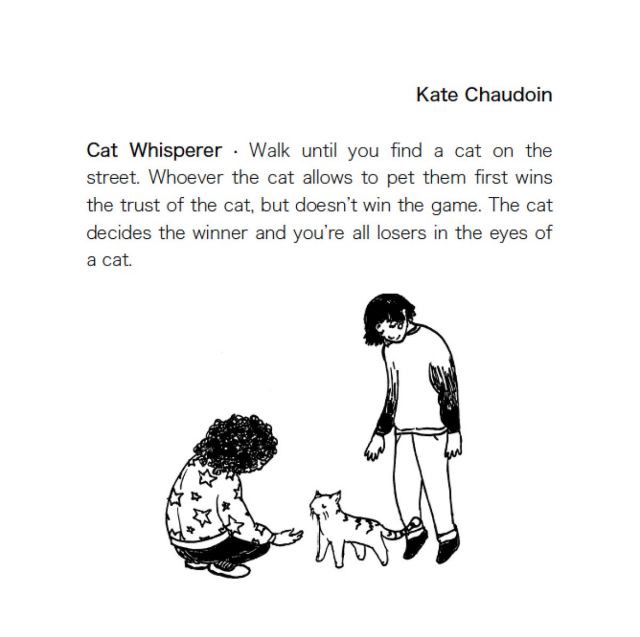
 So there’s this set of 63 Microgames. Like this:


Apart from being completely charming, the selection of games is really inventive, and shows the interesting power found in instructional language. The fact that by entering into the rules of one of these games changes how you accept the language presented, and most likely will change how you act in reality — for example: “Draw a tarot card. Keep it face down. Let this guide your day.” This is a great example of how the complete structure of the sentence, the full instructions, give you an entire new way of experiencing the world, as long as you play along with the game. I like it especially because it draws attention to how language is a game of symbols on top of reality, and that if everyone is playing the game, reality is formed by the language we use.


Becca Yenser has a new flash fiction in Pom Pom — Today I Was In A Movie
 
 Pair with, er, this sex column that contains good philosophy and excellent writing?


Thanks for reading Etch To Their Own, which is early, but I hope not too early for you. It was written with hunched shoulders by @CJEggett and proofread by holding up to the window to check if passing cars scream to a halt to correct me. Tell me about your favourite typo by email. Tell your friends about this newsletter, or send them here if they don’t like things in their inbox. Maybe next week will be a look back at all the good stuff I’ve read this year? Maybe next year will be looking back at all the good stuff I’ve read this week. Enjoy your Christmas — get fat and slow, easy to hunt by smaller pack (fun-size?) predators and ready for a long sleep.