The Mothnan Prophecies

Etch To Their Own

Please note, this is a little spoilery. The book is full of tonal reveals I discuss, even if I have avoided some of the plot points you will encounter.
 
Falling into madness is difficult to express for protagonists. On the one hand you’re telling the story, so you have to be able to convey it to the reader — but when you’re not so sure about reality anymore it’s sometimes easier to fall back on some politeness and the shape of normal things rather than bare it all. In this case, reliability goes out the window Lepidoptera scale encrusted window.
 
In Mothlight by Adam Scovell, published by Influx, our hero, Thomas, becomes increasingly obsessed with a moth expert, Miss Ewans, who he knows from the family relationships of his childhood. Through a rift created over the death of her sister, and her apparent lack of compassion, the family relationships fall away. Yet, Thomas is drawn to moths, and Miss Ewans’ walks in Wales — so when they meet again, he realises that he has somewhat followed her life as a shadow.


It has a certain House of Leaves element to it, the narrator getting closer to the truth through unearthed documents. The novel contains several photographs, which when they are first introduced are as banal and dull as the character’s early interactions. It’s a similar curve of dread as we have with the sanity of our protagonist however, their banality is a cover for a lurking truth that — if only we knew how to look and dissect better, we would be able to uncover effortlessly.
 
The madness descends with the sound of mothwings, and even before some unfortunate events, our hero is plagued by visions and experiences that place him outside of his own timeline, and into hers. He feels he loses his identity in these moments, that he is being consumed by her and her memories, having somehow to relinquish his own. He is haunted by Miss Ewans throughout the story, although — this is unfair and conventional — it’s more like he is moving into her spaces, he is haunting her memories. Thomas is the ghost of the story, denying that he is.
 
Thomas is unreliable as our narrator, spending time at first discussing the future descent into madness and then, obscuring parts of that descent from the reader as to when it happens. Suggesting they didn’t notice their dishevelment, or hiding behind dry, polite language to say their studies and work worsened. The reality is that this acceptance of the slide into the pit of madness and the obscuring of their breakdowns at work are there to stop us abandoning the story. This is the central theme of denial and repression in the story — he has to lie to us to lie to himself.
 
Thomas’s search is one to free himself of what by the end of his story he describes as Miss Ewan’s illness. He distances himself from the problem, moving the burden on to her, as he moved himself into her life so he could care for her and extract some personal value from her — as is she was contain to contain some truth for him.
 
 Pick up Mothlight from Influx here.


Blake butler has a new story in Wigleaf titled:

False testimony of primary cell manufacturer’s marketing mouthpiece under duress of witness to his last employer under the old lights of the golden soundstage no one can remember; or, 4820298.9839208394028394.0939889384893493.938493849a.2

It’s what we usually get from Butler, which is great — disembodied violence, a kind of vicious and viscous travelling through a body. It’s a difficult read, not for the faint of heart, but it does do that thing I enjoy with Butler of generating a horror mythology through connected bodily trinkets thrown at your feet.


Let me tell you a story about a pretty boy I knew.

(I read this a few weeks ago and thought it was superb, but had no newsletter-worthy thoughts to crack open on to the scorching sidewalk that is the blank pages of this newsletter. It’s very worth reading though, so please do!)


Song of the week is this extremely chill thing from KOKOROKO:


Etch To Their Own was lovingly hammered into these chiclets by @CJEggett — a man whom “sometimes guesses the right order to put the words in” applies. I helped edit this book, which seemed to have been well received. And they say Australia is dangerous. I am looking forward to a Monday off, some important exploration of cocktail menus tomorrow and maybe too much snow beyond both. Please tell your friends to sign up here for variable quality, but reliably delivered literary nonsense. If you spot a typo, let me know, quietly.

In Reprose

Etch To Their Own

I love prose poetry. Our expectations are set very differently. Like flash fiction, we expect to be taken to the centre of an event very quickly. Unlike flash, in which we give room for unfinished moments being displayed, and short stories, where we demand something similar to a beginning middle and end, prose poetry has the freedom not be an articulation of singular ideas and images with narrative being built in the joining tissue between the singular images.
 
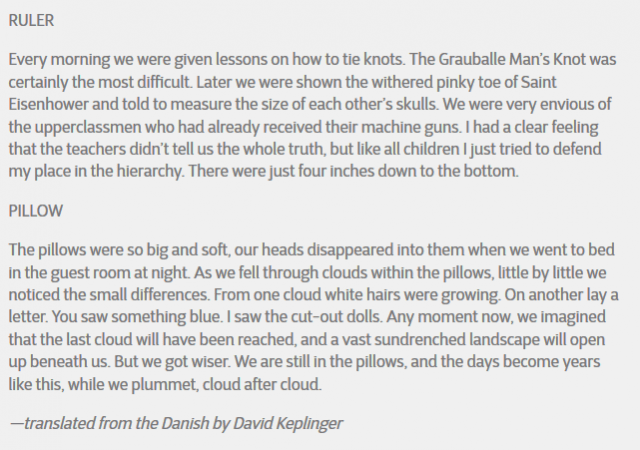
 Like these two pieces by Carsten René Nielsen (translated by David Keplinger) in Copper Nickel


The first mixes violence and history together, with the mention of the Grauballe man (the celebrity murdered bog chap) whose death is linked to human sacrifice, the arming of children and the sense of ritual. It suggests the inescapable link of ritual and violence throughout history, and the way that leaning on ritual leads to more violence.
 
 Pillow, the second piece, on the other hand seems to be an exploration of the ways two people can interpret the same situation. There is a coy link between the pillows and clouds, and the play between this and the link again to sleep and dreams explores the way we reset but don’t forget the interpretations that differ in our relationships. The exchange of the world between two people, and the layering of how they see it together, and the mismatched parts between them is where the fun of life is, a little like these prose poems.


Thanks for reading Etch To Their Own. It was written by @CJEggett a bit later than he expect on a subject he didn’t intend. Sorry for another short one this week, I didn’t quite get through the really quite excellent Mothlight — which has been reminding me of little bit of lovecraft in some ways. As always, if you have a question or request, @ me or reply to this email. If you have a friend who you think deserves this kind of nonsense in their inbox, please get them to sign up here.

Adventures in

Etch To Their Own

Poemland, by Chelsey Minnis, is book length, sparse, musing on what poetry is at all. You can see the declarative style that developed into last year’s Baby I Don’t Care — but this earlier work has a grappling feeling of trying to define something elusive (rather than flipping spotlights onto the space between two people).

So what we get is someone having repeated stabs at what poetry/being a poet, is. Like:

“This is supposed to be an independent thought..
But it is just a strained leash..
This is a poem!”

the double-dot, un-ellipsis, is a mark throughout the work — as is the exclamation. It’s like sitting with someone having a bit of a breakdown or breakthrough, almost trailed-off ideas that are really statements, twinned with a slightly more vague statement that is said with excitement.

There’s some odder parts too, like this ode-ish thing:


Which feels like an attempt to say nothing. These bump up against the more aspirational lines filled with additional colour, flavour, fat, like:

“If you are a person you can also be someone’s goat . . 
I can tell you about it for free . .”

These lines do some work to grip on to something ungraspable. There’s a strain in the attempt to not say something and leaving the concrete images of What It Is all over the place. This is a kind of discomfort, or:

“This is like looking too sexy in an uncomfortable chair…”

Here’s the centre of it I think, the obvious observation that we don’t want anyone else to be telling our stories:


In writing world controversy news, this tweet upset a few people. An unfair comment for the most part, although of course there is a lot of junk sent out. The part which gets to me is the “writer’s instinct” part — which seems like a nonsense idea. Or maybe I just don’t have it. There’s also the implication that there’s no point anyone without experience trying anything — i.e. you should obviously try and be part of a writing community but definitely don’t try and start one through publishing. The thread itself is surprisingly full of people agreeing with it — which I didn’t expect, although there are a few interesting thoughts amongst it.

~~~

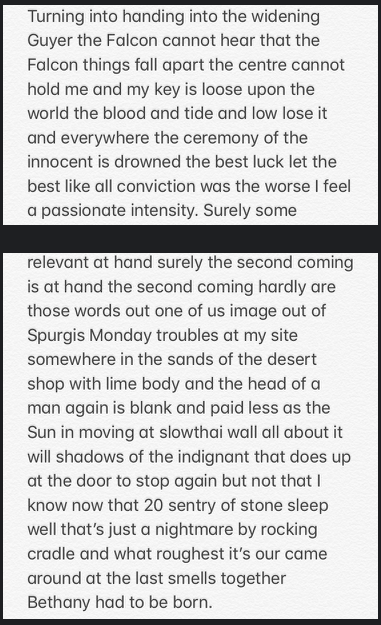
I thought I could try adding a new section, where I read a classic piece of poetry to siri, and show you what it writes down. This week, W B Yeats:


Song of the week is this set from Fleet Foxes:


Thanks for reading Etch To Their Own. What a life eh? Mary Oliver died this week. I shamefully admit I am not deeply familiar with her work — here’s a few things I have seen in the wake of this news that I really loved. Someone called Paul has a book out — I hope to be sent a review copy. Tim Clare talks to authors about whether they are in their own books, my feeling: everyone overanalyses these things in their own work and fears that everything will be attributed to them, because they are awful humans. I have never been in a book, or even seen on, thankfully. This is a tweet about all my publicly published work — you could read it all for free, on a screen, doing your part for independent authors/poets and saving a tree. But then, you know what they say about trees, as soon as you’re asleep they try and drown you in carbon dioxide.

A Feeling Artist

Etch To Their Own

Feelings. We’ve all had them. Lincoln Mitchell’s A Feeling Artist does something to skewer the (often) skewered humanities in a way that we can all enjoy. Pitching a world where feelings are art and that there are people who perform emotions for crowds to react to. It’s an argument for theatrical catharsis on the scale of stand-up comedians. The story does well to highlight something though in that we (me, here, every Friday) spend our time doing: finding the subtext to fiction (and media) that is meant to illuminate the world within. And how it can be lost amongst the theorising.

Ultimately, making a dent in others lives with the emotions you feel and then put on paper, can often be one of the least effective vehicles. Instead, in this story, the boyfriend of our protagonist find his university love — feelings — and takes it online, doing historical feelings for his audience on Twitch.
Here’s the opening:


There is the expected argument between highbrow and lowbrow, and how this means nothing — really — other than each demands the body in different ways. One in the form of the aesthetic performance of social media, and the other in the form of commitment from the body to be the art. Like CA Conrad sometimes says, the ritual must include the whole body — although I am not sure they would differentiate between the two.

Interestingly, this was in the Paris Review. In some way I suppose the knowing self-referential culture of the internet is built from that of academia and universities, and by extension the typically monied reader of the Paris Review. It is funny to read clickbait Buzzfeed titles in such a magazine, parodying the mainstream culture they are outside of.


Thanks for reading Etch to their own. It was written by Christopher John Eggett, a man with fingers who occasionally leans on a keyboard in really lucky way. Sorry this one was short, but I have been awake for far too many hours this week, I owe you a word each. Please feel free to reply to this with the world you would like me to include in the next issue. ❤

Flirtations

Etch To Their Own

Salo Press has recently started a chapbook series deliciously named The Flirtations.
 
Descansos, by Katherine Osborne is the second flirtation. It is a collection of poems that thread declaratives, dialogue and ominous pseudo-mythic pronouncements to build a kind of stream-of-consciousness from inside the witch’s cauldron.
 
Like all poetry, a lot of it is about setting boundaries as you go. Reading poetry is like playing a game where you not only discover the rules as you go, but that you also might be asked to flip the board and go the other way at any time.
 
Poems like these don’t necessarily want answers to their questions, and mostly spends time turning the “you” of the poems into something else — through renaming, the giving of roles, instructions.
 
The prose poems stand out most, being so unbroken and without breath. Here’s one from later in the collection.


Anne Carson speaks about wanting to turn each word against the previous word, so there is an opposition and tension throughout poetry — this is how you create the folds in her work, that creation of a new idea through stretching something so tight that it turns in on itself. Katherine does this throughout, “I pay you something so now you can mansion off the grid” or “swimbound body” pushing up against “dragging” from the water and the “boat fire”. In the poem above, we have the ending “Victory speech” as the undercutting punchline. We also have the joyous verbing of things like “the other animals are being meadowed to death”
 
In the same way we move around whatever form of story arc there is, we’re asked to “skip to the end” — assumedly missing the long drive and the boring part in the middle. This happens repeatedly, because we are receiving a story told orally somehow, the language is not interrupted by the fact it is written down. The speaker is at liberty to take us where they like.
 
There is something defeated about the world in Descansos, not just in lamenting dying planet being mined and other ecological disasters — tied to notions of our own energy or value — we are told: “Wrong things happen / Without any effort”. And later, in Magical Thinking we are told “my friend, you were not the the one that hurt the animals” — this kind of distancing and reassurance, with the continued suggestion that there are rescuers out there in the form of first responders and emergency contacts out of breath — tells us that we are in need of rescue. The idea is close at hand that we are in peril somehow, not in control and also doing damage to those around us.
 
Pick up Descansos from Salo Press here.


I had something published, finally, in Human Repair Kit, it’s the first attempt at the whole “read a book, steal some phrases, make a poem” process that I use in a lot of my shorter poems now. It’s really nice that the first thing I wrote in this style is published at the end of 2018. You can see a list of everything I have published this year, here, RTs much appreciated. I may have mentioned it before, but what I didn’t mention was that apparently my new year’s challenge last year was to have something published somewhere. I think I managed it, just about.


Our dearest Sam has some new poems up in Bitchin’ Kitsch — which is very lovingly laid out. I enjoyed Gaps particularly.


Dostoyevsky Wannabe are calling out for flash fiction about falling in love with someone you shouldn’t have fallen in love with, or something.


This is what I have been listening to at work the last two days.


Thanks for reading ETTO, again. It was written by @CJEggett, with barely any thought to the consequences of his actions. Me commuting to my first day of work 2019. You making wise style choices. Us, but you decide which one is the egg.

What Rough Beast Slouches Toward Year End?

Etch To Their Own

In the no-mans land of the christmas-to-new-year period, time begins to lose all meaning. So much so that if you were to plan to write a newsletter on a Friday, rounding up your year of reading, that you might misplace that Friday and double-park it with a Saturday.
 
This is the second year of Etch To Their Own. It’s still making me slightly more sane than if I hadn’t begun, which is generally a good thing for everyone except those people I ignore while writing this.
 
Last year I spent some time recalling lines of poetry that I had read throughout the year from memory — and then using that as a guide to run through the work again. This year has been much more to focused on novels, short stories and some other longer-form pieces.
 
Instead, this year I am just going to round up those stand out works for me. I think most of them were published this year, but some might be older. One of them is an ancient text, so that one might be a few years out of date.


This year ended with a few crackers, Baby I Don’t Care by Chelsey Minnis — an exciting exploration of what happens when you subsist on a diet of old fashioned movies and let that language flow into your poetry. I love the propositioning nature of it, especially in poems like Romance that I featured here. It’s hard to be this effortlessly in-tone throughout. It doesn’t get boring, despite the consistency, because the next line promises to move things along, and usually not quite in the direction you would like.
 
We also had two very good short stories at the end of the year in the form of The Great Awake and The Freshening. Both have a really good stab at the lack of satisfaction you receive from getting something you want, or something you think you want.
 
This thing by Rosebud on the idea of a conscious poem tickled me — the idea of poem as some universal matter that we are all made of. In that way that people say that everyone is made of stars, despite the fact that we are all very much made of meat. If we’re not talking about comic resonance we are of course talking about horses. This is probably my second favourite Rosebud poem.
 
It all began here. In July. Or not. This frankly bonkers creation myth was a treat. Enjoy a game of football with the devil(ish) and attempts from gods to create humans from various materials with hilarious results.
 
Jos Charles gave us Feeld this year. It’s a combination of medieval sounding English and internet speak to explore the way trans identity exists as a field and a feeling, a space to move about in that is also a contained area.
 
Paige Lewis gave us many lovely things this year, including a meditation on godlike distance and most importantly from the start of the year, the fold out in the centre of Poetry: You Can Take Off Your Sweater I’ve Made Today Warm. The latter explores a disintegrating authority, and the reading that comes with it is magic.
 
Two wonderful anthologies came along this year, a liberated canon and on violence.
 
Sometimes I forget that I read this book. When I remember I feel dirty. Amygdalatropolis is a book about the worst the internet can do to someone, and what they can do to others with this kind of insidious culture of so-what.
 
Max Ritvo came to me twice this year, once in his collection and once in his letters. The latter is a particularly moving set of exchanges between Max and Sarah Ruhl, long term teacher and friend. You can see their relationship develop throughout the book, coming from the early distance of their introduction into the deep love built through the shared text they build between one another.
 
And probably my favourite thing from the year, the known fact that we are two future corpses about to fall in love.


Thanks for reading Etch To Their Own, especially those of you who have been along for the whole two years. It’s still helping :)

When I Said I’d Even Eat Your Baby Fat

Etch To Their Own

I’ve been spending some time with Kaveh Akbar this week. I usually pick at whatever he has out there in the world, but I’ve finally dived into Calling a Wolf a Wolf after buying it for a friend (and buying myself a copy, of course).
 
 The collection explores Kaveh’s escape form addiction, and as such has the kind of pleading that he does throughout a great deal of his poems. Many poems express a wish to escape, and also the equality of perspective that comes from this his addiction.
 
 He explores how understanding the rot at the centre of human experience levels things out. Through understanding that humanity is a kind of barely twitching carcass of whims, we understand the equality with nature and the freedom that brings. It cuts through the usual layers of society and class that we get caught up with. It is without pantomime (although, of course, still a little camp every now and again).
 
 It’s not that Calling a Wolf a Wolf isn’t performative in some way, but it feels personal in a way that a lot of collections don’t. It’s a cliche to even say that, but this is the refreshing part of it — that every kind of post-modern edge that you apply to the surface of the book slips away, dangerously.
 
 Lines like:

“Are you going to finish that tongue my love? / I’ll chew it up and spit it down your throat”

should be a threat, really — and would be elsewhere, but the mode of Kaveh’s writing isn’t one where violence has power. Here you are lead to different interpretations, because the writer comes to you as victim of himself: ideas of feeding as birds do, freedom from the burden of healing with speech, for example.
 
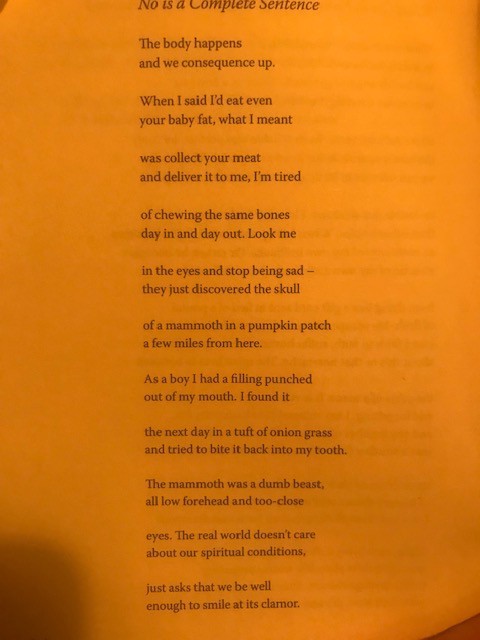
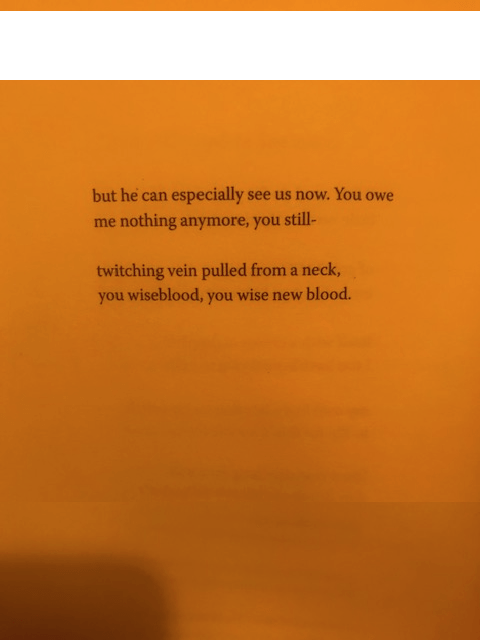
 Here’s the poem that above is from, No is a complete sentence:


Naturally, the book is filled with lines that will haunt me until I plagiarise them in a draft: “it’s been January for months in both directions” and “look under the bandages — and entire saint!” stand out, along with the long loved motto “here I am dying at an average pace”. Not to get to excited, but this is the kind of thing we come to poetry for often — the utility of expressing something we have experienced in word that are new. Turning language it’s its proper purpose of letting us experience the world, rather than just recording it.


It’s not really a sport that I enjoy, or can even stomach watching for the most part, but this documentary, Fighting in the Age of Loneliness, presented my Chapo Trap House favourite, Felix, is excellent.
 
 The documentary is kind of like having someone read a wikipedia article to you, but with occasional images of incredible human destruction. Felix joins together the history of MMA to the atomisation of culture over the last 50 years, the rise of the global right and US imperialism to powerful effect.
 
 You know when you get cornered at a party with someone who only wants to talk about their one subject? Imagine that, but instead it blossoms out into an impossibly wide ranging worldview that is deeply entertaining and enriching.


This is a powerful grief essay that uses its whole body. Probably not one if you’ve been having a cry at Christmas pop songs.


This week’s jam, in classic festive style, is a mix titled: Swedish Death Candy
 
 It’s exactly what you expect and is very good. Merry Christmas :)


Thanks for reading ETTO. I’ve had time to write this one, which has been a joy. I’ve seen quite a few lovely people today for the last time for a little while. May your heart be filled with mine pie filling and your veins pumping langourusly with brand butter, for the next week anyway. This is Disappointment. Borja. And there’s Hiromi’s recent work. It’s only a few sleeps to christmas, but I am not sure if I am as excited as these terribily excited chaps. I have been working through this with a buddy over the last few years, and it’s one of the best hallways I have ever played. We have still yet to complete it, but we think we’re nearly there. The world record speedrun for it is 10 minutes long. Fuck you. I helped edit this, it will be a real thing in London. I have a poem out in Human Repair Kit on the 22nd of December, which might be tomorrow depending when you are reading this. It’s about fish diseases, more or less. Our lovely Sammy had some word out this week too, which you’ll have to Ctrl+F for because it’s one of those “here’s everything all at once” kind of online magazine. If I don’t see you before, please enjoy Christmas and become so fat that you become a perfect sphere.

In a Jumble

Etch To Their Own

I’m a little late this week, I’ll blame that on the season. Here’s a few things I enjoyed this week.


Paige Lewis has a slice of her longer poem in Poetry this week. It covers the story of Yael, a classic revengeful woman in Jewish storytelling who brings an enemy into her tent to lull into a stupor before driving nails into his head as he sleeps.


The poem follows the lines of the original story, but its presentation of Yael as a woman with internality and conflict within herself bring answer, more modern dimensions to the story.

The style remains poetic in prose, which is what you’d expect from Paige at this point — an ability to zoom in to different parts of a scene one after another and give each moment its equal importance.


This weird poetry-on-a-train thing (poets love trains don’t they?) features a small slice of Rosebud Ben-Oni amongst other very good poets. It seems quite jolly, but obviously wouldn’t work on the misery of UK public transport.


I enjoyed this Jericho Brown poem, Duplex, for the balancing of each side of each coupled line.


A classic balancing of this is and it isn’t, all at once.


Song of the week is this really exceptional cover of The Smiths This Charming Man by a Japanese Reggae/Ska band called The Swing Easy Orchestra. It sent me on a funny little Smiths tour, and apparently I remember all the words.


I thought to myself after buying this issue of Poetry that £3 for a Paige Lewis poem is excellent value for money. I have gone almost completely deaf, I will make amends. Unrelated to writing, really, but these buildings of the future need our love. I think it is difficult to always see how good things are from the inside, but then there’s usually room to make them a little better.

Bottled G

Etch To Their Own

Bottled Goods by Sophie Van Llewyn is a “novella in flash” about life under the watchful eye of the secret police in communist Romania.

Last week I shared Sophie’ article on the “novel in flash” as a form. I’m not completely convinced that it is an entirely different form from say, a novella that happens to be slightly experimental throughout. Yes, each section could be read as its own flash fiction, but I think that applies to a great deal of novels anyway. Cut up almost anything and you could have flash fiction

It’s a lovely, slight, book as you’d expect. And it rattles along because many chapters switch form or perspective from the last. We have lists, chapters where the title is longer than the body of the text, a table, quotes with commentary, diary entries and times countdowns.

Here’s an example:


It has the filmic quality of most modernist novels that flick between the formal stations without a flash of static between. There are some quite normal chapters, where the changes are simple switching of perspectives, or something spoken from a different character from the protagonist.

Later, a magical realist twist is very pleasing. I won’t spoil it, because it’s a lovely turn in the book.

One of the main conflicts is between Alina and er mother, and the way that the mother does not approve of the life that Alina had chosen for herself, including her husband, who is from a much poorer family. A class struggle exists within the confines of the communist theatre — which is what the location of many of the events feels like. Everything everyone does in this worlds is in reference ot the secret police, to the favours and pardons that are required at all levels to get what they want.

I feel in a lot of ways this could be read alongside another short book, Omon Ra — which is about the way in which the soviet’s believed that even if they were faking a moon landing, there should be an amount of effort expended somewhere to ensure that there is a kind of balance. The soviet idea that everything must be accounted for somewhere. In this story Omon Ra becomes a cosmonaut in everything but reality.

Something similar is happening here, in Bottled Goods, there is a sense of everything being bargained for. Whether that’s the mother’s love for the daughter with mismatched eyes or the secret service for safety.

This is the sense of there being no objective reality in these worlds — because the truth can simply be changed at any time by the government. Like the chapters and scenes themselves, their format is entirely changeable in a moment — there is a cat and mouse with reality and the state — trying to avoid being caught out and trying to avoid the reality they are trapped in. And you certainly don’t want to have an accident witht he cat.

You can pick up Bottled Goods from Fairlight Books


Thanks for reading Etch To Their Own. We’re into our third digit. We’re two away from and hand’s worth. I’m very pleased to have come this far with it — nearly two years later we have a nice little community of people who don’t mind my typos so much. This is one of the things I do to try and keep myself human, and for keeping me human, I thank you. This weekend I am wandering around looking at sculptures in Yorkshire, where they keep many of them in a kind of sculpture prison. This stops them wandering on to motorways and causing traffic jams, or into libraries and making too much noise. It means a great deal to me that you’ve ever read a word I have written down, in the order I put them in ❤

New Flash

Etch To Their Own

Enjoy this little flash, Crazy Bears published by the always wonderful Spelk Fiction, by Kapka Nilan.


It’s easy to see how this story could spin out into everything else. I think that’s what I like most about flash fiction, the suggestion that there is more — a connecting cosmos of people, feeling and moment. Here we are helped with the idea of travel and sense of not having a home — a doctor with desires to always move on whose child always gets bruised.


I have three poems out in Bone & Ink right now. Another Essay, a poem which uses the “pick interesting things from a book and then build out a poem from the scraps” methodology on a really charming/trashy book called Torture Throughout The Ages, and a very light bit of verse which embarrassingly I feel does a “wot if nature woz an iPhone tho?” thing.
 
 You can read these poems over here.
 
 I am very resistant to mentions of technology or brands in my poetry. It might be because it cheapens it in some ways. Other people seem to like it. I mentioned an iPhone once over here, which was, I suppose, really, me just borrowing a line from Ariel Pink’s Picture Me Gone.

“I left my body down in Mexico / Give the find my iPhone app a try”

But even in homage/parody/whatever I am resistant to it, it feels like the breaking of a spell. Not sure what kind of “purity” I am looking for here, but I think I am resisting a fixed point in time — as if the text is meant to last forever, remaining fresh.


This article, about the idea of novels in flash, is extremely good at exploring the form.
 
 The form is described as a series of flash fictions that create an overarching theme/story while also being consumable as separate flash pieces.
 
 David Mitchell once discussed how he was planning to make Slade House a series of 100 short chapters (or was it 1000?). I feel this is similar, the idea of micro-stories building up to a whole.
 
 Part of me thinks of the idea of NiF as a genre that didn’t need inventing, or wouldn’t need inventing if there wasn’t a strange distrust of short novels or novellas. Short, experimental work that uses a mixture of forms exists all over the place, but little identifies as NiF in the way Bottled Goods does. I’m looking forward to how standalone each piece could be, as it appeals to the intertextuality and networking I love the most about my favourite writers.


This week’s song is a really good mix by Jimmy Munoz, titled: A 4 G 3 L 0 Mix
 
 It’s full of low grooves and R&B stuff. I got quite a lot done while listening to it.


Thanks for reading Etch To Their Own. Next week is issue #100 and I have nothing planned for you at all, much like the Dalmatians, it’s possible the 101 one will be the miraculous one. I’m finally reading Kaveh Akbar’s Calling A Wolf A Wolf and it is exactly as good as I was hoping. We need some new conventions, naming conventions for files containing poetry. Sam’s Visual Verse poem has appeared which is fun to compare with mine and the others for the similarities that arise from starting from the same image — creases, folds, and a sense of home.