I’m reading Jane Smiley’s 13 Ways Of Looking At The Novelat the moment. It’s a reinvigorating read and reassures you of all the things your novel can be, or not be, in the same way Pinker’s Better Angels Of Our Nature can be used to remind yourself that the human race isn’t all that bad — compared to our previous exploits at least.
Smiley’s book wanders a course through 100 novels, plucking at the variety of methods the novel employs to create it’s unique form. It reaffirms the internal, psychological and ultimately transgressive effect of the novel. It reminds you that, when someone does pick up your novel and let your army of ideas through the gates, it’s your responsibility to do the best with your opportunity — whether that’s to ransack and burn, or a peaceful transfer of power over to your governance.
Writing of peaceful transitions of government, reminds me of the excellent Poems for the Resistance newsletter. Every day you will receive a poem of resistance, and a little of its historical context. As the newsletter claims: “A poem as keeps fascism at bay.”
If you’re the one being invaded, how do you work out whether you’re being a good host or not? What is the etiquette? My favourite of Jane Smiley’s is The Sagas of The Icelanders — which all fans of Vikings should own — and contains an interesting peek at hosts, and how to deal with a bad one.
In Egil’s saga, he and his party are at the hall of another noble, Armod. Now, when you’re told to drink in Viking culture, you drink, especially when there is a toast. Armod’s man, who was entrusted with looking after Egil and his companions, made many toasts to them, asking them to finish their horn every time. Egil, realising that the host was trying to poison them with too much drink, instructed his men to stop drinking, and took theirs instead. Naturally, being the giant of a man that he was, Egil carried on for a few rounds — but when it became too much, Egil stood and walked over to his host, Armod. Egil grabs Armod and shoves him against a post, holding him there — and then proceeds to vomit a torrent on to him, filling Armods nostrils, mouth, eyes, and pouring like a river down his beard.*
So, we know what to do when a host makes us want to vomit under the guise of good cheer or well meaning, don’t we?
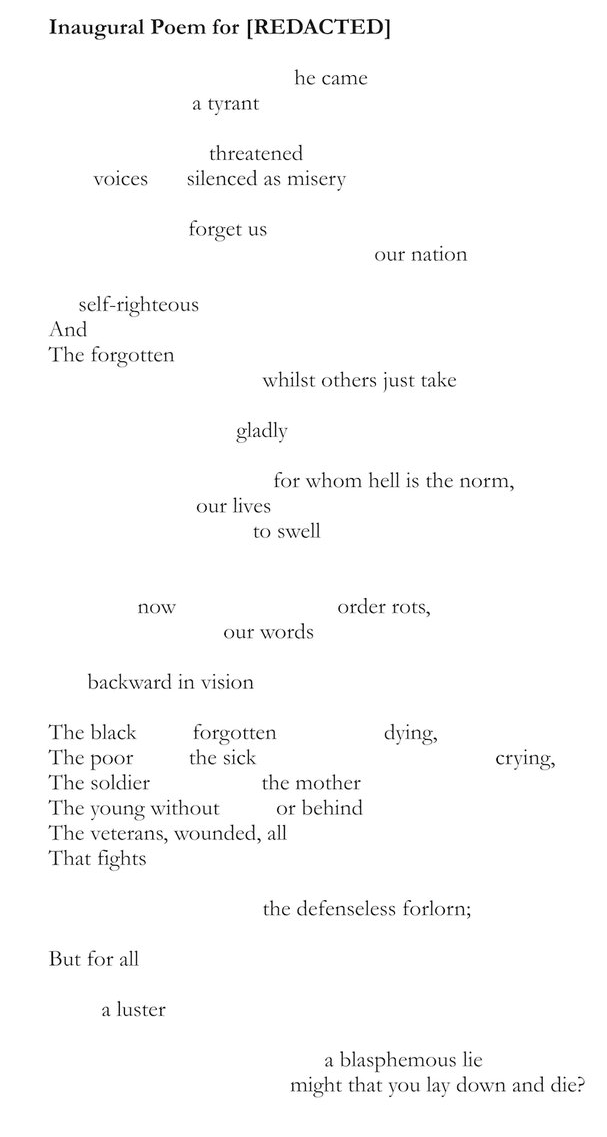
Jack Spicer, SPORTING LIFE:
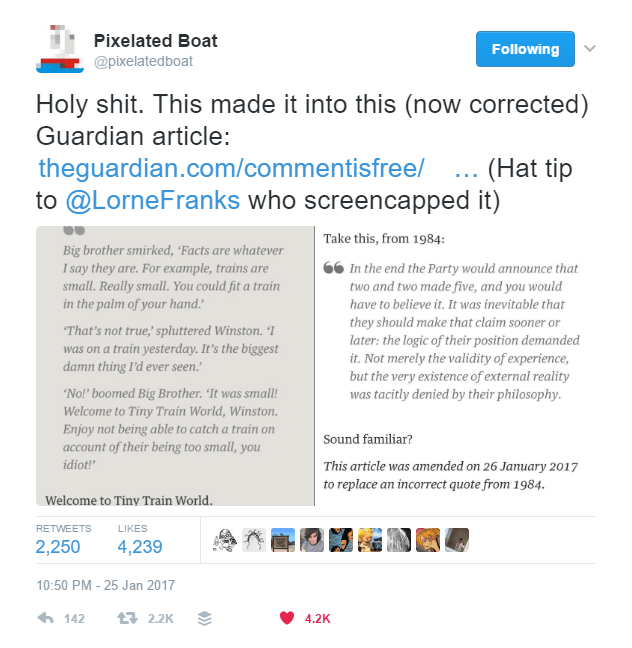
I don’t think I need to say much about the above, but, to carefully nestle this next to something else with a hit of media confusion, and George Orwell, here’s this absolute joy of a cock-up from the Grauniad:
*As an aside, it’s worth noting that Egil has as bit of to-do with the host’s men, who claim he has performed shamefully. Egil points out that Armod is vomiting, and he is just following the rules of the house. After that, he goes and sits back down and asks for more drink, and composes this jolly verse loud enough for all to hear:
Thanks for reading this week’s Etch To Their Own (issue #3). Etch To Their Own is written by @CJEggett and edited by no one. Please get in touch — I’d be really happy to hear about the cool thing you’re doing! I’d be grateful if you pointed out any typos. And I’d be born underwater if it wasn’t for the Dutch.
I’ve enjoyed this Smell which appeared on the occasionally excellent Spelk. Which is one of the places I thought I remembered reading a poem by a poet who wrote about violent sexual practice, bdsm, and powerplay. The poem explored it in a clever, concealed way — in a way that reminds me of that Neutral Milk Hotel song Communist Daughter.
Which means, if you run a slightly out-there poetry blog/magazine — you’ve probably seen in your search analytics someone searching for the word “fist” on your website. That was probably me, in my search for these poems.
The thing with poetry, and these poems in particular, is that I might not even be identifying the right keyword to be searching. Sure, one of the poems of three was definitely about fisting, but did it ever say the word “fist”? You’ll never find a poem again online unless you archive it somehow — but how do you know you want it until it haunts you weeks later?
All of these things blend sexuality with a kind of grief, sense of death, and so on. Lay back and think of brexit etc.
In the dark ages, when I was still at university, my dissertation was “A Sense Of Loss In The Pisan Cantos” (by our bestie Ezra Pound). Here he spent many lines bashed out in the DTC in Pisa lamenting the death of fascism in Italy — which is a morally interesting because as someone picking apart those feeling, you soon find that they are legitimate. You can grieve for the death of a concept, even if it’s functionally evil, and as a student pulling apart the lines, you can’t help but share a little of the sadness. Not because it’s something you’d liked to have kept alive, but because you can feel a man’s sadness as true.
Thanks for reading Etch To Their Own #2. You made it to the end, and that feels like a triumph these days. @ me, email me from where you’re standing using your blackberry or palm OS device, or add me to the shortlist for your doomsday bunker seal-up party group on ello.
I finally managed to get to the poetry bookshop in Hay over the Christmas break. I’d tried before, always arriving when it was closed — or rather — when it wasn’t meant to be open anyway. This time however, I was lucky enough to get in and work my way around the various section of the shop — in the relative silence of it.
I joked about the silence with the proprietor. It was funny, we thought, that the art of the oral tradition would inspire such tombly quiet for the average visitor.
Not that the visitors were average, they should be people interested in poetry, so should be a little bit strange. You’d expect them to kick the tyres and try reading out loud, a test drive of the verse. That doesn’t go on very much, apparently.
They’d not managed or bothered to do many reading, despite the festival — because it’s not a literature festival, it’s a book festival. And it happens in a field, miles away, so the Hay festival was in fact not really in Hay at all.
I asked if there was any Anne Carson hidden away. It seems she doesn’t hang around when they have her in. And, really, a second hand book shop — which relies on the cycle of wanting and unwanting of books — is defined as much by what it doesn’t have as what it does.
A really well trodden second hand bookshop should probably only contain the worst books — between replenishings donated through death and the shame of illiterate children.
“The people who pick up Anne Carson seem not not be letting her go.” Which is clearly the right sort of book to write, I know I won’t be giving away my copies of her work — but then, I don’t give anything away.
And, as Anne Carson has been teaching me in the The Economy Of The Unlost, giving is about putting yourself in debt, so an equal debt can be returned by the other person. Exchange for money unmoors us from the social bonds traditionally fostered through gift giving and exchange.
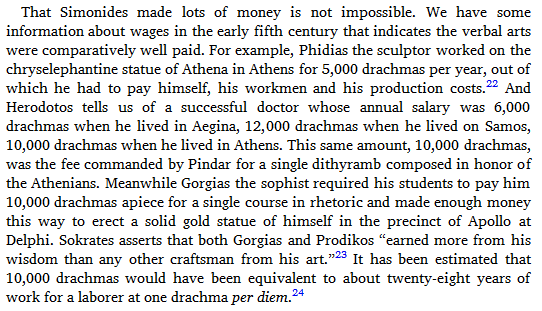
Hey. Remember when poets were paid as much as Doctors?
It makes sense in a world where Doctor’s aren’t going to prolong your life, making sure people remember you in verse for a little while after you’re gone may have a higher value.
Let me know if you need an ode, elegy, or just a quick couplet off the cuff. My rates are reasonable and may be covered by your health insurance.
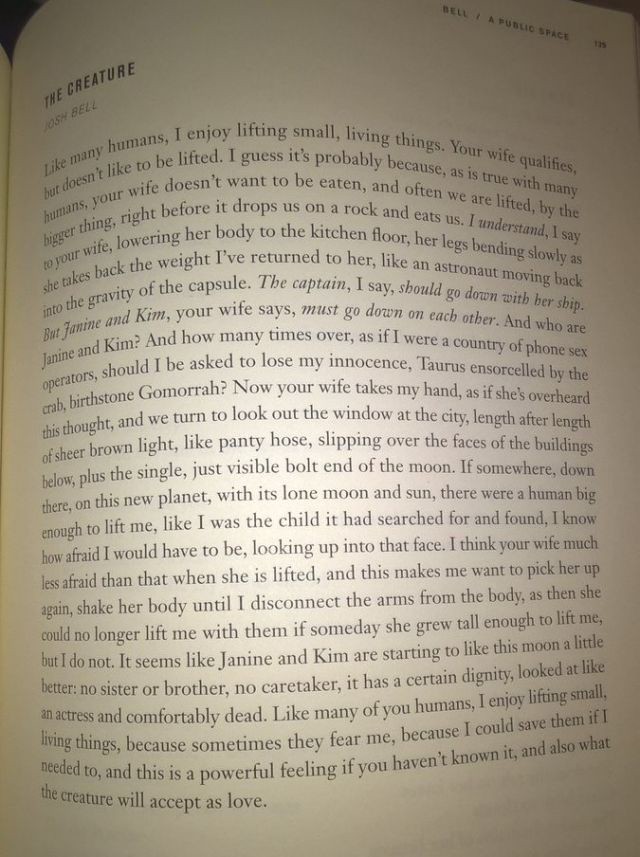
I have recently subscribed to A Public Space, and it’s wonderful, as this is, especially:
Thanks for reading issue #1 of Etch To Their Own and, more importantly, getting all the way down here. This email is written by @CJEggett and proofed by no one. I’d love to hear from you — even if it’s only to correct my spelling — @ me, reply to this, or rope me in to your ARG, secretly.
2018 Edit: I am not sure what happened to this fun little poetry magazine. As I can’t seem to find it online anywhere “proper” for the moment, here is my poem as they published it:
lit.cat is a small, scroll-able magazine which promises under 30 minutes of flash fiction, poetry, word jumbles, and other such jolly collections of words in orders.
It was originally written for Synesthesia Magazine for some completely forgotten contest or theme. This might explain why it’s quite concerned with texture, feeling, senses (and all that). I don’t remember whether it got submitted or not!
Anyway, I am glad it found its way somewhere.
UPDATE: Lit.Cat has just been redesigned, and is worth having a secondary poke around. The archive is especially good, as it includes my favourite metric for online words: reading time. My piece can also be reached, all by itself, over here.
This is a very strange way to recommend you some books
How do you feel about good words? Spread out on a page, arranged as a perfect length of rope to make a map, a knot, a snare for your heel to drag you along?
I sometimes explain how I feel about poetry by saying that, after reading something good, the top of my head (on the inside) would bubble and fizz, as if everything was working harder; as if it were hotter in there. Were the top of my brain a lake, it would be bubbling up dead carp by now — fat heavy things flaking in the roiling heat. Emily Dickinson said the same thing, a bit earlier:
If I read a book and it makes my whole body so cold no fire can warm me, I know that is poetry. If I feel physically as if the top of my head were taken off, I know that is poetry. These are the only ways I know it. Is there any other way?
Emily Dickinson
Very close, I think. A big build up of energy, a click, a cool sense of space left afterwards. It’s a violent idea — one where you’re not in control — or rather, where someone else is guiding your thoughts places they wouldn’t normally go to.
And as Emily asks, is there any other way to know it?
I think this is the taste I am always trying to track down when cracking a spine. But where can one find this kind of literary treepanning and pressurecooking?
I’d like to take a little bit of time to explore what I like about some of my favourite writers — the ones who do remove the top of my head each time I read them, or present a burning map, or make me feel like I am having a long sip of hot tar.
Reading Yourself Free
What I like most, what gives me the biggest buzz, a kind of internal shining crown in the skull — its leaves and arches pointing in — is best explained as a kind of jolly classicism, an integration of a grand system into another, through fragmented views and narration.
And this set of ideas hangs around in doorways at parties thrown by modernism and post-modernism.
Like a lot of people, I read for myself a lot when I was younger because it seemed to arm me against the world — and taught me how to connect ideas through context. You could learn things through reading fiction which were broadly true, if specifically lies.
Before then I read a lot of books about dragons being a nuisance to the locality, and some high fantasy nonsense. But I already knew that I was looking for something that felt more free. I didn’t have the vocabulary to talk about playing with form, but that was the kind of story I wanted to write.
My first real experience of this was when, at a more tender age, I bought Number 9 Dream by David Mitchell from a Virgin Music Store. I bought it based on nothing other than the fact I had to try to find something that wasn’t a classic or school taught, and couldn’t be a dull holiday novel.
It was perfect — it had a non linear structure, it played with form and it was referential to some things I vaguely understood; John Lennon, Tokyo — and thing I did understand: computer games, being a young confused man desperate to be in love, flights of fantasy.
It was probably the first time I bumped into magical realism (the narrative acceptance of magic and the fantastic without comment). This was ideal for someone who has thought of their fantasy habit as a little bit dirty, not because of the content, but because of the rigid set of expectations within it. Fantasy writing always felt like someone standing up very straight and using the right cutlery, while dressed as a furby.
And it was modern.
Again, not that I knew what modern writing really was. Clearly they were great because they were of a world which was worth exploring.
I Want To See All Of It, From Blossom To Root-tip
Readers often confirm that they desire what I often did, as a TV-watching child: wanting to know what the other characters were doing while off-screen. You knew it would be boring, but you wanted to be able to experience the wholeness of a TV show, or film. You wanted the rest of the world these character existed within.
This kind of demand for the wholeness of a world might come from playing videogames and accepting them as a legitimate medium. The promise in (many) games is that you can experience a whole space/narrative entirely under your own terms. Obviously you experience broken version of complete world more than not — and while you can turn your back on the narrative, it’s rare for a game to present you with anything as equally as interesting.
This sense of choice creates a taste for the “what if?”and the unlikely voyeurism that is often presented in modern texts. When a writer or poet re-imagines a known, shared text or reference, you get the opportunity to peek at Hercules between scenes.
So with classics we get the footnotes — and it’s even better if the source is working on something shared in the first place. The Divine Comedy for example, is a structure and system of hell presented in Inferno (a shared set of ideas being formed into a novel physical structure), which then has editorial footnotes sprinkled on top to aid the modern reader. It’s a kind of elegant greenhouse surrounding a narrative which explains another architecture inside.
And in the modern novel, like Number9Dreamyou’re introduced to our hero, building his courage up to approach a lawyer to find out who his father is, and imagining different scenarios. You’re treated to all of the different versions of his daydreams — including: death by freak flood, meeting his father within a videogame, and even success. Later, you find yourself in the house of a short story writer — and you’re not just told this, you’re treated to the warm up stories that she writes before getting to her real work — there’s a goat character who keep eating the stories within, a little like the way each minor diversion in the novel nibbles at its surrounding to inform it’s own architecture.
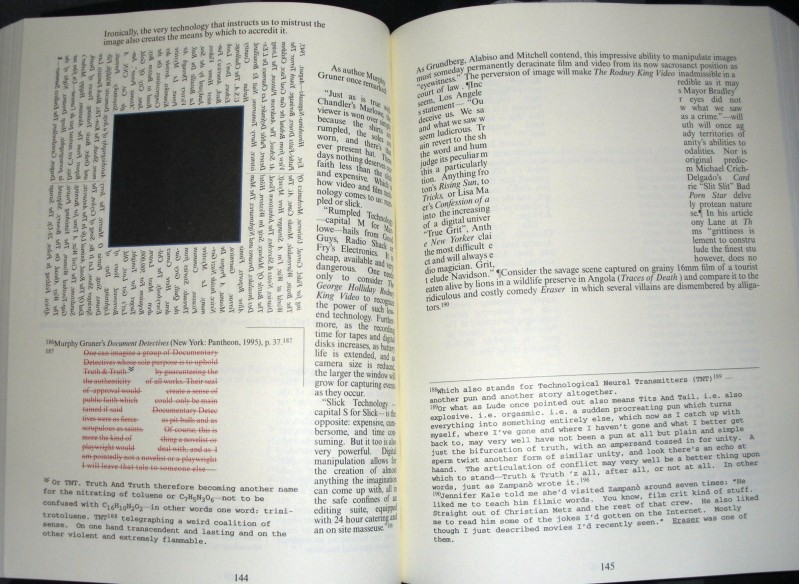
Speaking of architecture, in House of Leaves, by Mark Z. Danielewski, you’ll find a storm of footnotes, narratives within narratives, essays crossed out, appendices and cross-referenced ideas which blend between each formal delivery method. House of Leaves is a wonderful example of a book which wants a little bit more from you as the reader — while also playing notes from songs we all know. The way the notes on Midas/the Minotaur (struck through if I remember correctly) mirror the Navidson Records, and a father doing something drastic to hide his shame, which then gestates in the pool of Truant’s own familial issues. This is a great example of a linking of hands between Greek myth and Freud, with a shift in narrative position between allowing both to exist happily.
1908 and News That Stays News
In 1908 Ezra Pound turned up in London and gave the British their modernist movement. The outcome was, in part, T. S. Eliot’s The Waste Land and Pound’s TheCantos — both are world-nearly-complete poems which gives me lots of roots to scratch my nails between.
Let me describe Ezra Pound’s TheCantos to you as I have always seen it (no, please don’t leave, I won’t take long). The Cantos is a kind of great work of abstract stained glass — each canto it’s own piece in it’s own right, but part of a great system. You shine a light through the first and see what you see, and then you place the second canto behind it — this change not only the canto you’re reading but the canto you read, and the overall tone of the piece. Then you add a third. You continue to do this and the image gets more complex — and the light you need to shine through it has a need to become brighter and brighter… Which naturally you can’t apply all at once
This is the complex arrangement of fragments — sometimes lifted and borrowed fragments — is translated in front of you. Not only within the poem in individual lines, but your understanding from one canto to the next.
Because Pound seemed to be recording what could be described as a kind of cultural canon into this great epic poem, and much of it being translation and odd history lessons, you get this fragmented view of a particular kind system being built. Simultaneously this is a massive number of voices, but in it’s curation, composition and cutting together, contains his view of the world.
The Waste Land on the other hand is more free with it’s presentation of voice and fragments in one sense — and anxious in it’s peppering of footnotes in the other. Where Pound translates for us — directly after the foreign language line — Eliot leaves us with original. Knowing that Pound had a hand in the implementation of some of the footnotes asks us why he thought his work was so different.
Pound talked about poetry and literature being “news that stays news” — the idea that there is some ultimate truths expressed in the good stuff.
Anne Carson and The Desert Of After Proust
The kind of news which stays news is those big meta-narratives we all know and endure. Whether it’s Odysseus’s boat trip, Hercules’ to-do list, or folk stories closer to home — the seven swans of Fenland folklore for example — there’s always room to retell them in new colours, clothes, locations.
Anne Carson is one of them. Between Red > Doc and Autobiography of Red, I’m in love with all her modernist, post-modernist, classicist wandering. Carson pursues smaller gaps than Eliot or Pound, and gives you a lot more texture for it in her stitches.
Tell me a meta-narrative any time, and then make is specific — and I’m yours.
In both Red Doc>and Autobiography of RedCarson is exploring the story of a red monster boy known as Geryon. In Autobiography Geryon is coming to terms with his sexuality, and the heartbreak which follows after falling in love with cool boy Herakles. Red Doc is a later life experience of regret — two old bachelors — one renamed as Sad with his PSTD and the other as G. They take a road trip to check themselves into a psychiatric ward.
Retelling Hercules’ trials as a broken love story is the perfect example of taking something we know and then reworking it into something joyfully specific. We accept as a kind of trunk narrative that we can build from in all our storytelling, and the specific give us our texture and flavour against the grain. It give you an appreciation of the shared knowledge, the known story, which provides the undercutting sadness, as you know how it has to go — in this context.
So this is how I get that buzz from reading — it’s the fact I have multiple things to play with within the writing I am consuming, all at once.
“Prose is a house, poetry a man in flames running quite fast through it.” *
I suppose, what I’m really saying is that the stuff I really like is the stuff that makes you want to go write some words about it.
Anne Carson also talks about that feeling of finishing something good, in her case Proust, and casting about for your next fix, coming up cold, and then trying to find a way to prolong the experience of the work. This is the experience of being lost in The Desert Of After Proust:
This is why we’re here. You’re reading this because I wrote something while wandering my own Desert After Carson.
Reworking, Relayering, Translating Your Own Language
Re-layering and re-working of meaning through shared understanding is more or less what language is about. It’s the place where we can make commerce without having to meet each other entirely. Language is the neutral ground for trading of ideas and intent.
But you can re-layer and re-work meaning in a way which changes the context of something previously understood to mean something else.
Ben Marcus provides this kind of re-layering of concepts. For example, in The Age Of Wire And String — Marcus has the goal of reworking a concept into another through a tight expression of language and withholding of certain information. He show us that language is somewhat immutable/impossible to consider untrue as, while it’s something we strive to understand, it is also the tool we use for our understanding.
We are so used to the conventions of language, so ready for it to explain the truth of a situation, that we allow it to fictionalise another, existing concept.
Where Pound and Eliot made for connecting the existing parchments, the leftovers, Carson and Marcus both rewrite with their own language.
We accept that all thing can be all other things at once, because we accept that perspectives are changeable or multiple.
David Ohle — author of Motorman — runs the same game of changing language through forcefully constructing an understanding around the nouns and verbs of his world. In Motorman we join our hero on a Kafkaesque journey to escape his “home” and make it to somewhere more idyllic. It’s hard to explain the joys in it, but it has an attention to detail that is consistent in it’s weirdness. Usually, you would expect writing that spends time talking about the feeling in individual muscles of the body to be ponderous — but because this kind of writing in the novel is structured, and leans so well on itself, it becomes the way we view the world of the book. It’s much like watching someone build something before your eyes that you think might be a house, but ends up being a dog. You’re sure that you watched them write in the bathrooms and the kitchen, but no, it turns out to be a dog standing before you, wagging it’s tail.
C A Conrad creates systems for his somatic poetry (poetry created through physical exercises and rituals in combination with filter words), and a whole world in The Book Of Frank. In Frank the abused hero wanders through his childhood horrors and into a kind of peace of adulthood and draws in themes from and against Freud repeatedly — starting from the opening where Frank’s father asks where his daughter’s cunt is — and Frank’s expectations towards his masculinity are set in motion. This is explored throughout the multi-part poem where his envy of females is a central exploration.
In Conrad’s A Beautiful Marsupial Afternoon we are treated to the outcomes of his somatic poetic exercises. Because we know the structure with which he’s approaching the writing of these poems there’s a great pleasure in tracing back the immediate sensations and feelings to the ones which may have been felt during the exercises themselves.
Setting the rules
All of these writers spend time within their works setting out the rules within which it is interpreted. Whether that’s something discovered within the text, or through the implementation of another, separate text or story, we can be sure that there’s something for us to measure our understanding against — and compare our expectations to.
Recommend Me Some Books
The best poetry for me is the one which is very loud in my head. As much as I know poetry must be read aloud to be understood and heard — the poems I love are simply the loudest inside my skull, even when they’re sitting on the page sensibly. Some kind of fire map: a clarity of a system which seems to burn bright and hot, wild data over a known shape which is supposed to inform you.
And I suppose, all of this is a very long winded way to ask for book recommendations! Know anything I should have read by now? I’d like to expand this ramble into something even more rambling, so comment your recommendations at me!
You know it’s a good meal when you’ve been thinking about it all week and, when you finally get round to eating it, you’re still excited about the prospect of it.
This non-dissipation of excitement must be the perfect version of any meal.
We sat in the perfectly adequate sushi restaurant in Oxfordshire and, while polishing off the first round of dragon rolls, spicy tuna maki, spider rolls and grilled eel nigiri, T swings his head sideways round to me and says:
I am no less excited about sushi now that I am eating it
Which is surely the definition of food bliss?
I’d spent all week watching interviews with sushi chefs, tours of very nice sushi bars, and sushi making demonstrations on YouTube. If you’ve decided to write a novel in which a character has this profession, it’s your first port of call.
Watching serious, dedicated people cut up beautiful flesh into lovely sliver’d jewels builds up an appetite.
It’s rare for a food craving to be sustained through the process of eating the food. Usually, when you crave a burger — or fish-sauce marinated chicken with sriracha, mayo and shredded lettuce in a brioche (for example) — you’re met with the slight disappointment of feeling gross, guilty or lazy afterwards.
But maybe because I’m old and now crave fresh, clean things — and sushi doesn’t slow you down at all — you only feel your love for it grow during the meal.
We carried on to the next round — grilled eel temaki, tuna sashimi, tobiko, omlette, a rainbow roll — and the joy didn’t leave. We took some home too. To eat in the garden, in the sun, with a cold beer and the bubbling, chaotic noises of families in other gardens arguing about starting the barbeque breaching over the gently rustling hedge-tops.
In the future we will all be 80% cyborg, which means the remaining twenty percent human in the mix will be a tongue that lives in an amazing kitchen appliance.
I guess you might also be a mouth of sorts too — some kind of sensory area for experiencing textures and heat. Maybe you’d have some kind of teeth, but probably not.
Your robot body would be the perfect replacement in many ways, except the senses which are hard to give up — it’s fine to replace the bones, but not the flesh, not everywhere at least. Rather than needing to cook and eat your own food, you’d simply provide the ingredients, and the mechanisms in your new body would do all the work for you, providing your taste-buds with Michelin star food, for a body which barely needs it.
“Wouldn’t it be better if we all just ran everywhere.” I said.
RunWorld changed everything. Giving you the chance to build up healthcare credits by doing (and tracking) activities. Stay healthy and strong, and you can stay healthy and strong in your old age too.
Everyone is running all the time, and it’s great.
I wouldn’t say I ushered in the world of private healthcare, and the gamification of almost every aspect of our lives. It’s more like I was excited about the opportunity to run more.
The high-street is a world of lycra and running backpacks. Between shops we trot at a pace considerate to those around us. We take filter lanes into shops where we slow down to a walk, for browsing. We’re not savages after all.
The world is better place, tourists flock through old street soaking in history at speed while enjoying their own dopamine, we all rush across beautiful countryside because you can get more views in that way.
We live further away from things, but not driving distance, because we all know we want to run to the pub, and back. Not that we go to the pub to drink that much, as we all only have so many credits to spare, and naturally, these things are all connected.
At work, I walk or jog, on my treadmill desk — as does the developer I’m working with. The designer needs to sit down to do their job — a risk we’re all painfully aware of every time we ask her to do some revisions. But then, this is why she gets paid more — it’s the danger money of having to sit down, when instead you could be earning a trickle credits for your old age while you work.
Like most, I’ve been thinking about getting a new job, one that’s more active, and can let me accrue more healthcare credits as I go. When I was a boy my father wanted me to get away from the manual work he had done all his life. How blissfully he would have lived these days.
It’s not all good of course. There’s those who can’t quite manage, through some illness, disease or other genetic failure that the parent themselves failed to prevent through their own genetic grooming and pairing in. These people are a burden to their families. It’s like single mothers, who, nearly straight out of childbirth, ave to start running to keep their newborn alive — but they have to spend tokens while they do this.
That’s the weird thing, the way the healthcare tokens tick down for the treatment these people need — when you see a young carer running marathon after marathon, producing their own problems for old age while racking up healthcare tokens to keep their charge alive and well, you wonder if this really is the best way to do it.
Dystopian Futures I Wouldn’t Mind At Allis a series about worrying sci-fi futures that I could probably come to peace with in some way.
I’ve tried to write this lots of time in lots of different forms — but it is what it is: I am writing this entirely for a young cousin who has expressed that she would like to get into writing, professionally. I tried to dress it up, but it didn’t get done — so here it is, undressed!
Note: I am an unsuccessful writer, except in the sense of commercial writing and editing. In these areas I am adequate, but paid! I am probably the worst kind of person to be writing this kind of advice. If you’re reading this, and you’re the better sort who ought to be writing this instead — please add comments as it would be very helpful!
What to do to start being a writer today
Get a Twitter account
Get a Medium.com account
Get a Tinyletteraccount (link to it from the bottom of all your articles)
Write a thing every day
Edit, publish, email, and Tweet it the next day.
Why do you need these accounts? Twitter is for distribution, talking to peers (other writers), and subjects. Medium is where you articles go. It looks nice, people are into it at the moment — you could do it anywhere, but medium.com is super quick and easy. Tinyletter is an email distribution platform, get people to sign up, and then send them your writing weekly, or whenever.
The important thing about all these platforms is that they provide you with a way to write publicly, and over time, build an audience who likes to read you.
This will make your life easier when you want to get paid!
But what do I write?
This is the fun bit! Try writing different sorts of things. Here’s some stuff to try writing:
use a pseudonym — something catchy and interesting that means you won’t be identified as you. You can then write happily about anything without worrying about your family, friends, or (importantly) subjects reading it and getting you in trouble
“isn’t this the opposite of what you do though?” — yes, but I am protected by a powerful deterrent of being not very interesting, and also coming from a time when we all thought we could all really live online. We couldn’t, it was a rubbish idea.
don’t feed the trolls — and there will be some.
Getting Better
Practice forever, read lots, talk to other people writing, who you admire. Understand all the different kinds of writing out there, and how to do them. Practice by satirising these types — and then do a serious one at some other point.
Read everything, and understand what is good about it. Most of getting better is practice + reading + understanding context + understanding value, and then copying, emulating and internalising those parts that you want to keep.
You’ll find a voice once you have a craft.
Advice from a short story writer
I asked my friend who is a published short-story writer lady. Here’s some things she said:
Read lots of books and online stories, join different writing groups and classes (all different ones if possible where there’s a mix of ages).
Practice loads. Get brave and share and get feedback (you don’t have to listen to it all but it’s interesting).
Send creative stuff off as much as possible (I don’t do this much) but the more you send the more likely you are to get published and build your writer’s CV even if you’re not paid for it (which you probably won’t be).
So that’s good!?
Getting Paid
Getting paid is a tricky part.
Currently, the way that websites make money is that they charge advertisers to advertise on their site, based on thousands of impressions (in advertising this is CPM, a site might charge £1CPM, so if you have a million impressions might make the site £1000).
But don’t worry, as writing online is always changing, so it will get worse or better — but certainly won’t be exactly like this forever.
It’s important you engage with the idea that writing can be a job you should get paid for, if you’re good at it. This means understanding a bit about the way the people paying you would make money from your words. You need an audience to have power in that relationship.
Unrelated, but I love the sadly-probably-dead Today In Tabs newsletter, which you can read online here. This is a good example of someone who eventually got paid through sponsorship of their newsletter (like, probably not that much, and they are an established writer, but it’s the thought that counts!)
And then…
There’s loads of places to go in writing, and you can move between things more easily once you have a reputation. You could become an editor and run a whole magazine or publication, or start your own, or write a novel or 12, or move into screen writing, or take the business writing route and make some money!
Which is all very exciting… but you probably need to get started now, right?







 C J EGGETT | Writer & Game Designer