Absent Motormen On Their Way Home

Etch To Their Own

This week has been dominated by a couple of re-readings of Motorman by David Ohle. Motorman is one of those books that really attempts to push against the boundaries of accepted language as a sort of political act. To resist by taking apart the safe language we use every day that acts as a confinement for thought, and making things a bit strange.

But there’s not all the much written about it, aside from the introduction to the 2008 edition by one of our besties, Ben Marcus, and a handful of blog posts scattered about the internet. I’d like to put together one of those “Reading…” style books where I can ramble on about the themes and notions in Ohle’s work. And put together a wicked index.

So far I’ve been re-reading and making lists on the language in the book. A list of foods eaten in this strange post-capitalist-ecological-mismanagement world (crickets, cherry-water, grubs, snipes, popcorn and on), and a list of ailments and surgical maladies faced by our hero, Molendenke (removed lung, 3 additional hearts, infested with slugs when the moons are up — and so on). The foods are almost invariably gross, except for those consumed for entertainment, or not as part of a meal and point to some colossal failure of farming. The maladies seem more of a psychological problem, a set of “improvements” for quantity over quality — safety over vitality.

Ohle explores the idea of freedom by “making-strange” as in, to experience actual liberation, one must be able to break the stale language we use ever day. Our hero suffers metaphorically, and literally, from the effects of stifling rules of language — and works within a society set up to reinforce the high walls keeping him away from freedom.


It’s #BloomsDay — that is to say, the day where we celebrate one of the trinity of Irish literature: Joyce. Joyce’ Ulysses takes place on a single day (16th June, today, of course) and gives us the lodestone of modernism. While enough has been said about Ulysses (so I won’t add any more) I do like Jane Smiley’s comments that there is a small industry around the work designed on helping us mortal get to grips with the depths of each and every reference.

Okay, one thing I like about Joyce and Ulysses, he went to Italy to write it. He left the city he was writing about to take part in an act of writing home. It’s something I think about a lot. Do you really have to be absent from a place, a person, to be able to write it?


Dear One Absent This Long While by Lisa Olstein
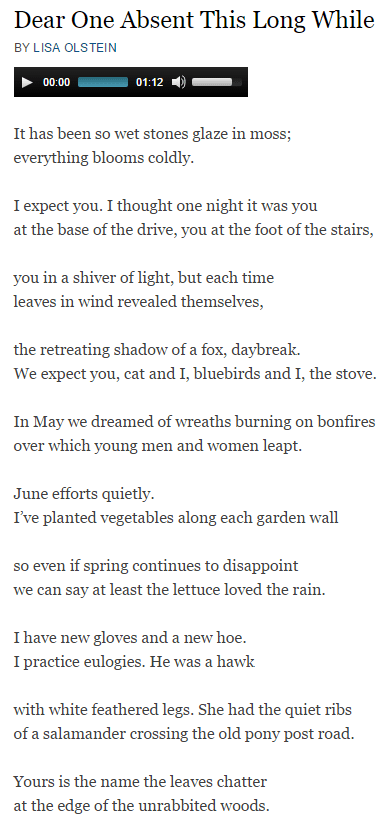

I have a bit of a softness in me for the re-articulated pastoral. The kind of things that would put me off usually, are nicely undercut — the companionship of animals undercut with the companionship of the stove and odd twists in the language like “June efforts quietly” and “unrabbited woods”.


Time Clare, renowned performance poet, writing advice purveyor (the last episode of his podcast is extremely something) and author, laid down this challenge for himself on twitter this week:
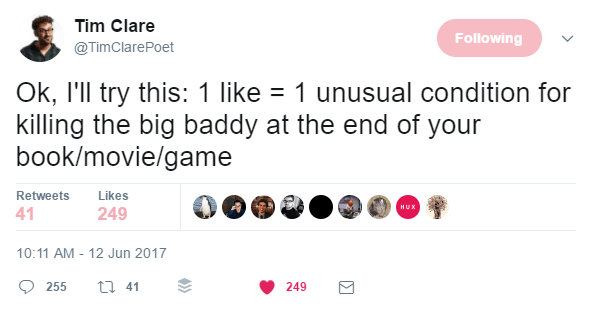

Some of the ideas are really excellent, others are promisingly silly. The thread is well worth your time and effor scrolling and liking.

Naturally, you should also like the initial tweet as it will encourage Tim to do a few more.


My dear friend Hannah Stevens has a short story in LossLit, and it is, as always, wonderful.


The following was kindly delivered to my inbox by Poems For The Resistance:


Today’s Song:


Com Truise — Propagation

There’s kind of a whole album of this here.


Thanks for reading this week’s Etch to their Own. There’s something in the water, and it’s probably in the beer too. Etch to their Own was written by @CJEggett and proofread over the shoulder in an old, filthy mirror. If you like what you’ve read, make sure you forward it on to someone who might enjoy it. A wise man once said. Did I tell you I am quitting my job to take up a slice of another business? It’s a good thing, and only filled with promise now that I have feeling in my skull again.

Owls & Hawks

Etch To Their Own

As always, when politics get in the way of people’s lives they become confused and stop talking about important things like poetry, and instead, pretend to have an opinion on boring an unimportant aspects of life, like economics and long term survival of the nation-state in which they reside.
 
But still, there has been a few pieces worth looking at this week, between the political seepages.


Owl is another great piece of writing published by Spelk. Taj Tanaka weaves us a flash fiction about the moral troubles of encountering a distressed animals, and the stories we tell ourselves to make it okay to withhold mercy.


There’s something really Murakami-like about the writing. That kind of gentle pinching at half mused-at threads, and then the snipping them into the relative whole of the piece. It’s that kind go writing that feels like a negotiation that writer is having with themselves.


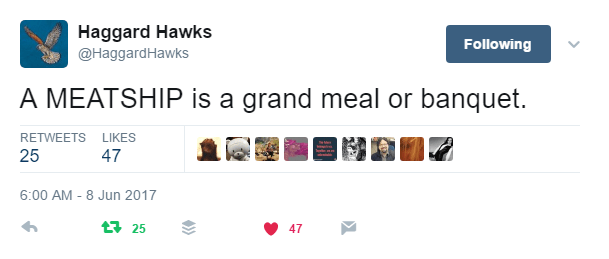
If you don’t already — please go and follow @HaggardHawks on twitter, and sign up to the newsletter. You’ll have your feed peppered with wonderful snips of language, such as:


My well-known fondness for found poems and other “constructed” poems is well known by now. This week I have a poem generated through picking out the best lines from someone’s Duolingo session! It’s called My Sister Goes To The Institute, and is probably best read on twitter on that link, but here’s the last panel:


Anne Carson, my living fave, might have a gender, or not, or several. This is an interesting little look at gender presentation in her work and life. As I have commented before, we can all follow Charlotte Shane’s fine words and start any discussion of Carson with:

“I love Anne Carson’s work dearly though I suspect I am too stupid for it”


Thanks for reading Etch To Their Own. As always, this was written by Christopher John Eggett and he is a scruffy as ever. Despite the fact there are plenty of people here, this newsletter remain unproofed. This weekend I am in Wales, near that bookshop that started all of it. Also, as I always like to say, please get in touch if you have anything you need to get off your chest and lodge into mine.

G H O S T C I T Y P R E S S

Etch To Their Own

(this is the online version of my poetry tinyletter, sign up to get it in your inbox)


This month Ghost City Press is giving away a chapbook every day, for whatever you would like to pay. It’s started already — but you can head over here to sign up for the rest of it. Also, there’s the 2016 Microchapbook Series available all at once — if several chapbooks a week isn’t enough for you.

I’d like to take a wander through YR YR by Matt Margo, Dream-Like Houses by Joyce Chong and A Dream You Have Not Had by Isbelle Davis. While there are many lovely things to come from this series, these already stand out as great collections in their own right.

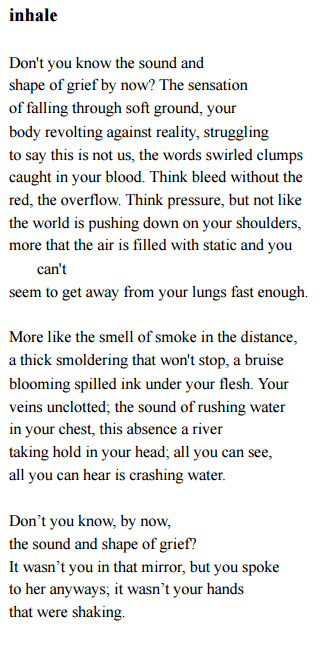
Dream-Like Houses has any number of lovely lines building out around the themes of the separated body, the definition of an abstract (grief, for example) through the making it strange (does grief sound of anything?).


(Of course it does)

And sets out the major theme of water, drowning, rivers and rapids, chlorine — things pool and drift and spill. If we were reading the collection like The Waste Land’s tarot, we would say that it presents us with change, new hope, renewal. Which is approached by Chong halfway through the collection in cliffside — a poem which starts with a violent drowning, giving way to “… You are drowning until you realise you can breathe …” before running through versions of moments not lived “In this version, you killed someone/something” and “in this iteration, you are trying desperately to fly”. All undercut in the end with another threat which still does not quite snuff out the hope, even if it snuffs out the versions.

A Dream You Have Not Had opens with The Dead Sea — although, the entire set of poems has less formal poetry about them, if more formality.


Isabelle Davis uses the form of contracts, definitions (dictionary or otherwise) — with their clauses and sub-clauses, and hierarchy of meanings to remove the narrative element from a poem. A little like Ben Marcus in Age of Wire and String or much of Anne Carson’s work, the idea is to present the lines in such a hierarchy that i. b belongs to b but not c. You can take a and c as equal facts, truths, or statements — but the sub-clause only belongs to its parent.

The collection runs the line of lovers and lakes that makes musing about where the sun sets over Lake Michigan (and “holy, holy, holy like my first kiss”) on par with the preparationry eulogy.

In YR YR by Matt Margo (apparently pronounced “your year”) is a kind of constructed poem where statements and lines are taken from Wikipedia, and built into a whole — each broken by a single Cyrillic character. I am unsure whether to consider the single character as something to be pronounced (each would be a half-syllable of sound, whispered, grunted, moaned) breaking each small string.


It’s a kind of Imagist construction — the throwing together of strong, single imagery, a kind of listing of flashcard moments building into a greater, single event and narrative which invited you to put the action between the words.

Also, interestingly, Matt writes these in pairs and uses the name of the magazine he is submitting to and breaks it apart for each poem. It seems entirely mad, but also completely suits the kind of non-ownership of the poem expressed through it’s construction.


Have you ever been paid for something you’ve had published in a lit mag? Well done if so, as you’re in an absolute minority — as discussed in this The Millions piece. Usually this sort of article would suggest that anyone who charges for submissions is more or less on the same level as a bent priest selling indulgences — but instead, we get a very measured approach to the world of paid submissions.

In my experience I usually don’t submit to anywhere which charges for submissions, unless I really want to be in the magazine. Most of the larger magazines with status and heft in their names don’t charge, so it sometimes feels particularly odd to be paying to submit somewhere which won’t greatly improve the number of eyeballs who skim you.

But I suppose that’s always the rule, there’s not much joy in being published in a magazine you don’t care about.


If that hasn’t put you off, and you’re looking for somewhere to submit to that you’ve never heard of, here’s a nice list from entropy mag.


Today’s album:


齐 by tech noir


Thanks for reading Etch To Their Own, it’s like drowning, but there’s less water. As always Etch To Their Own was generated by a twitter bot that selects words based on bible verses you favourite late at night. You should follow it, it acts very real and self obsessed. It was proofread by no one. You can find it online, but not in your inbox on medium. And I would always appreciate it if you could tell your long-lost, unloved and badly behaved family members to sign up here because: they too deserve poetry on a Friday. If you can’t convince them to sing up, please forward it richest people you know. It really has been a good week — and if you want to make the next one just as good, please feel free to respond, or send me something to read that you love.

There’s So much “if” in an Elegy

Etch To Their Own

Today, I have returned to the very excellent Brighton poet Tommy Sissons. He’s a poet, often called a performance poet because of his extensive video work, who deals mostly with mortality through working class eyes.


In his poem Elegy for the young we can see how Elegy and Eulogy separate. A Eulogy must always be about the specific, the person, a kind of sad CV of life. A celebration, but about the limited nature of what actually happened.

Which in itself, never answers grief. Grief is always about what could have been, the IF of it all — whether something could have been different. The IF in any elegy is about the missed opportunity of a life, or the concept of a wasted life or time.

A little like the wish-thinking in Possibilities by Tommy:


This is a kind of poem which regrets the opportunities denied to the speaker in the poem. The idea that a day off work is the the ultimate freedom — akin to winning the lottery, or some other transformative moment.


in the newsletter there was a piece of my own writing here, but I don’t think it’s ready for the internet beyond your inbox — sign up to avoid missing out..


There is this nice story in the Kenyon Review called Prakt Means Splendor by David Ebenbach, which is really just about the usual male commitment issues related to pregnancy, but, you know, somewhere else.


Which you can pair, quite unhappily with one of the best things from the last couple of years, The Husband Stitch by Carmen Maria Machado.


Todays Song:


Liam Lynch — United States Of Whatever


Thanks for reading Etch To Their Own. I don’t think that song is very good, but I think it’s very today. Etch To Their Own was written by @CJEggett and proofread only by those who who write his eulogy. You are all beautiful humans, and you should spend some time contemplating that while hydrating and writing me a response to this very email. If you wanted to tell a friend about this, firstly, please don’t incriminate me in any serious way, and secondly — please sent them here to sign up. If you wanted a friend to know about a specific back issue, please send them to medium. I don’t know if you can tell, but I’ve had a few beers. I hope you have too.

What’s in a Name

Etch To Their Own

This is the online version of my poetry newsletter, Etch To Their Own, sign up here to get poetry in your inbox every Friday!

I completely forgot to give you a subject line last week, and this can obviously not be forgiven.

But on the other hand, it does give me a chance to look at the idea of why we title poetry.

There’s really three versions of the poetic tile:

  1. The encompassing concept title
  2. The first line title
  3. The ordering title
  4. Something else I’ve forgotten? Let me know.

The first is say, something like The Waste Land, which sets out the stall for the entire scope of the poem.

The second is the lazy version — and the cheating version where you use the first line of the poem. This is mostly the untitled poem — or the poem which is named something like Sonnet 18, but isn’t in a sequence.

The third is the ordering title, a little like calling something Canto IV. To say that the poem is part of a larger work.

Each gives the reader something different to take into the poem. With something with a concept title we know the intention of the author — we have the theme, it’s the metadata of the poem — an instruction for how to read the poem.

The Waste Land tells us that we’re discussing a place, not a country, something that has been renamed by the author, it evokes the wounding of a place by war and the inability of those inhabiting it to function with love and humanity. This means when we approach the poem we have to see it’s contents as something descriptive, taxonomically enlightening, to the title. In the case of the concept title, everything else must flow from it to support it.

With the untitled poem, which we usually take the first line from, we are often helping ourselves understand the poem for its content. It is also often used for poems where their first line is the most powerful line, or does the scene-setting work of the title in the concept titled poem. The difference is the second type doesn’t ask you to hold it all together under the concept presented in the first line. You know there is more of a linear progression from the start to the end in one way or another. You’re not necessarily being asked to hold on to the entirety of the poem all at once and it’s context and comparison with other elements has to be given with other formal elements.

The poem in sequence asks you to consider it in not only it’s entirety, as a functional unit, but as a step with those that surround it. It has to be compared to the previous and past poem.


Bonnie Shiffler-Olsen shared this with us via Rust + Moth, enjoy Photographs Of God:

How’s that for a title?


Today’s song:

Kiedo — Thas NY Baby!


Thanks for reading this week’s Etch To Their Own, I hope the title was more satisfying this time! Etch To Their Own was written by @CJEggett and proofread by no one. This weekend I am wandering around Centre Parcs. Get in touch to let me know if you’re wandering, at all.

He Does The Poets In Different Voices

Etch To Their Own

Last week, like many weeks here at ETTO, we touched on T S Eliot’s The Waste Land. I think it was writing a little about it which made me think to wake up early one morning to listen to the recording T S Eliot reading the poem himself. This recording, which is the same as the one I own, and shows that despite poetry being the oral tradition, there’s nothing to stop the author absolutely mangling their own great work. He makes it feel staged, the voices insincere, and the delivery entirely starched rigid for a poem so full of rhythmic intelligence.

As far as I can tell, there is no good reading of the poem in it’s entirety, although this Jeremy Irons reading (with wonderful preamble and analysis at the start, on Radio 4 of course) is pretty close.

I think my dissatisfaction with it is the requirement to make it much more staged and theatrical than my reading of the poem allows it to be. Naturally, when recording something like this, filled with voices, seemingly cut into acts, and with scene changes — there is an easy path to consider the option of getting an ensemble cast to read each part. Equally, putting on excessive voices (yes, I know the poem’s working title was “He Do The Police In Different Voice”) draws me away from what I consider a central understanding of the poem — it feels a little too literal to suggest that this is just a Dickensian wander down the street.

To suggest that the places and voices are literal an not figurative, takes me away from the idea that this is a single view of history (or a moment in it), that the poet is involved in the transmission of this view, and the the observation of these things is an expression of how that poet sees the wounded world. I think of the voice in The Waste Land as belonging to one person, narrating with their last authority — maybe the wounded king of Arthurian legend whose wound causes the land to fall fallow — and the other voices only aspects of his.

Maybe you’ve heard a good version of The Waste Land — or maybe you’ve ever recorded one — reply to let me know!


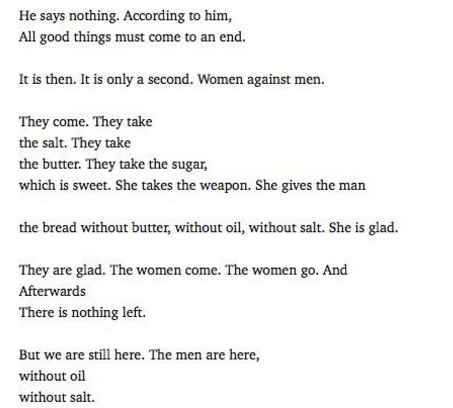
This kind-of-elegy by Alex Dminitrov is all the frustration of a regretfully wasted existential Sunday afternoon:


You can now preorder Calling A Wolf A Wolf by Kaveh Akbar right no on Amazon. UK | US


Over at Public Pool Rodney Gomez provides us with some powerful lines on authority. Here’s a snippet:

*

If you want an answer

ask the trigger

not the target.

*

Suddenly tornado.

And every boy thinks,

when I maim,

I won’t maim

so badly.

Pair with this by Joshua Bennett on Mike Brown.


And finally, an affirmation of life from Safia Elhillo:


Today’s song:


We Go Home Together by Mount Kimbie, Featuring James Blake


Thanks for reading this week’s Etch To Their Own. I have been frolicking away as many calories as possible this week as I attempt to achieve what I thought I always looked like, in my head. Of course this is fiction, but it’s nice to run across the countryside and hear birds trying to murder each other. Oh yeah, they found a giant dead thing. Sometimes a mistake can stick. As always, this was by you, written by me and you can tell me about the typos though any means necessary. Probably through twitter or replying to this email. Alternatively, tell me about your adventures in poetry — whether there be dragons or not.

Love For The Long Poem

Etch To Their Own

Organ Mountains by Caitlin Malings seem much about the enjoying of threat — the idea you might be struck by lightening (or step on a snake) and the thrill of the close shave. Although, of course, both are unlikely as the lightening is erratic and not much interested in her and the snake already has it’s dinner.


But the knowledge that it is a possible threat is what makes it interesting. Those who know the danger are most likely to react to the potential of it. Knowledge corrupts in the sense that it lets you star weighing more things against one another, the rats who didn’t know they were getting shocked didn’t hurt as much as those who flinched.


I spotted this poem tweeted by @OmarjSakr, who pointed out:

It’s worth noting a lot of the poems shared these days are shared because they’re short enough to fit in tweets like these. Or are quotable.

Which is to say, despite the expansive, unrestricted size of the internet’s storage capacity — the fact that we need to share something tweetable that fits nicely on a phone screen is the deciding factor. That is mostly what you’ll see in this newsletter too.

And yet, long poems are probably my favourite kind of poem. They offer you something that you can chew on for years, all through your life. They’re often monumental in some way as the work that goes in to them often has a similar weight. For example the Anne Carson book Glass and God lets her excise demons of a past lover as well as express her relationship with her mother, and the ghosts of the Brontës. For Hannah Gamble, Growing A Bear is a portrait of someone searching for a masculinity they are happy with as they realise they are approaching the middle-ages of their life. And of course, the Waste Land by T S Eliot which brings us not only the ensemble of voices and views of life in inter-war Britain, but also how civilizations rise and crumble, and how we hold on tight to their fragments to retain a sense of history and our place in it.

All of these poems have lines that I can recite from memory and give me something new each time. Maybe we need to find a better space for long poems — but then, maybe it’s that imaginary poetry radio station wrote about a few weeks ago!


Please listen to the Hannah Gamble reading of Growing A Bear because it’s not only masterful, but probably my favourite poem. evs. I put it up there Prufrock in terms of poem-as-portrait-of-man.

There will be an Etch To Their Own dedicated to this poem alone one day!


If you’ve ever been a Radiohead fan (lapsed like myself, or still full blooded) then you’ll remember the short stories of Stanley Donwood. Gloriously these weird little things are still up on that archive, and are still worth a wander through, if you don’t mind feeling a little put off.

Well, he’s part of making a book from lead — which actually sounds wonderful and very much in the idea of those process books that we talk about when we talk about Anne Carson.


Make sure you put your best work in for the Aesthetica Magazine Award over here. The prize includes some poetry subscriptions, which means you can probably take my job!


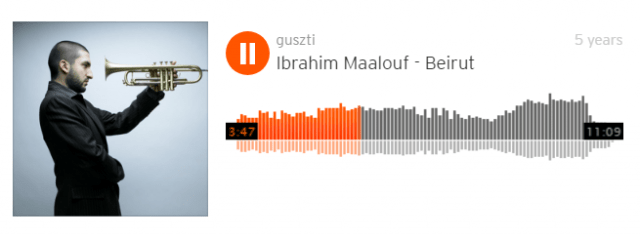
Today’s song:


Ibrahim Maalouf — Beirut


Thanks for reading Etch To Their Own. If you have a trumpet, blow your own, but if not, please blow mine (by telling other people about this newsletter). Etch To Their Own was written kind of in the dark in the end by @CJEggett and proofread by no one living. That Ibrahim Maalouf song is so good that my better half had to come find out who it was. I was thinking of making a proper website for these, and maybe a podcast, let me know if you would listen and/or visit my web zone! Support me and my ego. Support me and my auntie’ bicycle. Read online here.

It’s Pastiche, Alright?

Etch To Their Own

Today is Terry Pratchett’s birthday and like a lot of young readers I grew up on the Discworld series, although I probably haven’t read one of his books since I was a teenager.

What Pratchett does in almost all of his writing is take a historical event, a social movement, and apply it to the already existing fantasy world he had created, extending it onwards each time. It was always an accumulative effect, reading another one of his books, because endlessly adding another rule to you fantasy world means that the list of rules ends up being very long indeed.

But that was part of the fan service, to know that this new occurrence will somehow effect the old rules you had, means that sometimes you could work it out. It was a game of what you could remember from the entire corpus — and the historical events he was pastiching — to find the resolution.

This rewriting and rebuilding of old stories, and the interconnectedness of the worlds, is the kind of thing that gets very nice essays written about poets, but usually a dismissive shrug about fantasy writers.


Speaking of interconnectedness, here’s a jolly essay on Anne Carson’s writing and her approach to the building of a world through disparate shards.


Earlier this week, on the 23rd, it was Shakespeare’s birthday. Here’s a few words of what Harold Pinter thought of him from Granta:


I think Pinter was a fan.


I very much missed Sarah Howe’s Loop Of Jade when it was winning awards, but I really have to go pick it up now after reading this one.


Love poems are not always about love — and often more about the pairing of people. It’s not always about the passion, but how life is lived with another person. With that in mind, pair the above with this from Michael Bazzett’s Our Lands Are Not So Different:


And you can pair this again, with a writing pair who work together on their poetry collaboratively, but have only ever met once. They go by the collaborative name of Bright Division, but consist singularly of Corey Zeller and Sophie Klahar.


It’s good to see what’s in the space between people.


Todays song (mix) was wonderful to work through a hectic week to:


Soul Circle Radio — Natalie Oliveri x Freddie Joachim Show #175


Thanks for reading Etch To Their Own. Seems like a short one this week. This might have something to do with me coming off the coffee and being a bit of a grumpy zombie. Who knew you could get headaches from not having a cup of coffee. Still, I do this in the name of sleep and must say, I have been very unconscious lately, if I do say so myself. This old thing? Written by @CJEggett, and proofread by no one. Send me typos, tips, and review copies of your debut poetry collection via whatever means necessary. You can find these words, slightly bigger, on medium.

Distance Must Remain Distance

Etch To Their Own

Is the English Novel in decline? Houman Barekat at the TLS seems to think so. Or is, at least, asking the question. Houman puts forward the idea that the avant-garde novels published in English currently are either in translation, or are not written by English writers. It’s certainly true of those who I can think of right now, and those doing the most for the language currently. The conservatism of the publishing market, and the necessity of fringe writing to be fringe in places which are outside of the main London publishing hub is also covered in the essay. It’s full of erudite opinion from people in the know — especially this comment from David Collard:

“With small presses it’s not all about marketing, and focus groups, and risk aversion. While small presses may be a way ahead in that sense, the writers don’t get much out of it — tiny advances (if any), modest sales and little financial support. I’ve sometimes made the perhaps glib analogy with other hipster enterprises — artisan cheese, vinyl records, craft beers — in that indie publishers are operating on a shoestring for a very savvy and encouragingly substantial audience.”

Which you have to agree with really, when you find yourself gambling on odd, unheard of presses, small magazines and occasional twitter recommendation to find something that sets the top of your skull on fire.

I suppose it all depends on what you want to define the English novel as. If you think of it as the radical social tool as used by Dickens, Austen, the Brontës and Woolf — used to express a vision of the world against the structures that already exist — then you might be right. English novel writing is comfortable with it’s place in the world. Even those display clever formal tricks such as David Mitchell are doing so in a way which is designed to feed a market (a market which happily includes me). English writing which doesn’t come to the conclusion that families are difficult, society is cruel, and the self is humble but true, doesn’t often make itself apparent to me.

Maybe you know better? Please suggest me some new, English novelists who are doing work to build our language by replying to this email!


Speaking of small presses making waves with interesting new writing that is typically not English by birth, here’s a marvellous interview with the man behind Fitzcarraldo Editions — Jacques Testard. Wandering through a really quite excellent CV (to have half his experiences in publishing eh?) and the history of the press really does make you long for your name in white on blue (or blue on white if you’re the non-fiction sort).


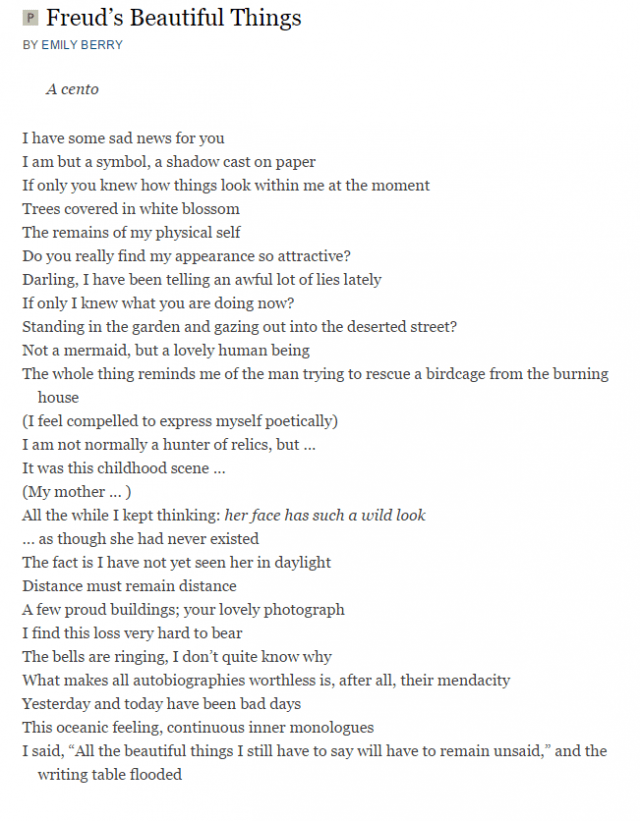
Emily Berry’s Freud’s Beautiful Things feels wonderful this Friday evening:


Maybe I am just after a bit of conversation therapy to talk me down from the week, but the chatter to no one. Distance must remain distance indeed.


Sorry to feature her two weeks in a row, but my dear friend Sam very bravely recorded some poems for youtube. They’re worth checking out with your ears and your eyes.


I am sure I have said this before, but I would love there to be some kind of poetry radio station. Some kind of endless podcast or stream which just played nicely performed poetry with only minor interruptions. It could be something like the Poetry Foundation’s podcast, if they cut out all of the analysis, interview and preamble and just spoke forever. You could just have the poet’s name, the reader and the poem’s title and just roll straight in. I suppose this would be a bit like wanting to listen to those birdsong radio stations, or watching a TV channel of a roaring fire.

This sort of thing comes to me when I would like someone to speak softly at me about deep beautiful things for hours on end — because I might be a little frazzled at the tips.


My most anticipated book of poetry this year is probably Kaveh Akbar’s Calling A Wolf A Wolf. Which I barely serviced effectively at all over here. However, a cover has now been released for the book and it’s really wonderful. Don’t worry, I am already begging for a review copy!


Today’s song is one that I couldn’t believe I hadn’t already subjected you to in these pages:


Nick Cave & The Bad Seeds — In To My Arms

I actually love this song, mostly for the opening line: “I don’t believe in an interventionist God” — and if you want to hear a little preamble about how Nick wrote it, then this version is also very good.


As my grandfather always said: “call a wolf a wolf if you like, just don’t call me late for dinner”. Thanks for reading Etch To Their Own #15 — I’m sorry if you’ve heard this one before. As always, Etch To Their Own was pecked judiciously from the keyboard by Christopher John Eggett, and proofread with one eye closed and one eye thinking of something else. Send your beloved to this newsletter form, so they too can spot my typos and grammatical failures and then tell me about it. You can send your mother this webpage for her to print out and attach to the fridge, obscuring a drawing you did as a child of a looming presence that lives at the end of your garden which will get you, if you turn your back on it.

An Introduction to Potential // No Rainbow

Etch To Their Own

(You could have read this on Friday, sign up here to get it in your inbox)

This arresting little chapbook by Judson Hamilton is full of promise. I don’t just mean that in the sense of the anticipation one gets from judging a book good by its cover, but rather, promise and potential are the subjects of these few pages.


Every element of the book is a work of framing. It not only has that Saki-style sense of satire about it (although, I don’t think this is satire) but has any number of formal and narrative “frames”. From the form of the scene preface to the nature of the scenes themselves being almost staged, theatrical.

Each section is prefaced with a short description of the actors and place, and maybe a slight overreach to say what they might be discussing — even if, you might feel, they don’t quite discuss what the preface has promised from the section.

The work is a series of vignettes of the interactions of a family of small children and teenagers, and their keeper — a traditional governess of sorts: Miss de Mo. Each only offers a little glimpse at the social structures, period and relationships between each character, and you can only pick up the truth of their lives between those part of the work which seem archly-reported. That is to say that sometimes you can feel the director yanking a few puppet-string, as if some of the actors aren’t willing.

And yet, No Rainbows itself feels like the opening of a novel. Something really only just stretching out its roots before the heavy work of a few hundred pages begins. Intentionally so, I believe, it lays out the huge space of potential, and then denies it from the reader to highlight the sense that all is not well in the future.

A key feature of the last act is the Miss de Mo telling the group of children a story, each of them presenting a kind of reaction to it in its telling. The story itself is one cut short, without a satisfactory punchline — despite it, itself, having that well-establish shape of a fairytale. Much like the story that contains it, the fairytale ends in frustration. But that is in the conclusion of the story, where we understand the children are not entirely safe, and may indeed be homeless as their parents have sent for them without the ability to pay. Dire straights await them, wherever it is that they might find themselves exposed to. The chapbook is an expression of it’s meaning in its form, a playing with your expectations as to what comes next.

No Rainbow by Judson Hamilton is published by Greying Ghost, and you can buy it with your money here.


If you don’t know Saki, can I recommend reading, er, everything he wrote. They’re all very jolly satires, and there’s even one about imagism, which I can’t seem to find online for you right now!


Horse Music by Matthew Sweeney is a bit magic:


Someone tweeted a transcript of Allen Ginsberg’s lectures of Pound’s Pisan Cantos. Clearly, they know their audience.


Thanks for reading Etch To Their Own #14 — it’s a bank holiday here, which means I will be ritually submitting myself to the sun in the form of sitting in pub gardens and drinking cold American Style IPAs. I might do a bonus email, if that won’t upset you, and I get time. As always, Etch To Their Own was composed by @CJEggett on a variety of typing devices using a number of different bodily appendages. If you spot a typo, want to say hi, or have something for me to read — please feel free to send me electronic mail, tweet mail, or chain mail. If your publisher would like this, please forward it on. If you want to tweet a link, tweet this one.