Grand Designs

Etch To Their Own

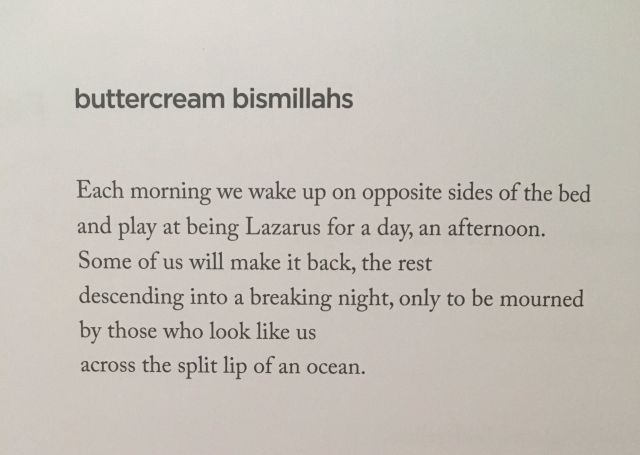
I’ve spent my free time this week round Omar Sakr’s house. I mean, not literally, but metaphysically. These Wild Houses is a poetry collection that plays with location and identity, and the metaphor of the house — the home — as a person, a body.

Omar invites us into his house with the banalities of domestic decoration — setting out these rules of himself as a space in that familiar way of visiting someone’s home for the first time. Like everyone who own odd, strange and compromised homes — there are the warning of “mind your head” and “watch your step” — you know, our little way of saying that the natural way you inhabit your own home might not come so easily to strangers.

This kicks off another theme in the book — the house as a public and private space — that fact that you can be invited in, the fact that “I am breakable — never / mind the wallpaper claiming otherwise”. This is the idea that even the presentation of ourselves that we choose might not be for all our guests, that, in this context, that wallpaper wasn’t for you.

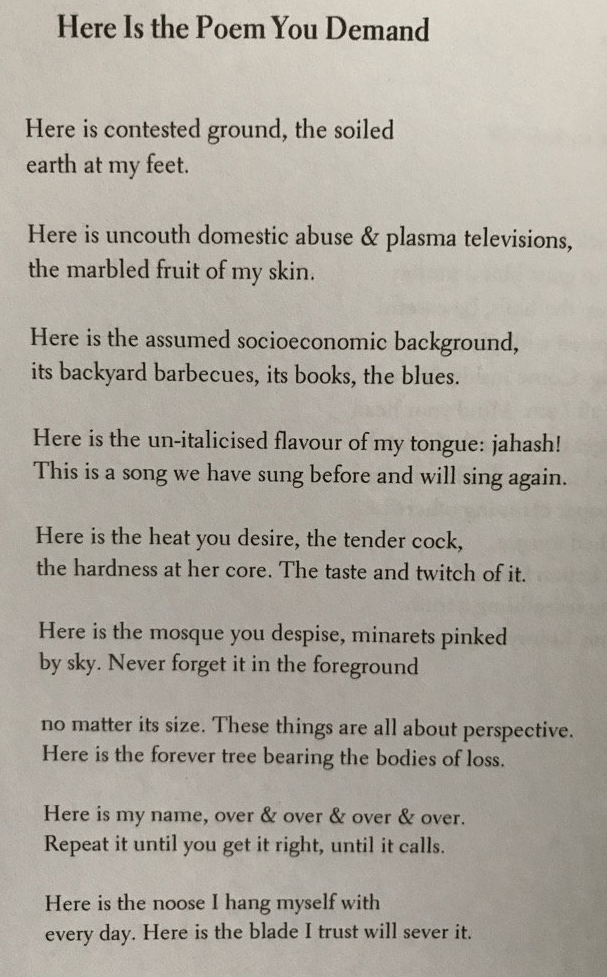
“here is the un-italicised flavour of my tongue: jahash!” (italics, er, mine) is possibly the best line on presenting foreignness in text I’ve read in some time. The poem Here Is The Poem You Demand is the way in to another part of the identity we are exploring — it links those lines of the name, and the song to be learnt by thick tongued — and says in the linking that there is real praise here, but also a sly kick out at the assumed “authenticity” presented by the stat-line of our queer Muslim Arab Australian from Western Sydney, from a broke and broken home.” The scene is set here, for us to examine our own assumptions and voyeuristic tendencies (a readership of peeping Toms I suppose, given the house context).

The next poem, interacts with the previous directly. Landing shows us how the strain between generations can present it’s own kind of fetish of legacy, or the rejection of it. The older generation speaking as prophets, able to keep the fledgling feathers of their heritage in a way that the poet is confronted by. They almost taunt him with his lack of understanding of the breadth of their loss: “You do not know what it means to take, / to rip your roots from clay and craft them into sails // ready for the sky”.

Equally, the poet resents the uprooters. How much could they have really carried with them? How much did they leave behind, that he, now, cannot inherit, cannot use to furnish his home.

The collection weaves between the tragic of the living and the dead — the grief, the absolution of sin being buried as a newborn — and the more personal building of bricks and mortar.

In Not So Wild we understand that the boys in their budding selves, leave the creek a little less tame each time they visit: “we left them each time a little less tame, naturalised, shaggy with weeds, brambles, the occasional thorn and cobweb.” They leave as freer boys, but it is implied that they have an effect on the location too — do they tame their environment, as it makes them wild? Do they bend it to their will a little in the trampling of brambles. This seems to throw up the idea that the locations inhabited by the poet and himself as a location have a kind of balance. We see the same in a later poem Comin’ Out The Station the gaudy brokenness of hedonistic commercialism (linked with the sexual encounter there) balances with the building of a self image of the gentle haircut the poet will receive, where his identity is built from what he is already made of — chiselled out rather than reflected of the neon. But both inform the identity, both are the reality.

In This Girl, This Country we see a deconstruction of the woman as land/wildness/fertile hills trope that is scattered across most of literature. It’s of particular note, the idea of two girls together is a national park — and their independence is “an indigenous council meeting in a stolen house” — which is to say, there is no maths of the status quo that will make these women human. In Election Day we are reminded, “just water those damn flowers.”

Omar delivers all these with that rush of language and held breath (Call Off Duty, a great example of this) in addresses to various people in his life or those who have left it. I suppose we all receive our post at home, it’s the return address we write on if we want to get a reply.

The house, the body, is a central exploration of the collection — and the tensions and conflict that are presented throughout are where we draw our vibrations from. I would suggest picking up a copy, or at least having a browse of rightmove.


Today’s song is Suicide Dream 1 by How To Dress Well (Live on KEXP). I wrote a whole novel while listening the Love Remains album. It was a pretty miserable novel, surprisingly. But try Lover’s Start from that album if you want to hear him in his more upbeat moments.


Thanks for reading Etch To Their Own. It was gently shuffled into place by @CJEggett and proofread by no one. If you spot a typo, let me know. If you think I’m wrong, please also let me know — but, like, tell me why. Did I Mention I Am In The Advertising Business Now? I’ve spent some time on the fun end of a microphone this week and I must say, I don’t sound as bad as I had hoped — although, of course, I eat every 3rd word Marjorie. Send people here to subscribe. Send people here to pretend it’s 2014. Send yourself here for a bonus poem. And finally, send someone here if they like thinking about hands.
what it means to survive if you have to eat others to do it

Etch To Their Own

So it seems like GIVING GODHEAD by Dylan Krieger might be in contention for the best thing of 2017, according to Thomas Simmons of the Boston Review at least. I have to admit, I didn’t know there was collection to be had until today.

We’ve seen Dylan before, with her powerful rush of language. It tends to flow out forcefully, a little like ETTO favourite C A Conrad. The review will probably send yourself skittering over to Amazon to scratch away at that order button — but, until it arrives, revisit: Spring broke half a nation state away.


This week (3rd August) saw the 80th Birthday of Diane Wakoski, apparently. There are so many poets I haven’t read, and Diane is one of them.


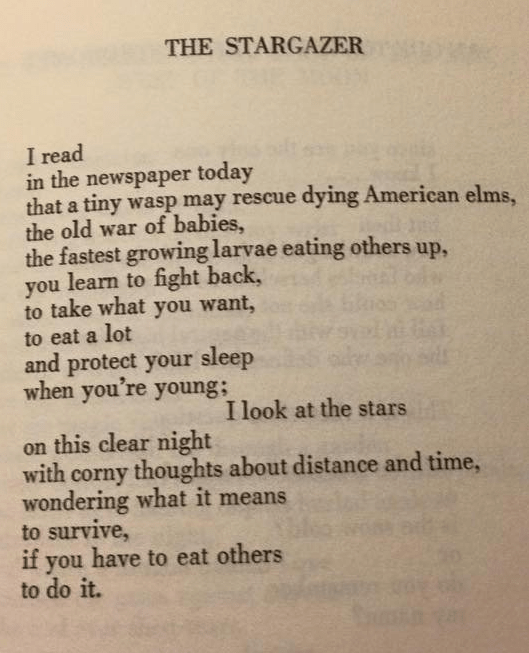
The Stargazer is one of those poems that starts with the kind of banality we often think of as below a lot of modern poetry. Of course you read the newspaper, but the poem is from a time when expressing these small normal moments was a kind of tearing up of the traditional framing of poetry. Reclaiming poetry for keeping next to the kitchen sink (with the drama you see).

It then opens up into the saving of something great and old — and then savagery of survival in youth. A hooked linking line between the dying American elms, and the corny thought — which turns out not so corny.

I briefly scratched around and enjoyed this quote pulled from her essay The Blue Swan: An Essay on Music in Poetry:

“first comes the story. Then comes the reaction to the story. Then comes the telling and retelling of the story. And finally . . . comes boredom with the story, so that finally we invent music, and the nature of music is that you must hear all the digressions.”

Which I love, as it’s the opposite of Blake’s version of the formation of poetry. Blake’s version is to have the divine idea, the dance, then the music, and then, as the pen is placed to paper, these things drop away. As our buddy Ezra said “Music begins to atrophy when it departs too far from the dance… poetry begins to atrophy when it gets too far from music.” In both Blake and Pound here they seem to suggest that you move away from inspiration — whereas Wakoski suggests a reapplication of music once you’re bored with the ebbed inspiration.


Sam Rose has three lovely poems in Bindweed this week. They’re great, as always.


Trump’s full address to the boy scouts.


Today’s song is Vessels — Vertical


Thanks for reading Etch To Their Own. I’ve done this for as many weeks as I am years old, and for nearly as many days as I have been free. Remember jokes? They were good weren’t they? We’ve met before, don’t you remember?It’s very easy to run away with things in your head, dreaming of some perfect world in which you’re the sun, rather than the meteor diving into it. Etch To Their Own was written by Christopher John Eggett, who likes to see his name written out from time to time. If you like what I have been doing with my Friday evenings, please tell someone about this newsletter — or send them to the medium archive. If we all need therapy, lets go together, it’ll be fun.

30 Days of Mogul

Etch To Their Own

I joined Mogul officially on the 3rd of July 2017, buying in to the business, taking a 40% stake, and saying farewell to the safety of my long term employer. Here’s a little bit of what it’s been like.


I have worked with Mogul before in a freelance capacity — at first just helping out a friend, and then, later as the projects got bigger, with larger more dedicated work on the content, SEO and technical consultancy side of things.

I have been here 4 weeks, and my first month has been better than expected.

It turns out that what I believed to be true, was true: if you speak to the aspirations of those you want to work with and for, they start to share those aspirations.

And that’s our job at Mogul in part — to give back to organisations the idea that they’re doing something interesting, important, inspiring — not just churning a machine that produces money for them.

Although, of course, what we do makes the machine a little more efficient — because everyone understands what it does, and why it does it.

Developing an idea from a mad spark into an inch of reality is exciting, as is the very measured and careful crafting of questions for our research and discovery interviews.

All of it comes from a natural, genuine curiosity — a place I am happy to be spending most of my time inhabiting for the last month.

The reality of working under your own steam is that everything you produces something at the other end. You can see the direct result of everything your turn your hand to, and as such, it allows you to own your work in a way that has no guilt associated with say — trying to unpick a problem while on a run, or thinking of new ideas for a client in the off hours.

Ultimately, the first month has been an absolute joy especially in finding that if you give yourself to something, you get something back.


We’re running a few fun projects over the next few months — the first of which is the Oxford Print Fair.

The print fair is being hosted by Modern Art Oxford on 9th September, showcasing 21 artists and print studios from across the country. Artwork is available for purchase direct from the creators themselves.

Prints range from large, intricate work and bold posters to smaller items like cards and postcards. There’s even some fun textile work too. Come along to meet the artists (and us!)

Visit us: https://www.oxfordprintfair.co.uk/

and I give my breath to a small bird-shaped pipe

Etch To Their Own

Max Ritvo died one year ago this month. A poet who went to Yale, and continued his work after in an MFA knowing that his life would be shortened by bone cancer, died on August 23rd last year. His poems are filled with direct and life-giving imagery, even this — Afternoon, which starts with the line “When was about to die / my body lit up / like when I leave my house / without my wallet”.

Here’s the rest:


The poem does what a lot of his work seems to — takes those unimaginable moments and connects them with those mundane shocks we experience every day. With lightness and beauty his work wanders through topics like god, death, loss and so on — and plugs them directly into everyday experience, the grand to the minute connected.


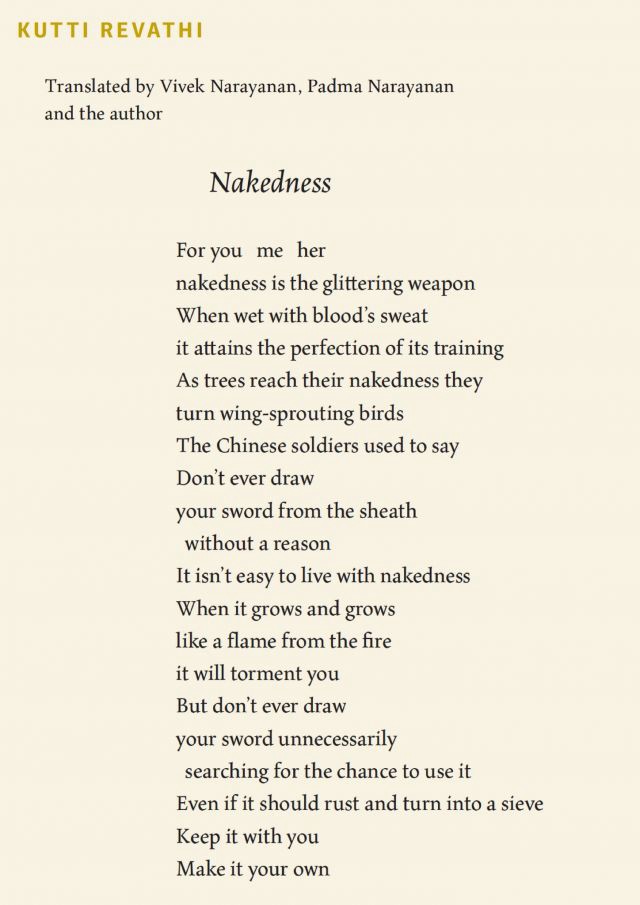
Talking of making one thing another — taking the alien and making it understandable — how about this translation. Warning, nudity:


As you know, I love a little ritual. And you don’t get more ritualised than the natural order of planting and tending of plants. I think it’s especially interesting when meaning is ascribed to things that may, in reality, not have required a spiritual aspect — but developed one over repetition, misinterpretation, and a will or their to be a connection. With this in mind, enjoy a little bit of ritual from Sharon Telfer over at Spelk.


Not a cruel song at all.


This is nothing to do with poetry, or is it?


You may have spotted these two lovely concrete poems in the Tweets this week. These jolly poems are from @brian_bilston and do the thing I bore you with about form and — hey, don’t drop off! It’s rude to fall asleep when I’m being boring.


This week’s song is Little Tiger by Tune-Yards which can be paired with Bitten By The Tailfly by Elbow for song that seems to have left the chainsaws plugged in.


Thanks for reading Etch To Their Own. I would deliver this by hand if I could, but my shoes are wet and I cannot put up with the chorking. Anyway, you would hear me coming an it would ruin the surprise. Someone said that I should look for a grant to do these professionally, I showed them this cartoon. I’ve had some odd dreams recently. Etch To Their Own is known as ETTO for short, and has been getting shorter as the poems get longer it seems. This week, much like the other weeks, it was written in a rush by @CJEggett. Please tell your nearest mutual follower on twitter about this newsletter, and you will be visited by the spirit of well spent anniversaries on your next one.

Pain In Perspective

Etch To Their Own

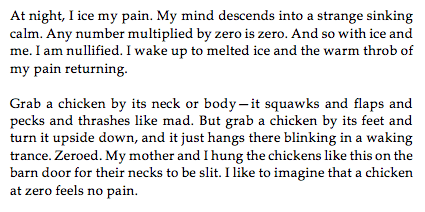
This week we have Eula Biss’s prose-poem-essay on pain, called The Pain Scale, which you can find a direct link to here.


I felt really lucky to find this as it articulates everything I’ve ever wondered about pain in the context of medicine. She articulates ideas about those questions about pain you get from doctors (and in her case, her father) where you’re unsure if they are asking about additional pain on top of the pain you’re already feeling — or as a whole — or compared to the worst pain you know — or anyone has known.

Eula’s pain is unimaginable to me — but the articulation of it has that irresistible persuasive tug that you can find in the work of Anne Carson. So reasonably taking a step forward each time, navigating a little love and the huge distance we face even when we should be sharing something fundamental. Like pain.


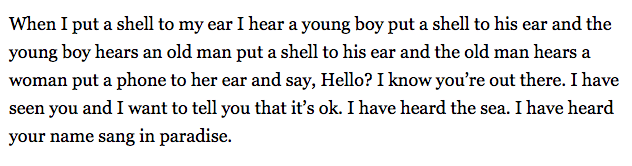
Speaking of the distance between us, how about this little slice of sad burning transcendence from Miggy Angel?


Did you get any on you?


Here’s a little more of the power of repetition — a story about telling a story from Poems For The Millennium.


One of the best prize-money-per-word competitions is now opener business. Write 100 of your best words for The Museum of Words.

The prize is a massive $20,000 — which obviously makes it really competitive. You get TWO entries as well, which is a really nice way to not worry about which particular 100 words ever being worth $20,000 if you have competing drafts!


An AI that generates “British Place Names” — with predictable results.

You will also be unsurpised at the top highlight — the potential hamlet of Fuckley.


This week’s song is less a song, and more of a couple of sides of spotify playlists.

Minor Literature[s] has presented us all with is a mixtape full of fun, abrasive things. I’ve only managed to make my way through the “Metal” side of the mixtape, and hope to get to “Wood” soon.

You can find them for yourself over here.


Thanks for reading Etch To Their Own. I hope you’ve found a way to apricate recently. You’re my favourite sort of people. Etch To Their Own is written by @CJEggett almost entirely crosseyed with tiredness and proofread by no one.

Nude Poetry — Here Is What I Forgot

Etch To Their Own

This week Kaveh pointed out that it was Tintern Abbey day, to barely no fanfare. It’s an abbey I visited last year, and completely forgot the poem in the presence of. I couldn’t even string the opening verse for my cycling friends who were so desperate for a bit of culture during their break from the hills before their sandwich arrived. It opens like this:

Five years have past; five summers, with the length 
Of five long winters! and again I hear 
These waters, rolling from their mountain-springs 
With a soft inland murmur. — Once again 
Do I behold these steep and lofty cliffs, 
That on a wild secluded scene impress 
Thoughts of more deep seclusion; and connect 
The landscape with the quiet of the sky. 
The day is come when I again repose 
Here, under this dark sycamore, and view 
These plots of cottage-ground, these orchard-tufts, 
Which at this season, with their unripe fruits, 
Are clad in one green hue, and lose themselves 
‘Mid groves and copses. Once again I see 
These hedge-rows, hardly hedge-rows, little lines 
Of sportive wood run wild: these pastoral farms, 
Green to the very door; and wreaths of smoke 
Sent up, in silence, from among the trees! 
With some uncertain notice, as might seem 
Of vagrant dwellers in the houseless woods, 
Or of some Hermit’s cave, where by his fire 
The Hermit sits alone.

There’s more, as you know. Anyway, those snippet that start this are what I forgot.

Honestly, it would be nice to remember the right poem at the right place for once.


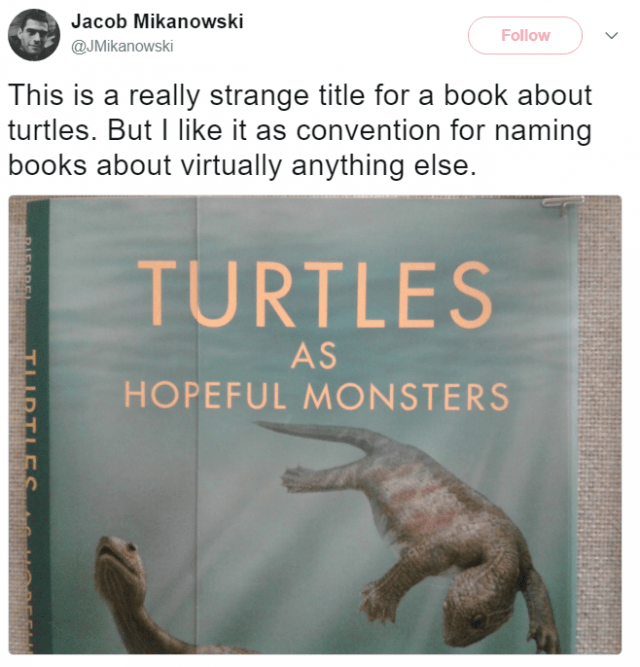
I have found a naming convention for my series of memoirs:


There’s a little bit of suicide in this contemplative schoolyard effort from Cathy Ulrich.


Our dear friend Hiromi Suzuki has three new visual poems to play with in 3AM magazine. As usual they offer you a few contexts in which to approach them.


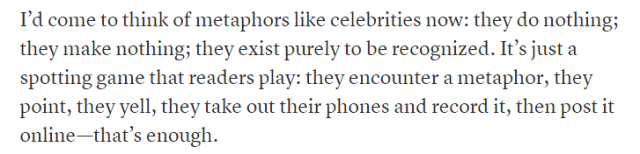
When it comes to owning a thing, nothing really beats owning your own space. Except when that ownership is a form of oppression for others. In this article in the baffler, the concept of ownership is discussed, as well as a powerful case put for the death of the metaphor. In a sense, is there any sense in making metaphor ion the world can offer you only uncertainty and misunderstanding — after all, isn’t the silent agreement of metaphor that we understand the world in a shared way, that that metaphors are a show cast by or against it?


And, to mention Kaveh again, he has something on offer in the Baffler too.


Octopie.


Apparently today is national nude day, which I celebrate every day and assume you do too. While noticing this fact I was made aware of Laura Berger’s work.


This week has been really good for short stories. Jennifer Fliss offers us Towels — which expresses a whole human existence lined by soft and starched towels.


As someone who grew up on a lake, I must say I am identifying hard with the catfish here — eve though I am more of a carp soul.

And, to speak of a man being other.


Today’s Song: REM — Let Me In


Thanks for reading Etch To Their Own. It was written by @CJEggett and your adventure ends here. I am sorry if this doesn’t reach you until Saturday gee em tee. The very lovely and kind @Writersamr took me out for what is known as, “the drinks” in these parts. Here’s some pretty visuals based on weather data. Yeah, all those stars drip down like butter. This is me very much getting out of the way.

Ritually Speaking

Etch To Their Own

C A Conrad is a poet whose work caught me from the first page of a book I picked up in the excellent English language bookshop, St George’s, in Berlin.

I briefly exchanged emails with him over whether he was ever going to get around to recording a reading of the entirety of The Book Of Frank. He asked why I would want that, maybe to listen to in the car? Not that he had a car, but some people might want to, right? (He also said something nice about my writing, which probably made my 2012 — and you can read my younger thoughts here).

The Book Of Frank is that kind of longer narrative poem where you can try and piece together the whole through the shards of a broken kaleidoscope — while you can gather a general impression of the overall arc of the poem, it’s often more interesting to wallow in the strange imagery of each individual poem itself in the 131 of the book.

Later works, such as — A Beautiful Marsupial Afternoon — which I feel is a kind of sleeper cell of a book that is less consumed critically at the time of reading, but instead plants deep and interesting ideas about process that slowly bloom into a powerful love for the book and it’s author.

Each poem is accompanied by the ritual that was used to make the writer present enough in the world to write the poem. These rituals are strange, bodily things, that if you try aspects of you’ll soon not be able to untie from the world. Maybe we should all be spending our time on rituals to make the world more real.

Andrew Ridker, over at The Paris Review, talks about C A Conrad’s work this week, in a kind of biographical retrospective that should give anyone not familiar with him some deeper insight into the poet’s background.


As soon as I have any cash in my pockets I am rushing out to buy this issue of The White Review — which includes regularly worshipped regulars of this newsletter such as Anne Carson and Claire-Louise Bennett.


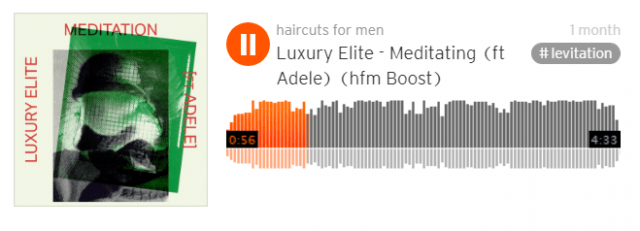
Today’s Song:
haircuts for men — Luxury Elite — Meditating (ft Adele) (hfm Boost)


Thanks for reading this week’s Etch To Their Own. Sorry it’s only a mini one. I have read less poetry this week than I have for some time, I guess that is because I own all my hours and I am probably panicking about using them for making cash somehow. I will get back to it when I understand the balance of my life a little better I suppose. Thank you for understanding. As always Etch To Their Own was written by @CJEggett — a man in search of praise as good as this one day. I miss you all very much. I hope to be at the beach tomorrow bright and early, searching for haikus in the rockpools.

NOTES ON: C A CONRAD “THE BOOK OF FRANK”

Etch To Their Own

This is a copy of something I wrote in 2011, that should probably be lost to the mists of time. And yet, here I am publishing it again. Take with youthful salt.

Poetry has to grab me these days. I have to instantly interested, a turn of phrase is all that’s needed to draw me in, but once done I can settle with it. I need a hook is all I’m saying.

The Book of Frank’s particular hook was the inclusion of the line:

“Where’s my son’s CUNT?!”

On the first page. Thus hooked I purchased and ploughed on.

A camp tales of abuse, debasement, metamorphosis, fear, sex and psychosis these short sharp poems wander jumps from theme to theme like the poem itself is on a pivot — each side showing you a new facet with its fully developed rollercoaster of nastiness, the degradation of the human soul and the like.

This culmination of 16 years of work (we only read the wheat of course) is actually a display of the roughness of life.

Like all work produced over a number of years — and maybe all long poetry in fact — the author only offers up little slices of the whole at a time. Each poem is a solid representation of the moment but as the moment and the persons are so varied and changing, those around Frank anyway, there is a lot to take in. Only after being given each sordid polaroid we’re able to build our whole Frank-flick-book. Importantly each snap catches change in action — the animation actually only offers us the dimension of time.

“He read the metamorphosis, just for kicks” We’re told. This joke (the sneering quality of the line) makes light the Kafkaesque nature of metamorphosing characters — a fundamental support to the whole collection. We come to expect a kind of “knowing” change quite early on. Frank’s mother grows tentacles as he realises how involved in his life she is. Frank grows crows for hands. In the beginning Frank seems to be at the mercy of these changes, yet, slowly, he begins to take a grip of the rudder and enjoy the changes.

Frank searches for a metamorphosed version of his sexual-abusive father in the shape of a transsexual — Frank kneeling for a kind of knowing abuse. He takes this and, eventually passes it on.

And this might be at the centre of it. Frank is in control in many ways — he absorbs all the horrendous parts of the world around him and owns them completely. Frank seems to be the victim for much of the extended poem, yet he manages to become part of the oppressive chaos around him.

To say this is about the degradation of the human soul is, in reality, a little much. Frank is dammed from birth to be mis-labelled, over-labelled, abuse. As much as we like to pretend there is a grace to fall from in reality the soul is something with its snout firmly in the corpse of another.

Kids, These Days

Etch To Their Own

This last week we’ve been blessed with a short story from J A Field: People Are Everywhere. It concerns that kind of quiet neurosis, restraint and internal retellings you see in a certain kind of modernish novel, something like that looming threat and self doubt undercut by absurdity

It’s the kind of middle-class/first-world concern that wriggles around inside a lot of us in our weaker moments. It’s that fear you have for having something, and the possibility of losing it. It shows a paranoia about the world held even by those who are helping — the protagonist here seems scared of children despite working within some kind of social care context.

Maybe it is this working with somewhat “damaged” children (or children at all) that gives her this internal distrust of reality as it exists outside her skull. To our protagonist at the start of the story others aren’t legitimate — that her point of view is the single, tangible, canonical version of the world. And this might relate to the un-relatable views of the children she might be surrounded by. There’s something alien about the way children see the world, and something wild that doesn’t conform to the expectations of society in general — naturally transgressive they represent everything she’s trying to hide from.


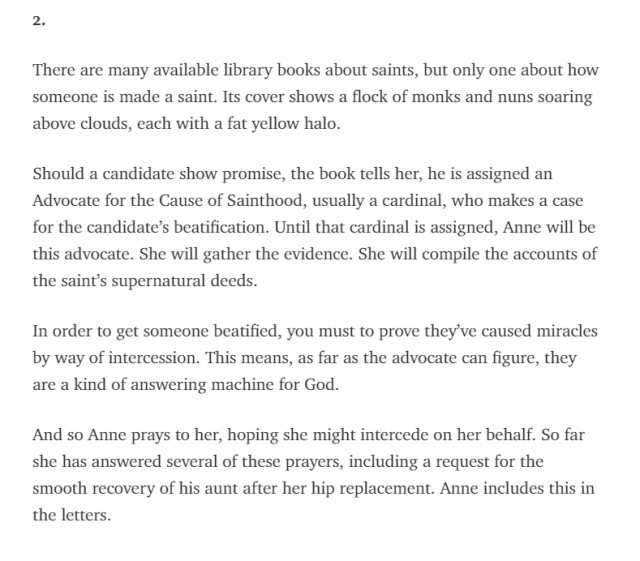
Pair with The Advocate for the Cause by Dan Hornsby traces a completely opposite kind of innocence.


The first issue of fun new lit mag Underblong is here and it’s pretty good fun! Apart from everything else wonderful about it I do like their format.
 
This piece by Janice Sapigao in particular is great (naturally I love it, as it’s a kind of formal play using the language of definitions to suggest authority, and then undercuts.)


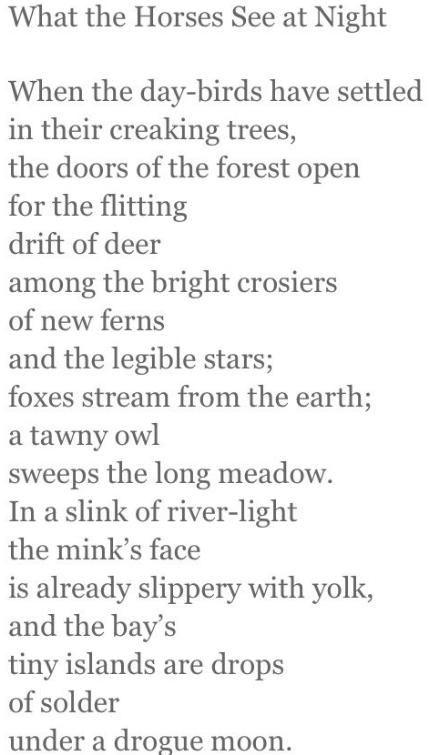
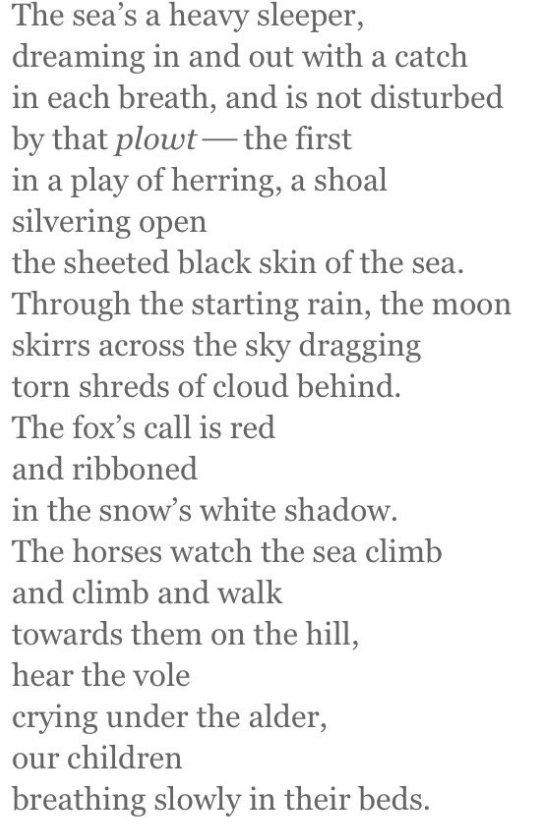
Doesn’t Kim French share some lovely stuff? This week I’ve picked out Robert Robinson’s What the Horses See at Night:


Today’s song:
Four Tet — She Moves She


This, and the entirety of Rounds, is pretty much my favourite piece of music (maybe ever?) It’s from a time in my life where I was trying to re-centre myself after tragedy. It’s good for getting balanced out.


Today was my last day of working for someone else — hopefully forever! Sadly someone has been plagiarising my CV already however, especially the “I am good at nothing but I can carry you”. The new business is just getting set up, you can find us a We Are Mogul. Don’t worry, this newsletter won’t become a linkedin spam mailer. Although, do email me if your company needs someone to think very carefully about how it is seen!


Thanks for reading Etch To Their Own #25. I’ve drafted this early, but will send it when I come back from the pub. Anything that follow comes from then: it’s simple. I love you all as much as you might expect, for other it might be more so. I am not that drunk, or that sober, but I thank you for reading this over and over.

The Heat & The Hum

Etch To Their Own

This week we’re kicking off with a poem from the upcoming chapbook from Spencer Williams, called ALIEN PINK, which can be pre-ordered over here at The Atlas Review store. Here’s literally the only snippet I can find of SPRING:


I actually don’t know if it continues from this point on, or ends there. It’s enough to get my preorder however. I enjoy this kind of back-and-forth implied by the left and right aligned halves of each line. The tabbed spaces suggest a breath or a pause, and that back and fourth suggest that kind of exchange in this description of a birth that wouldn’t be entirely out of place in Hesiod’s Theogony (a kind of who’s who of Greek deities and, inevitably, their awful and powerful rituals associated with their forming).

The violence of transmutation, the exchange between one side of the page and the mother and the child — some ritual magic, some attempt at infanticide, some nurturing, has something of Echidna about it (the mother of monsters) whose childrens’ births were extremely violent. But on the other hand there is joy, sweet music — although it may be from the womb, and therefore be tinged with the sadness of exile


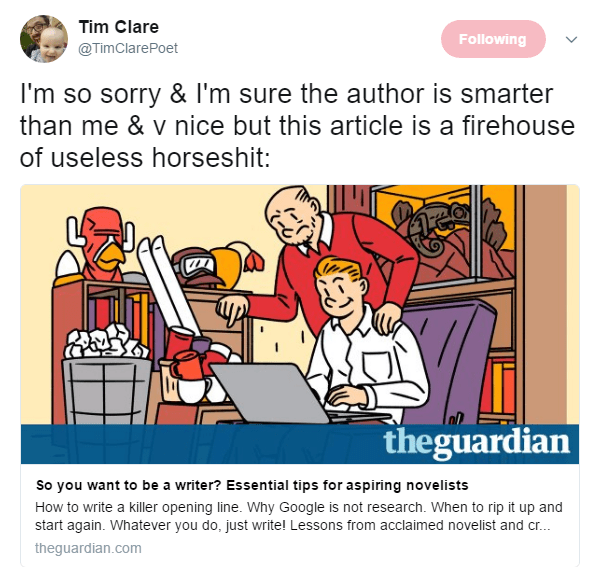
Sorry to feature Tim Clare for two weeks in a row, but I am afraid it’s a little bit unavoidable, especially when Death Of One Thousand Cuts comes back tomorrow (point your podcatcher here), and he’s been talking about bad writing advice. Here’s a dissection of writing-a-novel-advice that didn’t quite hit the mark:


The original article can be found here. As Tim’s thread suggests, it’s filled with all sorts of rhetoric that sounds like good advice, but it barely applicable because we’re left without examples of what is really meant and how it could be applied.

More annoying for me is the fetishization of the difficult labour of writing throughout the piece, the language of it suggesting that there’s little between, say, building a house and writing a novel. I am sure Colum McCann is an excellent writer and tutor, but I think this might have been written with a low-hanging deadline.


How about a little domesticity from Momtaza Mehri:


And Marianne Moore’s England has been floating around twitter recently (for me at least). Despite her closeness to Pound (I think I have a book of their letters to one another) I don’t think I’ve read her work to a serious extent. Something I decided to correct immediately after reading this:

ENGLAND

WITH its baby rivers and little towns, each with its abbey or its cathedral; 
 with voices — one voice perhaps, echoing through the transept — the 
criterion of suitability and convenience; and Italy with its equal 
 shores — contriving an epicureanism from which the grossness has been 
 
extracted: and Greece with its goats and its gourds, the nest of modified illusions: 
 and France, the “chrysalis of the nocturnal butterfly” in 
whose products, mystery of construction diverts one from that which was the object of one’s 
 search — substance at the core: and the far East with its snails, its emotional 
 
shorthand and jade cockroaches, its rock crystal and its imperturbability, 
 all of museum quality: and America where there 
is the little old ramshackle victoria in the south, where cigars are smoked on the 
 street in the north; where there are no proof readers, no silkworms, no digressions; 
 
the wild man’s land; grass-less, links-less, language-less country — in which letters are written 
 not in Spanish, not in Greek, not in Latin, not in shorthand 
but in plain American which cats and dogs can read! The letter “a” in psalm and calm, when 
 pronounced with the sound of “a” in candle, is very noticeable but 
 
why should continents of misapprehension have to be accounted for by the 
 fact? Does it follow that because there are poisonous toadstools 
which resemble mushrooms, both are dangerous? In the case of mettlesomeness which may be 
 mistaken for appetite, of heat which may appear to be haste, no con- 
 
conclusions may be drawn. To have misapprehended the matter, is to have confessed 
 that one has not looked far enough. The sublimated wisdom 
of China, Egyptian discernment, the cataclysmic torrent of emotion compressed 
 in the verbs of the Hebrew language, the books of the man who is able 
 
to say, “I envy nobody but him and him only, who catches more fish than 
 I do,” — the flower and fruit of all that noted superi- 
ority — should one not have stumbled upon it in America, must one imagine 
 that it is not there? It has never been confined to one locality.

I have so much love in me for: “in which letters are written not in Spanish, not in Greek, not in Latin, not in shorthand but in plain American which cats and dogs can read!”


Joyce Chong, featured a couple of weeks ago for her microchapbook from Ghost City Press has started a TinyLetter. It’s been good so far. Add it to your inbox.


Today’s Song is an “old” cover of The Weeknd, by Dillon. Not sure why I looked it up again, but I love the stripped back cover and the very youtube video which includes the artist probably checking something on the laptop that everything being recorded into and kind of almost, for a moment, forgetting that she’s mid song. It’s dreadfully endearing:


Dillon — Echo of Silence (The Weeknd Cover)


Okay. I’ll be the one to say it. It’s been too hot for poets. Books are boring aren’t they. This was swept up in the laziest way possibly by @CJEggett, and transmitted to you with about the same amount of care and attention. I can’t help it, it’s who I am. I thought I was going to include something about humming in here because I have a few thoughts about it, but I didn’t, because it’s too hot. To this end, I would like to offer one of my family heirlooms to you, a joke my Grandad used to tell:

“What has one wheel and hums?”

“A wheelbarrow full of manure”

If that hasn’t put you off, I would really appreciate you telling one person who might put up with this sort of thing about this very newsletter. It’s really the only way I can think of validating myself.