From A Feeld In Eng-er-land

Etch To Their Own

Feeld, a new poetry collection from Jos Charles, is a strange wandering series of connecting poems. Focusing on ideas of identity and trauma for the trans poet — placing herself as a hypothetical horse (saddled, broken) in a field which we will have the run of for the connected poems. The feeld itself is one that we move about in and observe trauma and change through pastoral imagery.
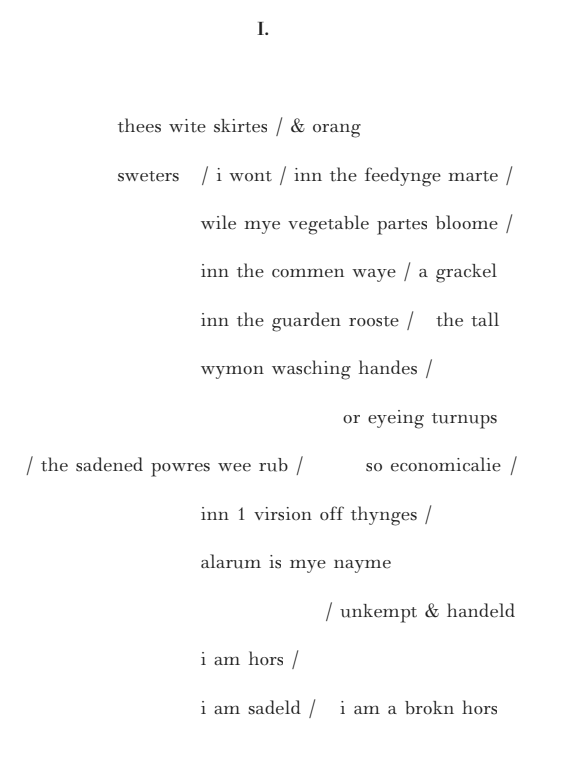

There is a lot of playing with the location/physical space here, curling up into the space of an egg as a place where “the grl beguines”, or demarking borders “the waye 2 inclose & disclose a tree”.
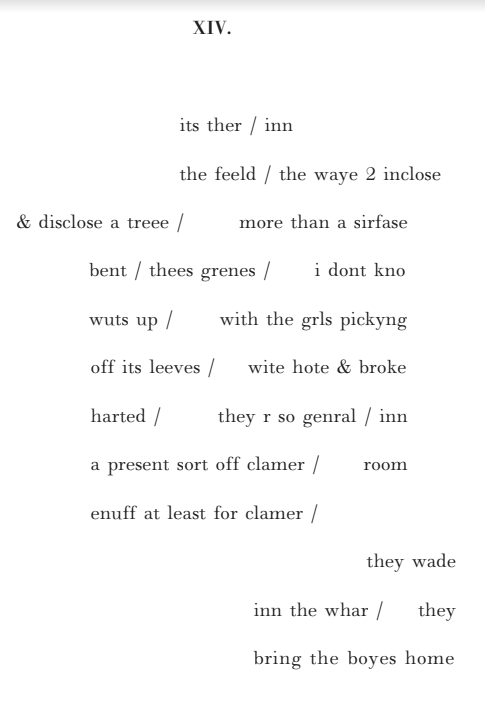

Trees themselves, a way to provide borders to the feeld present life in the obvious ways — we’re unsure of the girls plucking the leaves and:

speeching off treees

from the insied / u can growe

deer 2 one / onlie from the insied /

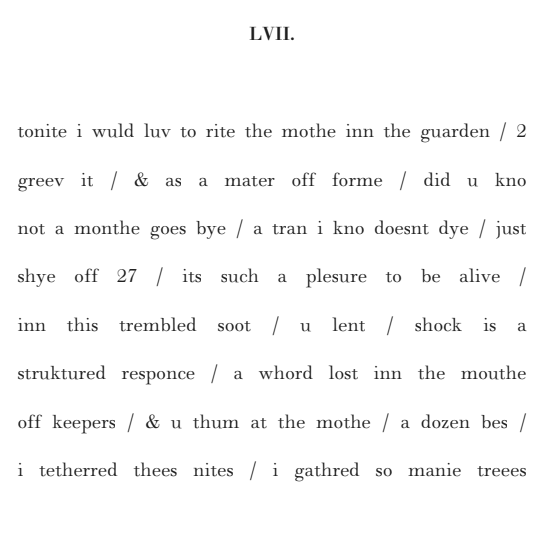
comes to us near the end of the collection. Trees are damaged and disfigured throughout the cycle of poems, they’re unknown at the start and “deer” at the end. Through their manipulation by others we see how the identity the ‘I’ in the poem goes from one suffering trauma to one who accepts their experiences as forming. The horse is broken in and saddled, but this doesn’t have to be a negative, because it is a continued existence — if negotiated.

All this is, of course, offset by the use of internet-style spelling and grammar that often slips into an approximation of old English. I’ve struggled writing about this collection as I’ve wanted to flit between saying that the whole thing is one long poem in the epic style, or that instead of each poem Jos is posting.
 
 Still, in the same way that anyone can read Chaucer if they relax the part of their brain containing what they think are the rules (read: what they were told as a child was correct) and read aloud, the same can be said for feeld. The effect is one which presents conflict between the childishness of it — and the associated authority with have with old English. It jars forming a neat set of double meanings (deer/dear, the field/a past tense to have felt) and produces a similar effect to the content of the poems themselves — that of balancing the past with the current, authorial reading.

You can pre-order Feeld over here and read a good interview with our boy Kaveh over here.


I am hoping to get a bit broader with the genres I cover here — I am sure it will mostly remain literary, but I was recently sent this book of short sci-fi that you’ll be treated to at some point :)


Blake Butler has a new weirdness.


And this week’s song is Blake Butler’s fault — Miles Davis & John Coltrane in Stockholm 1960.

If you’re in the mood for more jazz, this is László Krasznahorkai, from his interview in the Paris Review.


Thanks for reading Etch To Their Own. It was written by @CJEggett and proofread by no one. If you spot a typoe, let me know. Inform your newest, freshest wife that this is where she needs to put her email address. Inform your most diligent, hottest, stable-boy that he can read it online later, here, from a haystack. Or take a seat, yes, anywhere you like. I am selling a drum machine, buy it? Don’t be like this guy (please read my very good response it’s exactly what you would expect of me I am sorry). Isn’t the sun nice? Aren’t our bones warm? I met some French people down an untravelled track today — it started as a road and then gave up as the trees touched limbs above — and they will be making their way to the Norfolk coast by now, possibly passing through my home town to get there.

Blacking Out

Etch To Their Own

Bristol, a collection of poetry and experimental prose edited by Paul Hawkins (who publishes our buddy Hiromi Suzuki) includes the kind of formal play we live for over here at ETTO.

David Turner offers us satirical glances at Turner prize winners and their work going slightly wrong (Hirst shouting “Flatten its snout and bang a load of teeth in it” when presented with the wrong kind of marine life to pickle) or getting caught in having to run a charade (Emin having to sneak the homeless into the Tate to ensure My Bed is as authentic as possible during a retrospective).


The poetry in the collection is along modernist lines — floating images tethered to one another in a non-linear form — giving us a sense of a city reflected in broken glass. Alternatively, there are the opening pieces by Sarer Scotthorne which are laid out in the syntax of computer code. The computer code suggests a hierarchy of meaning through items “called” before others — meaning there is a kind of dependency on the former for the latter to have any mean.

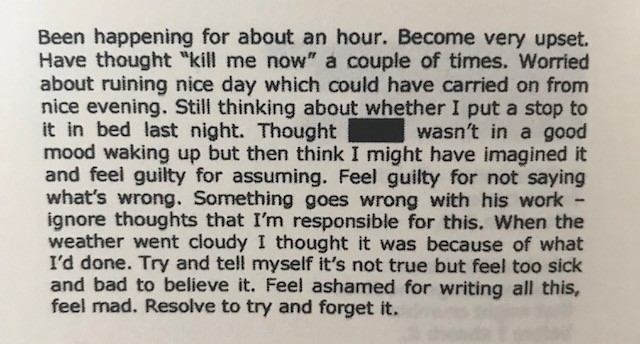
Lizzy Turner later in the collection gives us blackout poetry, transforming the meaning of the text by removing/blotting out various parts of the section. Here’s a snippet of before and after, there’s also another panel between:


I like the presentation of this because here we’re served the text being chipped away it to find meaning. It is designed to say that the whole text you are provided with does not contain the fullest meaning.

The collection focuses on these ways of relaying information to the reader — whether you need to cut away at structure and assume there is no canonical connection between images in a poem, cut away at a text to highlight meaning by obscuring others, or present a hierarchy of meaning through syntax and form. Each comes with their drawback — none can be truly be presenting something canonical. Even in the short satirical stories are about suggesting that the presented authorship of a piece of work is not to be trusted in itself.

The collection, called Bristol, is published by Dostoevsky Wannabe and can be purchased here.


An important message on productivity from Harriet Tarlo


Hoping to get my grubby hands on this.


Greying Ghost are looking for things currently, and as they previously published Judson Hamilton’s No Rainbow — which we covered all the way back here, we think they’d be good for an interesting chapbook project.

In similar news, Broken River Prize is still open, and I have enough poetry to submit to it. Maybe you do too?


Today’s song is this live Grandbrothers’ session on someone’s decking. Grandbrothers as an act has yet to grow on me fully in their studio releases, but as with everything, if I feel I am somehow seeing how it works it pleases me a great deal more.


As an aside, this is the band that I call bloodfathers because the person who introduced me to them couldn’t quite remember the name. This is also my next band’s name, so please don’t steal it.


Thanks for reading Etch To Their Own, it’s been a warm, frustrating week this week and I am glad to be able to slip into the weekend where there isn’t quite as much atmospheric pressure. I assume she fed 1000 Elisabeth Ingram Wallace’s into an artificial intelligence to make this tweet. This is what self care looks like. Sometimes we want a thing more than we can admit we want a thing. Other times we deny ourselves things because it’s the right thing to do, like not having three double cheeseburgers, and only having one. In personal writing news, I am very happy to say I have been collecting things together like a pseudo-literary Smaug and have 20k worth of short stories ready to edit and 40 pages of poetry to make poetry shaped. It’s nice to see that little things add up.

Sweet Spoonfuls of Nothing

Etch To Their Own

Nutella, the modernist’s spread, can be served many ways — but we know the canonical Nutella delivery system is the spoon. Yes, you can put it on other things, but it’s the individual servings taken from the whole in the jar which deliver the individual half-quenelle of sweetness.
 
 Which I suppose is why Agustin Fernandez Mallo’s book is called Nocilla Dream — Nocilla being a kind of Spanish market Nutella.
 
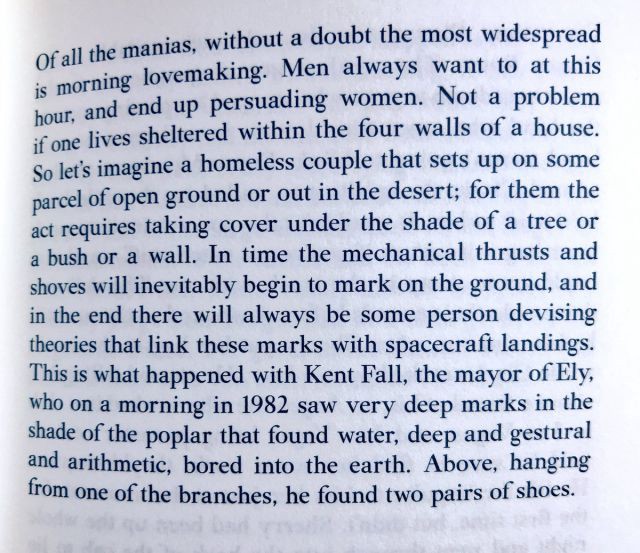
 The narrative is a sprawling, branching even, set of vignettes or prose poems, set around the poplar that found water in the Nevada desert. The tree, nearly halfway along the stretch of road which contains nothing at all and is bookended by a brothel on either end, is one that people stop at to throw their trainers over. Or pass by in an attempt to circumnavigate the globe, or make love under, pass in a hurry or lose your briefcase full of found pictures beside.
 
 Here’s a few snippets:


The stories are universally pleasant brain ticklers — there’s no page that doesn’t provide some sense of hope about it. Each is a portrait of a character or characters initially set against the endless nothing of the desert and equational skyline, which soon morphs into the ways in which people form connections and define their own meaning.
 
 There are grander visions here when the subjects shifts slightly to not just communities and the internet, but also micronations — small organisations of people search for their own kind of liberty away from the rules presented by their current state. Individuals congeal into pairs and small groups to start, forming their own way of seeing the world, and then eventually organise organically into their own discreet societies.
 
 Every story starts from a grain of the material world. It is sort of a way to say that every object contains a story and every one of those stories links people to other people by the physical world we’re in. Our existence is non-negotiable, but whether we see ourselves connected to one another through atomic-level baton handing that leads to shared stories is all in the way we look at things. Which I would say is the most optimistic way to approach a book made up of fragments.
 
 Buy it from Fitzcarrado here.

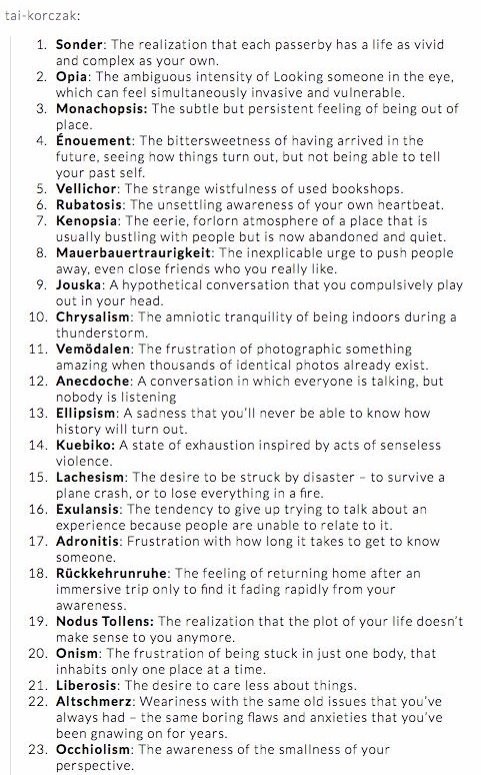
Emotions, I’ve had a few, but then, too many to really categorise prop-er-ly — oh, hold on. There’s this.


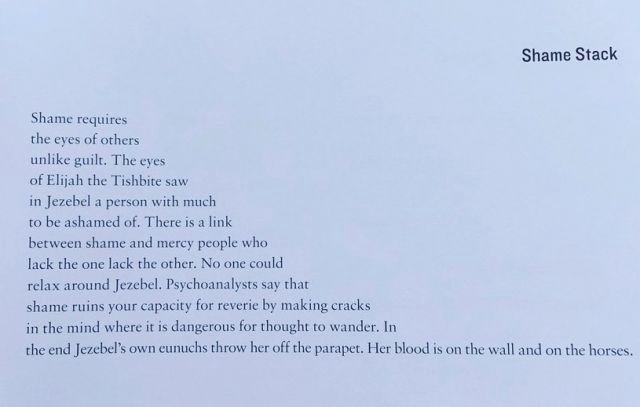
Obligatory Anne Carson snippet of the week:


It’s from FLOAT, by the way.


I’ve been on another one of those YouTube abseiling afternoons where I just listen to covers of one song — and that song is Redbone by Childish Gambino.
 
 This cover has a lot of beard
 
 This cover has a kazoo
 
 This cover has a guzheng
 
 This cover once told me
 
 I have not included all the earnest teenagers here because, while that is clearly the best genre of covers, you probably don’t need to be subjected to that. Why it is okay for me to subject you to a Chinese harp is yours to ponder for the weekend.


Thanks for reading Etch To Their Own, I love you all like you were my own relative units. Me? I’m @CJEggett and you probably signed up for this here. Here’s some relevant units. Forecast for the weekend. It’s an omen. Remember, the important thing about saying anything is that it can only make the world more like the way you believe it to be.

Foam of Sadness

Etch To Their Own

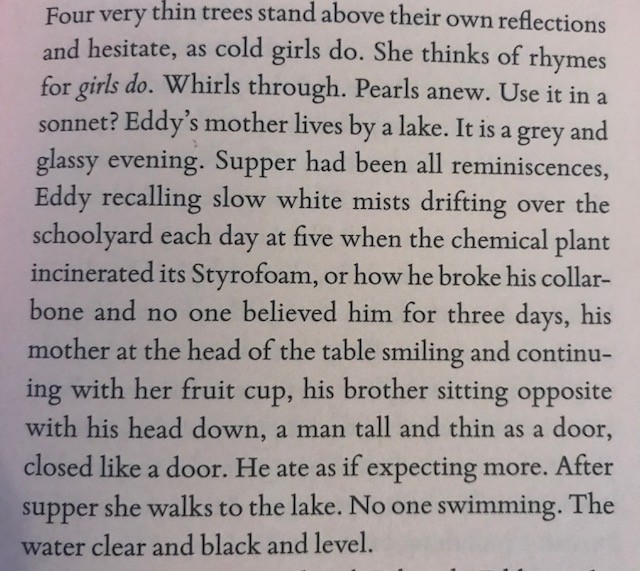
I’ve spent the last week crawling over the coastline of Wales on bicycles, in suits, and with beers in hands. I did manage to do a little reading for you all however, in between the usual holiday blur. But rather than give you something I’ve read over this last week, I think I would prefer to spend some time talking about the Anne Carson story from Brick’s 100th issue, which I tweeted about back here.

The story focuses on the relationships the writer — a lecturer and poet — finds herself in. She is only vaguely strained between two brothers, both of which she has some affection for, and Vern, a female confidant and owner of a collapsing balcony.

The story starts with the lyrical flourish of trying to think up lines for a sonnet, but presented in prose — and it’s this easily agreed connection of language that is the root of Carson’s work.


She makes connection of ideas through very simple means — i.e. the words fit with the previous and an image is created out of the tension, rhyming couplets, repetition of the end of a line, an abrupt change in sentence stresses.

This light connecting of images links with her observational characters — always looking, finding tensions. She likes to stay between the two brothers, because together their connecting lines bring out something good. She is a kind of observing actor in the story, taking action only to improve their view of the world as it stands, to improve their entertainment. It’s like Carson’s protagonist here is asking for meaning in everything that is seen, the world floods over you and you connect everything that you notice before it slips away.

She watches as Eddy, who seems like the initial object of the protagonist’s affection, “gradually vacates himself” — becoming sadder, a little less full of the world. It’s this kind of sadness, and the childishness of the brother that leads to the breaking of the relationships. Eddy’s sadness “foams in her ear” and the relationship with the brother ends too. She has observed as much as she could, and now she has become too entangled that the joy of that tension is broken, like touching a bubble it all popped once too involved.


So, I am helping out at Linen Press at the moment (until they realise I am a charlatan obviously). They’re the UK’s only remaining independent women’s only press. They also have two books in the People’s Book Prize. If you have time to wiggle your fingers over to the website and vote for either The Red Beach Hut by Lynn Mitchell or In The Blink Of An Eye by Ali Bacon that would be really useful for them!


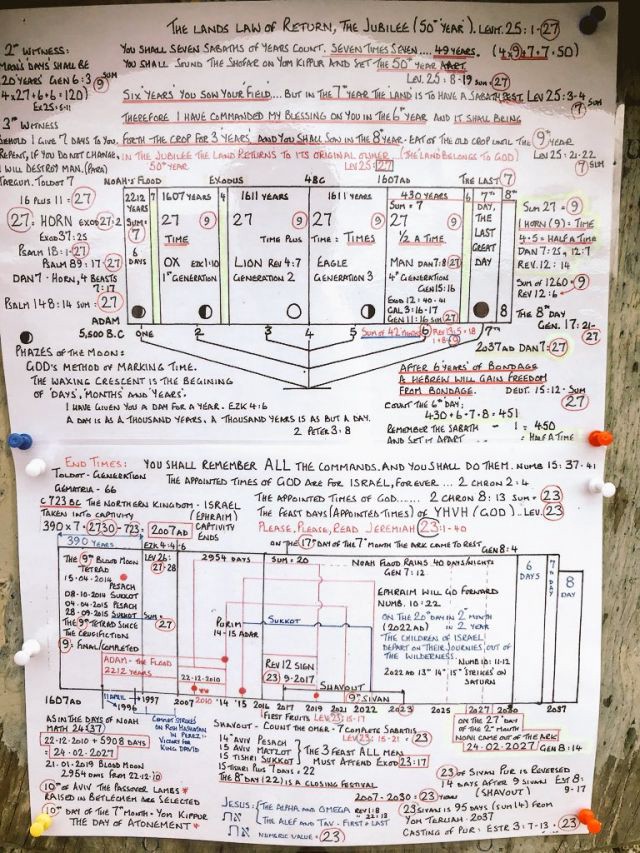
Oh, at the church where the wedding was held last weekend (in which I did a reading that was universally acclaimed as good in a way that I do not trust in the least) there was a new notice pinned the day after. It’s very normal and easy to understand.


I assume it’s about the end of the world. If you have time to work it out and explain it (ideally by adding more lines to the diagram somehow), please let me know.


One of the most closely tracked projects of this newsletter is Mike Kleine’s Lonely Men Club. And now there’s an excerpt on 3:AM. It is exactly as bonkers as expected. I am looking forward to getting my hands on it.


Can a friend kidnap a friend? Sort of, it seems. Laura van den Berg’s Friends in Catapult this week. I like the exploration of places that aren’t really anything because they’re not big or small enough — and the way that this is reflected in the joy of the relationship that certainly is something for its parameters, which include only meeting at night.


This week’s song is Miiike Snow’s Genghis Khan, again. Sorry :)


Thanks for reading Etch To Their Own, it was written by Christopher John Eggett and proofread by no one. I recently went on holiday, which means I went to a cemetery — but this time it was for dogs. What kind of times are these? I think I am dancing silently tomorrow evening, and eating sushi during the day, which sounds very much like my holiday continuing. Will it ever end? I hope so because I am completely knackered. Wish me luck and orderly bodily movements on the dance floor.

Other Womaning

Etch To Their Own

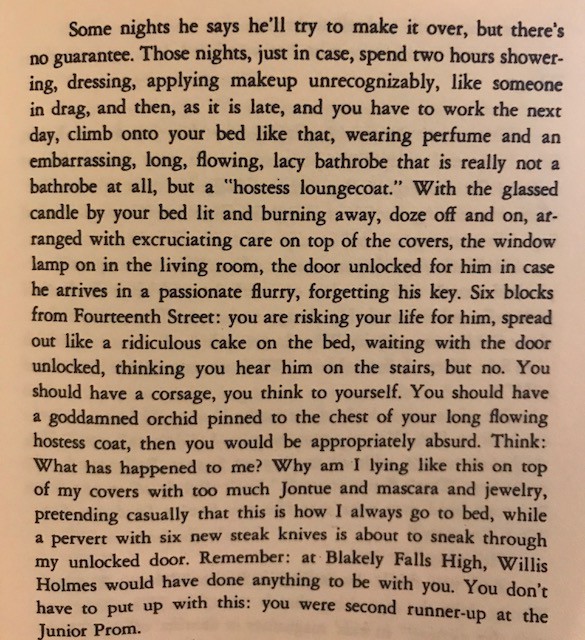
Lorrie Moore’s How to Be an Other Woman, from her collection Self-Help is a instructive-styled short story in which the protagonist struggles with becoming the role. While it seems that it is easy enough to do — fall in love with a stranger who seems in control of their world, discover afterwards that you have become an other woman, the filling out of the role personally requires some kind of magical thinking about the self.
 
 All versions of an Other Woman in the story are built out of the idea of the canonical wife — all aspects of an Other Woman must live partly off this reflection. After all, she cannot be as such without the wife.
 
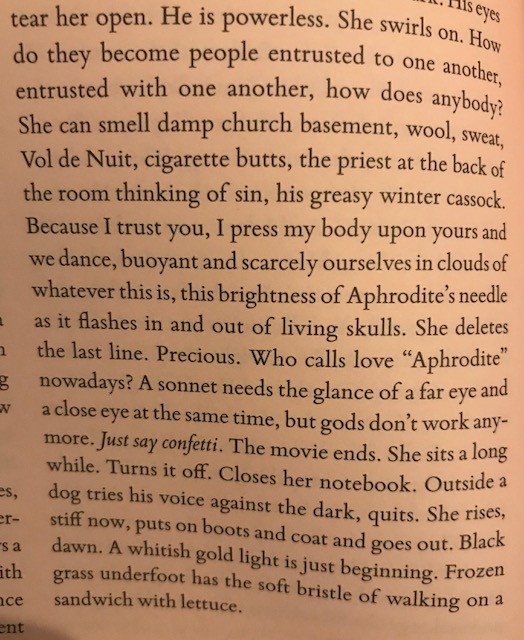
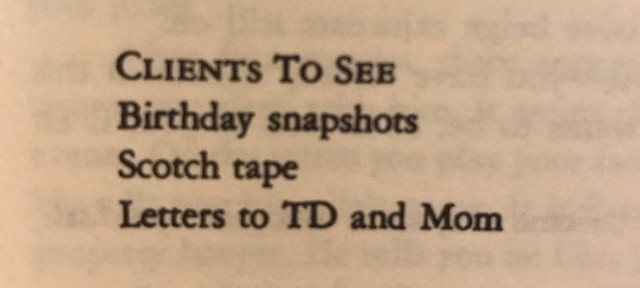
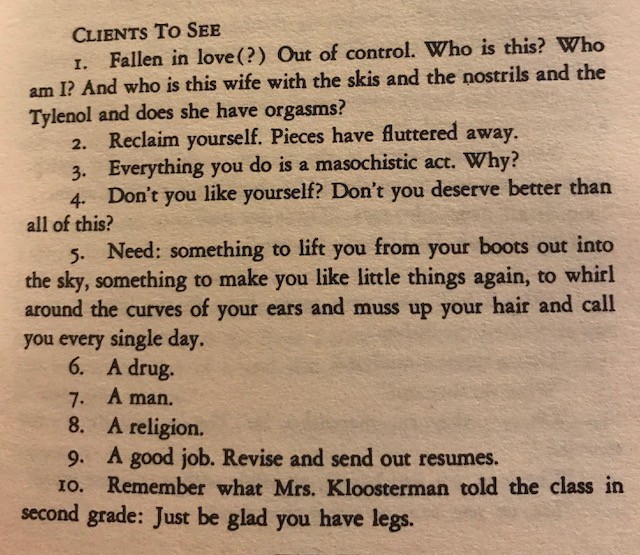
 This identity by reflection comes from the protagonist constantly punning away from the central language of her counterpart. When she discovers that the wife of the man she is seeing makes lists, and that this is something he likes about her, she begins producing them as part of her narrative identity as an other woman:


Our protagonist is constantly punning — changing herself into objects or pushing words and phrases around so they slip from one thing to another. Flipping secretary to sedentary. Jokes about waking up with a jerk.
 
 She refers to herself as a “ridiculous cake” when describing how she is made up to go to bed on the chance that he might arrive. She turned herself into objects often to make the self less real. She has to develop the idea by trying out the reality — I suppose here being The Woman — and then slipping it and flipping it into another shape that seems more appropriate to what she believes she is becoming.


Later in the story when she realises she is not the other woman at all, merely one of the other women that he is building this life around, the taste of it all is tarnished. This makes her entire conceit pointless, and she returns to a world where her otherness is an instructive expression of failure to the women around her — having a good education but an average job, a distance from others, a desire to be plucked out because of her university associations.
 
 In both cases, she is searching for a way to exist that validates herself as a separate entity from hat can clumsily be called the normal world. She reflects on her body through language and separation from the normal things she sees around her. She is searching for some kind of way out, a narrative that satisfies her own existing self through her actions, and one that doesn’t have to belong to the world of women she is surrounded by, or cast against.


This is the weekend of that wedding where I’m reading a thing, hopefully. You can read all about the Carol Ann Duffy poem I am reading this this back issue of ETTO.


This is by the endlessly excellent Mary Ruefle


This week’s song is something dredged up by grabbing CD’s before a car journey without looking at them properly. As such we have another Bright Eyes song, which is nearly timed correctly: June on the West Coast.


Thanks for reading Etch To Their Own. It was written by me, @CJEggett, and proofread by no one. You can sign up for it here, and it will come to your inbox. A lot of people I love are having exciting or difficult times all at once, so I am very stretched out — this isn’t a complaint, just a statement of thinness. I’ve been kindly given the opportunity to help out with some literary projects, which I will update you with some time soon.

It’s No Good

Etch To Their Own

I have had the pleasure of reading Kirill Medvedev’s It’s No Good — a collection of free verse poetry and essays from what some term the Russian Bukowski.


Medevedev’s poetry does have something of Bukowski about it, the muckiness, the poverty, the lines that seem like he’s looked up from the paper to swear at someone in the bar or cafe — but continued jotting that interruption down. However, while they share this rambling freedom to simply put-it-down, there’s the obvious gap left by Bukowski’s lack of politics in his poetry. While of course we read politics into Bukowski’s poetry through his underclass moment, he doesn’t every really express himself as a part of a movement that should ever hold sway on the world. Bukowski is disconnected, revelling in his bottom-feeder status along with his other mud-slurpers. Medvedev’s writing is one that has a view of society as a whole, not as something he is external to.


Medvedev’s poetry is the kind that you simply let wash over you — it is consumable in the same you drink water from the tap. There is little difficult about it, it is what it is — but it is accumulatively good. His power in it is in his constant doubling back on himself, this idea that there’s no truth in a statement that can be left unconnected and uncommented on. These wandering thoughts trip and waltz back on themselves can feel irrelevant at first, but it is in these small moments of circling the idea of fish pate in the supermarket that you realise the demand that everything is connected and organised — if only by the effect of observing them. 
 
 Like all writing of this kind, the joy comes in those changes of texture — odd moments of lyrical flourishing — most of which come in his later poems.


This collection also contains one of the most interesting things an artist or writer can do — which is give up copyright.


As you can see, it’s not without clauses. Interestingly, for someone whose work is so much about the connection between everything (whether economic, spiritual, political) Kirill Medvedev denies the right of publishers to use his work in anthologies. This idea that his work should only be presented beside itself is interesting — but makes sense considering the how the collection reflects on the reforms of the 90’s in Russia which, like most of the world at the time, saw a retreat from power for intellectuals and some politicians — giving over the space of their influence to capital. The idea that someone could subvert your intention through context or association is one that is important, even while giving the rights of your work away.


You can pick it up here from Fitzcarraldo right now.


A great deal of Medvedev’s writing was first published on LiveJournal — here’s a podcast from Reply All explaining the difficult existence and resistance of LiveJournal in Russia.


The above was part of the lovely book post that came from Fitzcarraldo (with a bonus from Paul Hawkins in the form of a Dostoyevsky Wannabe anthology)
 
 I have been getting a lot of nice things in the post, and if you know someone who would like to contribute to the postman’s burden, please put them in touch and I’ll do my best to read everything.


Lydia Davis, one of our favourite short story/flash writers, has apparently blurbed a book about cows
 
 This makes absolute sense considering her masterpiece about cows in Can’t and Won’t of which you can have a snip below:


Kaveh has another thing out, this time in The Shallow Ends.


This Anne Carson story from Brick Mag’s 100th issue is really something — I tweeted some snippets. There may be more to come because I feel it is a really good example of the style that Carson gifts us in her short talks and performances, but on the page.


In looking for something background-noodley, I found these background noodles from 1975 by Suzanne Ciani.


Thanks for reading Etch To Their Own. It was written by @CJEggett on an ergonomic keyboard, but maybe he could write it one something else next time? He has a website. This newsletter has a website too. This is the new street fighter movie? You can catch it by reading. John Wick does and action, he does another, he does another, after a line break — and it is described abstractly, John Wick says something to an interestingly described antagonist, line break, John Wick growls: “is this poetry?”. If you have written something, and would like me to read it, please get in touch. So I’ve only just started listening to this as I write these important closing remarks, and it is possible this should have been my song/album of the week. There’s these novels right, and some of them you don’t like.

Returning To The Logbook

Etch To Their Own

This week we’re returning to our old friend Hiromi Suzuki, who has recently released logbook.


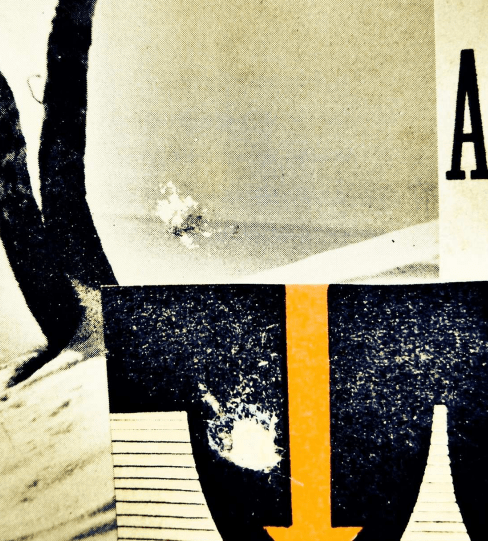
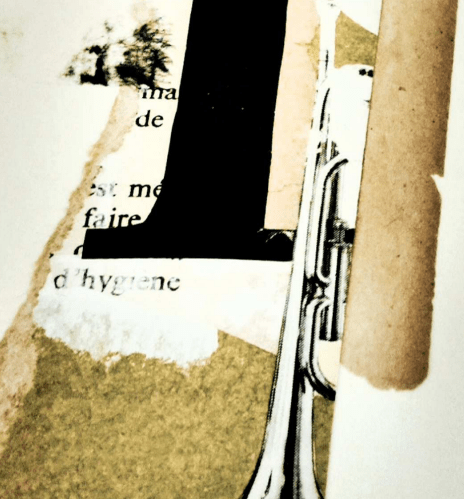
logbook fits with a tradition of artists and poets making collage books as a meditative activity. This differs from the usual way we look at a book, instead of simply being the vehicle for the poems or text, the books is itself a tangible art-object.

While Suzuki in this excursion is more of an artbook than a poetry one, we see similar playfulness to the work when we first noticed it back in issue #5.


These punning on structures and objects in Suzuki’s style, layered texture and a glitching/washing out of various elements on the page is where we start exploring the themes of the book.

Punning, and the kind of wordplay-with-structures is a kind of pure and childish entertainment. It scratches at some direct sense of pleasure you get from connecting two things oddly but correctly.

There is a strong theme of nostalgia here, as if the memories present the broken up views of children in a world not quite made to their scale, obscured and moved often against their will.


(all images are segments clipped from the book, not full pages)

Hiromi’s mission statement, at an early break in the book, is that by producing these things as a form of automatic writing they are engaging with them as memories. Somehow I feel this is about respecting the subconscious tar-pit part of the brain where your basic urges bubble up from. By giving over to the part of the brain that applies pressures without form Hiromi builds up these sketches of scenes/memories in the way we form them in our minds — not complete or scrutinizable.


Poets and artists who use book making as a form often engage with it upon a similar line to Suzuki’s — taking something away from themselves in creating the object, removing some kind of authorship. Anne Carson said similarly of NOX, a grief object for her estranged late brother, using the form of definitions to develop her own responses. I wonder if it is in the obviousness of where things go when they are physically placed before you that leads to this, or the ritualization that comes from it. A ritual has to involved the whole body somehow.

A later part of the artist’s statement says that Hiromi creates a collage each night before falling asleep as an act of forgetting, distraction, allowing the ritual obviousness of the collage dig into part of the brain and produce the work without conscious presence.


Buy it here.


This week’s song is, of course, Childish Gambino’s This Is America.


Thanks for reading Etch To Their Own. I, @CJEggett, writer of newsletters and proofreader of none, have been cycling in the sunshine all week and really couldn’t be fuller with love for the world or vitamin D. You can read this online, later. I got a really nice email from probably my favourite publishing house saying they want to send me things to review, so there will be more of that sort of thing to come.

Nice

Etch To Their Own

I am reading at a wedding later this month, and was asked to pick a poem. It turns out that this is surprisingly difficult, despite the endless pool of poetry about love and devotion that we regularly paddle in round these parts.
 
 We ended up stewing in a pile of books spread across the floor, every piece of poetry I own skimmed for something that seemed appropriate. Quite a lot of it is inappropriate, because, as Kaveh Akbar mentions on the VS podcast this week, there is an issue with poetry that you come to with a complete idea. Complete ideas are without the tension of being built on the page lack some sense of wonder and confusion that comes from the internal tugging of a poet with the concept.
 
 A wedding and marriage are simple and complete ideas, and as such not all that good for poetry despite that central theme of love. As we worked through the piles of books, sending ones we liked to the bride, we discovered that all these love poems are about love missed out on, love and regret, love and dying, infidelity, or get a bit too sexy for a mixed gathering.
 
 We even turned to giant bible-paper collections I haven’t opened since studying, and old collections that I’ve only dipped into from time to time.
 
 We ended up with something from the first book we went to, one that I bought a friend as a wedding present. I read at that wedding too (extremely fast, extremely embarrassing) — and was told later that it was funny that I bought them a book of poetry filled with poems that might have been more appropriate.
 
 That poetry book is the only poetry book my better half has read entirely, that is dedicated to slow love completely, and occasionally makes people shudder because they studied the author at school.
 Rapture by Carol Ann Duffy remains one of my favourite poetry collections to return to simply because it contains such a single and complete idea of love.
 
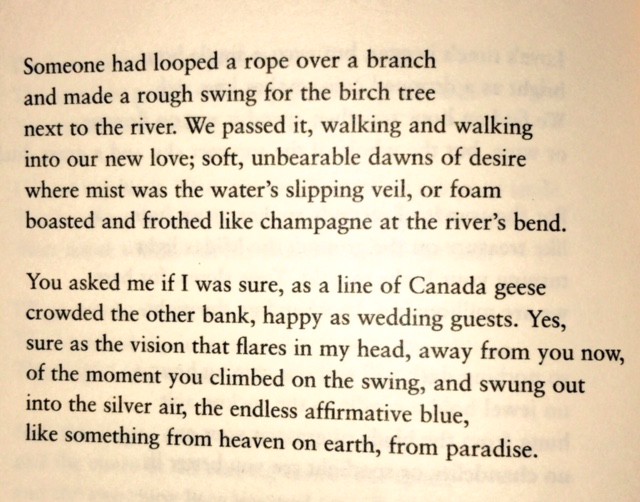
 The poem that has been chosen is Swing, which you can read below:


It’s quite good for a wedding — the geese guests, the looping of the swing round the bough like a ring, the veil. The celebratory champagne, at the bend of a river, where the flow changes course while being of the same current. The asking and the shameless joy of the action.
 
 The swing metaphor itself is a nice one, because the joy is simple and the excitement/threat of swinging over the river is a contained one because it’s tethered. There’s the idea of pushing someone on a swing, a kind of selfless labour. And out into what — an affirmative blue, and idealised space that one must imagine the space beyond a wedding to be like.


Interesting picking through the idea of island erasure in the name of tidy maps.


I saw some sunshine recently, which means I have been listening to Kendrick.


Thanks for reading Etch To Their Own. It was written by @CJEggett and can be found in your inbox on a Friday if you sign up via tinyletter, or online on medium a little while later. Please don’t GDPR me. I have been reading about Sheol and mushroom farming. Good phrases from the latter are: “fire-fang”, “local nurseryman”, “fruitbodies”, and “peak-heated” — all coming to a poem near you soon (one hopes).

Ghost Hotline

Etch To Their Own

When reading and relaying something about Anne Carson, there’s an urge to simply say: yes, it is her, more of her, in the way you expect tickling the same parts of your brain.
 
With issue two of The Well Review (which is very good in itself) came with a lovingly put together pamphlet by Anne Carson. The pamphlet is called Ghost Q & A — and it is just that, a chat with a ghost.
 
Here’s a sample:


The ghost (or ghosts, it is hard to tell if this is the same voice responding) are unsurprisingly interested in the kind of things Anne is most of the time. This includes language and the unseen/obscured. She questions on grammar and there is a suggestion that it is different there, in a way that excludes the living — not that both are equally missing language. She asks about Virgil and is treated to the difference between shame and guilt — here being that guilt is not always observed from the outside.


Naturally, anything about ghosts is about liminality and the Q&A format is one which allows us the sense of something passing back and forth between an obscuring veil. Like the guilt discussed, there is some things, from the outside, which cannot be directly understood by the questioner. Equally, with the unwholeness of the grammar available to the questioner, it would not even be possible to put forth the right answers.
 
Later there is a discussion about zeros, there is a man whose jobs is the zeros — you can’t put one in until you take one out. This idea of displacing nothing with nothing, and that it is a labour, expresses an idea of an afterlife that can only be partially gratifying for the living.
 
There are no satisfying portrayals of the afterlife, they are either unknowing entirely — like that which is beyond heaven in Dante, or they are replications of life as we know it without direct pain but still many of its painful structures such as in The Lovely Bones. Here in this version we get a bobbing-for-apples version where we learn that it is neither extreme nothingness nor saccharine replication, but a reassurance that there are the things we need to be human and individual, language, space, movement.


There is a version of Ghost Q & A on A Public Space. This is only somewhat similar to the version published by Well Review, and might be considered an earlier draft of this work or the things that this version is responding to.
 
 But I do very much like how it ends however:

Q does your hair keep growing
 
 A yes but it is apples


Mike Kleine goes into how he put together his mad zodiac manuscript. It looks like it’s going to be complete magic.


Writing a novel on a phone seems a bit daft, but apparently lots of people do it. I have been trying it recently with siri’s dictation, and I like the madness it comes out with — it’s wrong, but it provides a good disconnect from the freeflow of my brain to the editor who deals with it at the other end. I am not sure I could manage the whole thing however without the disconnect freedom that comes with really jamming on a keyboard.


Like this one from our Sammy.


As you know, I started this partly to have a way to protect my brain from the rubbing sludge of everyday life that clogs moving parts and smooths sharp edges. It was also an exploration of discovering what I actually love in literature — it allows me the chance to be as fully aware of the stuff we’re surrounded by, and what I want to emulate and reflect in my own writing. Here’s a better articulation of that from Inside The Castle.


Cool thing I don’t understand of the week.


This week’s song is Rid Of Me by P J Harvey


Thanks for reading ETTO today. Did you know that Samuel Beckett drove Andre The Giant to school? I didn’t and then looked it up and turned out that yes, indeed he did. This email was driven to your inbox by @CJEggett, and his loud fingers. It could have been Henry Lee again, but it was that instead. My better half is away at a hen do somewhere, so this weekend should be a good one for a big writing project — but it’s more likely to end up with video games and sleeping. Feel free to do a Q&A with my ghost when the time comes.

Books Away From Home

Etch To Their Own

This week’s ETTO is being drafted in the tiny terrible seats of a Ryanair flight to the wonderful city of Berlin. As such I can’t offer much in the way of close reading, but I thought I would see what I can come up with in airplane mode.
 
I was thinking about books away from home, and how reading changes with your location. I had a reading week in Berlin a few years ago as a friend I was meaning to visit had to disappear to a damp warehouse to make an art film, I was left in the city with books. I picked up a number of short things, including my first brush with C A Conrad and The Book Of Frank. I dined our alone with a H P Lovecraft collection and remember getting spooked in the UBahn station on the way home before receiving a call from my displaced host from his cold, leaking barn, where the mad film was being made. I felt a little bad that I was enjoying his gift of a week of reading while he was shivering for art.
 
The week of reading alone in a foreign country gave me a chance to take dives into these books without coming up for air — room for contemplation and extension. Ben Marcus once said something like: “I knew I was a writer when I would be reading a book, then stop reading, and the story would continue”. This idea of taking the world you’re given in fiction and wandering on with it is aided by the isolation of being away from your homeland and the interruptions that come with unavoidably understanding your language.
 
Similarly there’s something special about English bookshops abroad. It is a condensed representation of English language culture from usually one or two people’s point of view. Whereas you can wander the aisles of Waterstones and feel a bit lost with the huge amount of popular fiction, the a-z and cul-de-sacs of genre, these smaller shops will just display a manageable understanding of what’s available and good. 
 
Years ago in Bangkok I went to the English literature section of one of their large chain bookstores, inside the palatial malls and found myself faced with a single ten metre shelf. It covered it, fairly happily. It hard to look at an ideal summary of the cannon of your culture on the shelves thousands of miles away and not feel a little bit happy to have such a history to draw on.
 
In Nantes, a tiny corner of a bookshop was dedicated to modern English fiction. Here I picked up Pond by Claire-Louise Bennett, and read it each day after cycling to the next location, bouncing with flow of the prose as the Loire slumped alongside. The location of the reading made the stories of the complications of a simple life in the sunshine more direct in feeling. 
 
The time spent with books in reflective moments like this give them the opportunity to set roots in a way that the books you fit in amongst the jumble of life don’t.


Okay, you can have a bit of poetry


Song of the week this week is Portugal The Man “feel it still”


Thanks for reading Etch To Their Own, Sorry my links are not beautiful. I started this on a plane and am finishing it in a beer garden. If you’re in Berlin please say hello 👋🏻