Ghost Hotline

Etch To Their Own

When reading and relaying something about Anne Carson, there’s an urge to simply say: yes, it is her, more of her, in the way you expect tickling the same parts of your brain.
 
With issue two of The Well Review (which is very good in itself) came with a lovingly put together pamphlet by Anne Carson. The pamphlet is called Ghost Q & A — and it is just that, a chat with a ghost.
 
Here’s a sample:


The ghost (or ghosts, it is hard to tell if this is the same voice responding) are unsurprisingly interested in the kind of things Anne is most of the time. This includes language and the unseen/obscured. She questions on grammar and there is a suggestion that it is different there, in a way that excludes the living — not that both are equally missing language. She asks about Virgil and is treated to the difference between shame and guilt — here being that guilt is not always observed from the outside.


Naturally, anything about ghosts is about liminality and the Q&A format is one which allows us the sense of something passing back and forth between an obscuring veil. Like the guilt discussed, there is some things, from the outside, which cannot be directly understood by the questioner. Equally, with the unwholeness of the grammar available to the questioner, it would not even be possible to put forth the right answers.
 
Later there is a discussion about zeros, there is a man whose jobs is the zeros — you can’t put one in until you take one out. This idea of displacing nothing with nothing, and that it is a labour, expresses an idea of an afterlife that can only be partially gratifying for the living.
 
There are no satisfying portrayals of the afterlife, they are either unknowing entirely — like that which is beyond heaven in Dante, or they are replications of life as we know it without direct pain but still many of its painful structures such as in The Lovely Bones. Here in this version we get a bobbing-for-apples version where we learn that it is neither extreme nothingness nor saccharine replication, but a reassurance that there are the things we need to be human and individual, language, space, movement.


There is a version of Ghost Q & A on A Public Space. This is only somewhat similar to the version published by Well Review, and might be considered an earlier draft of this work or the things that this version is responding to.
 
 But I do very much like how it ends however:

Q does your hair keep growing
 
 A yes but it is apples


Mike Kleine goes into how he put together his mad zodiac manuscript. It looks like it’s going to be complete magic.


Writing a novel on a phone seems a bit daft, but apparently lots of people do it. I have been trying it recently with siri’s dictation, and I like the madness it comes out with — it’s wrong, but it provides a good disconnect from the freeflow of my brain to the editor who deals with it at the other end. I am not sure I could manage the whole thing however without the disconnect freedom that comes with really jamming on a keyboard.


Like this one from our Sammy.


As you know, I started this partly to have a way to protect my brain from the rubbing sludge of everyday life that clogs moving parts and smooths sharp edges. It was also an exploration of discovering what I actually love in literature — it allows me the chance to be as fully aware of the stuff we’re surrounded by, and what I want to emulate and reflect in my own writing. Here’s a better articulation of that from Inside The Castle.


Cool thing I don’t understand of the week.


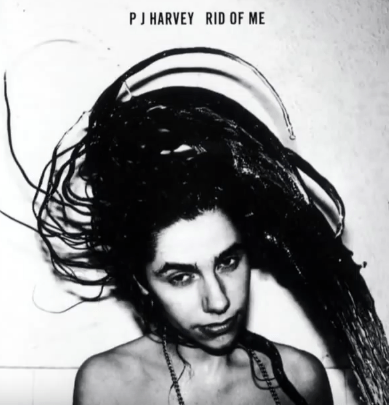
This week’s song is Rid Of Me by P J Harvey


Thanks for reading ETTO today. Did you know that Samuel Beckett drove Andre The Giant to school? I didn’t and then looked it up and turned out that yes, indeed he did. This email was driven to your inbox by @CJEggett, and his loud fingers. It could have been Henry Lee again, but it was that instead. My better half is away at a hen do somewhere, so this weekend should be a good one for a big writing project — but it’s more likely to end up with video games and sleeping. Feel free to do a Q&A with my ghost when the time comes.
Books Away From Home

Etch To Their Own

This week’s ETTO is being drafted in the tiny terrible seats of a Ryanair flight to the wonderful city of Berlin. As such I can’t offer much in the way of close reading, but I thought I would see what I can come up with in airplane mode.
 
I was thinking about books away from home, and how reading changes with your location. I had a reading week in Berlin a few years ago as a friend I was meaning to visit had to disappear to a damp warehouse to make an art film, I was left in the city with books. I picked up a number of short things, including my first brush with C A Conrad and The Book Of Frank. I dined our alone with a H P Lovecraft collection and remember getting spooked in the UBahn station on the way home before receiving a call from my displaced host from his cold, leaking barn, where the mad film was being made. I felt a little bad that I was enjoying his gift of a week of reading while he was shivering for art.
 
The week of reading alone in a foreign country gave me a chance to take dives into these books without coming up for air — room for contemplation and extension. Ben Marcus once said something like: “I knew I was a writer when I would be reading a book, then stop reading, and the story would continue”. This idea of taking the world you’re given in fiction and wandering on with it is aided by the isolation of being away from your homeland and the interruptions that come with unavoidably understanding your language.
 
Similarly there’s something special about English bookshops abroad. It is a condensed representation of English language culture from usually one or two people’s point of view. Whereas you can wander the aisles of Waterstones and feel a bit lost with the huge amount of popular fiction, the a-z and cul-de-sacs of genre, these smaller shops will just display a manageable understanding of what’s available and good. 
 
Years ago in Bangkok I went to the English literature section of one of their large chain bookstores, inside the palatial malls and found myself faced with a single ten metre shelf. It covered it, fairly happily. It hard to look at an ideal summary of the cannon of your culture on the shelves thousands of miles away and not feel a little bit happy to have such a history to draw on.
 
In Nantes, a tiny corner of a bookshop was dedicated to modern English fiction. Here I picked up Pond by Claire-Louise Bennett, and read it each day after cycling to the next location, bouncing with flow of the prose as the Loire slumped alongside. The location of the reading made the stories of the complications of a simple life in the sunshine more direct in feeling. 
 
The time spent with books in reflective moments like this give them the opportunity to set roots in a way that the books you fit in amongst the jumble of life don’t.


Okay, you can have a bit of poetry


Song of the week this week is Portugal The Man “feel it still”


Thanks for reading Etch To Their Own, Sorry my links are not beautiful. I started this on a plane and am finishing it in a beer garden. If you’re in Berlin please say hello 👋🏻

Cove

Etch To Their Own

I paddled through Cove by Cynan Jones this week. It’s a joyously short (some 90 pages book brought to us by Granta. I may have said this one hundred times before — but if you’re writing a novel, please make it the shortest best thing you can, for my sake.

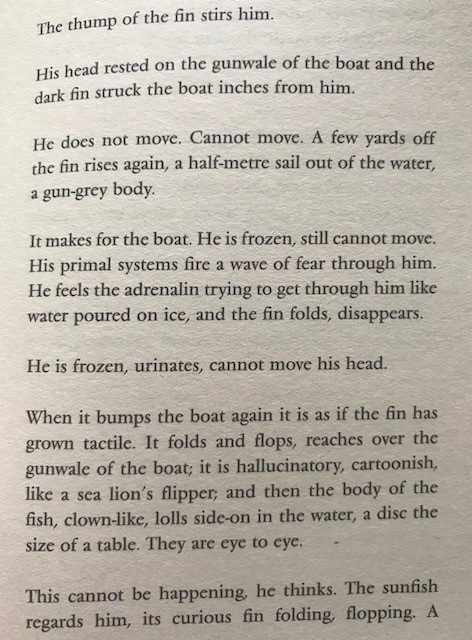
The story follows a man taking his father’s ashes out to sea in their old kayak as a storm edges in. He’s struck by lightning and we follow his amnesiac attempts at survival. Here’s a tiny taste:


The language of the book is sparse with short paragraphs almost entirely snatched at the crest of a wave. The flavour comes from exactness of that language — he “husbands” his exploded and ruined finger, the “gunwale”, the “stile” and so on. This isn’t exotic or unusual language; it’s just exactly what is needed at the time to describe exactly what is happening with complete utility.
 
 While there are moments of lyricism and magic — the arrival of the sunfish which rubs against the boat and possibly keeps him within reach of land — there is a sense that the language can be so plain and sparse because of the obviousness of the sublime of the sea. The situation needs no adornment, we are simply told what events are when they happen: “the sun drops beautifully” for example.
 
 This plainness of language fits with the shock of the lightning strike and the grieving. The man goes out to the sea to spread his father’s ashes — or to have a fishing trip with his father before doing so. He hears his father’s voice in the early parts of the story, as is common for the grieving. When lightning strikes, the man is covered in his father’s ashes — and he loses his memory of what he is doing out there or even who he really is.
 
 Unmoored, literally and figuratively, he tries to piece back together what he was doing with the objects around him. Like the obviousness of the language that we use to put things together, he then has to do the same — coming to the conclusion that he was fishing too far out, and that’s all, to begin with.
 
 The simplicity of his situation means that he in the first instance loses the notion of his father, and the notion of his partner — for whom he left a very short note about buying salad. 
 
 This note, and thoughts about not mentioning where he was going, shows the possessiveness that grief gives people over the past. The future is, at the beginning of the story, of less importance. 
 
 He in losing these things can only reach for primal survival instincts, deep things that simply tell him to move towards the land, to ration his water, to eat the raw fish he’d caught earlier.
 
 The forgetting levels his grief with his future. We know he came to the boat with the idea of his father’s ashes; he wanted to speak to them to make them real. He was at the end of his grieving, but not yet looking up to the future. His survival push takes that weight of the past and puts it in the lap of the future — making the throwaway note about salad and everything that surviving would mean as important. 
 
 With this grief is overturned, the voice of his father comes to him to provide guidance toward the future, not as something from the past that he wants to keep to himself.


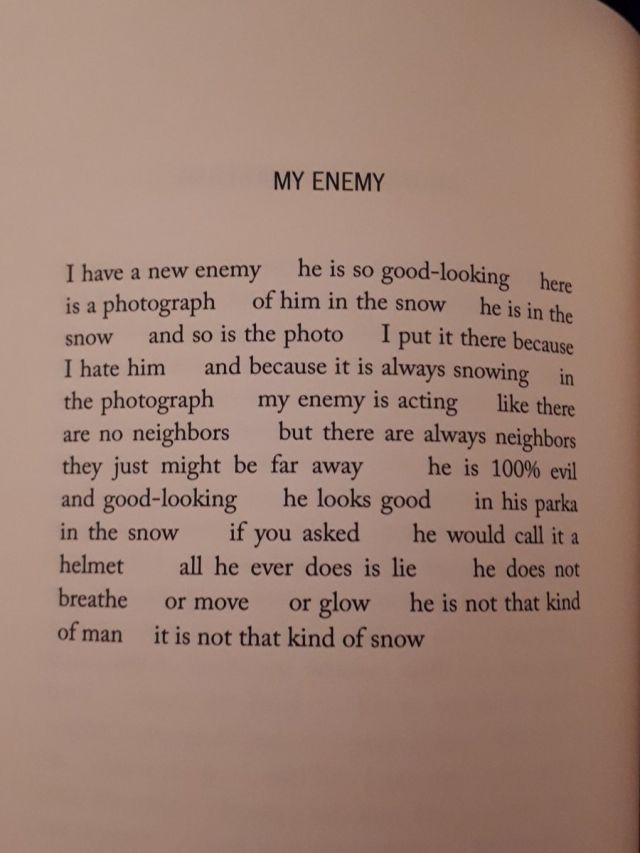
Looking for poems with percentages, unearthed this:


By Heather Christle.


A day with Kaveh.


Quiet.


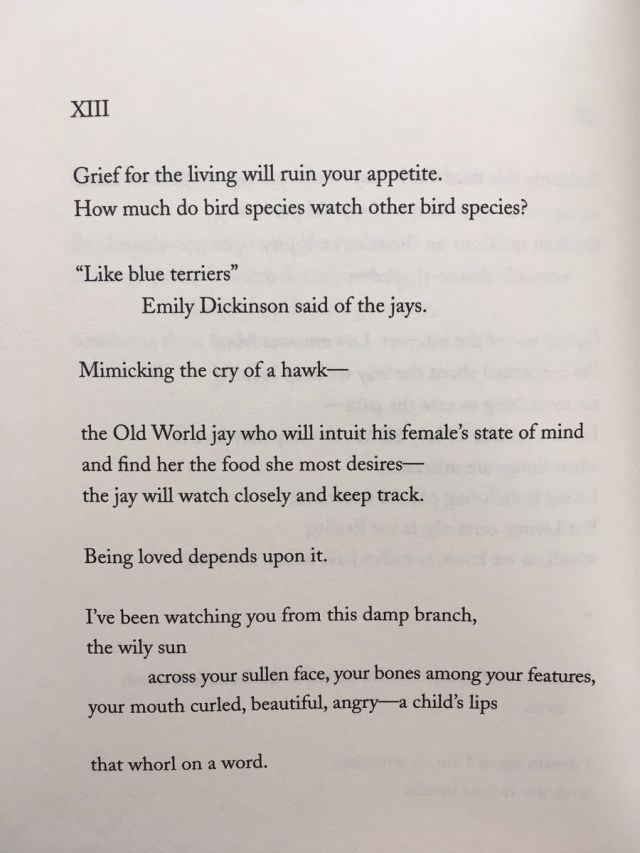
I think I need to pick this up: Bianca Stone, from Blue Jays in The Möbius Strip Club of Grief


It is like this. The night is lonely until it isn’t.


This week’s song, because I have listened to nothing much but very soothing synth demos like those by Red Means Recording and Knobs, is: Toto’s Africa Played On A $1 Piano.


Thank you for reading Etch To Their Own, which squats upstream of your inbox every Friday like an inconsiderate medieval neighbour. It was written by me, Chris. This is a comic about birds, beasts, and fish that I noticed today. One for the lapin du mer fans. Don’t tell me that’s not French. I got a really nice email about how someone — one of you lovely people — reads my newsletter as part of their Sunday ritual. It warmed all parts of me that are decent yet internal. If you like any of this, it’s nice to hear, also, if you spot a typo, please let me know and I might even correct it. Someone has released my nudes apparently. IRL ❤ emoji or actual death? MORE SYNTH. I once thought about getting into modular synth, but I am not smart enough nor to be trusted with wires.

Bee Wolves & Godlike Distance

Etch To Their Own

Paige Lewis offers us this in the Rumpus: It’s Hard To Enjoy The Stars When You Don’t Trust Your Neighbours


The poem takes us from the difficulty of observing something grand — stargazing — to the ease at which we flip ourselves into positions of power.
 
 While she compares the flooding of millipedes — her own godlike act — to the man who invents a bomb in the film, it is suggested that this flip from glancing up to punching down is one in reaction entirely to mistrust. She glances over her shoulder, making herself dizzy in trying to see the stars — a cosmic swirl like that of her ear (where our bones for balance are) — because she doesn’t want to be exposed to any kind of attack.
 
 The dramatic irony continues in her ability to “forget where cold comes from” while judging the scientist for his quick forgiveness of himself. He is wider eyed than the poet, his choice of ignorance making him handsome, ignoring the similarity with the choices the poet has made.


CA Conrad, one of my favourites, talks extensively on the commonplace podcast with Rachel Zucker. Hold this to your ear.
 
 They cover The Book of Frank and how CA’s poetry became a factory, the editing process that is gone through for their Somatic verse, queerness, and most hauntingly — a very frank description of the trauma of CA’s boyfriend, Earth’s, death many years ago.
 
 This last part is interesting particularly because CA used ritual to shock themselves free from a movie that started playing in their head. The movie was a revenge fantasy mixed up with the story of the real events — and the real events are a horror show told very directly.
 
 CA also reads some of their poetry, including some work to be published later this year.


I have been working through Beowulf again this week and comparing the Tolkien version with the Seamus Heaney version. It is how you expect — Tolkien is a bit of a tart with plumped up speech and Heaney trims back with kindness. Heaney’s remains verse while Tolkien makes it prose. Tolkien skips nothing and Heaney skips as much as possible.
 
 This aside, the version of the Tolkien I have has Sellic Spell in it too. This is a completely reworked version of Beowulf, removing much of the politics and speeches, and instead getting down to the bones of heroes doing heroing despite what people expect of them. It’s a playful retelling, likely for children, which renames characters to things like Beewolf, Breaker, and Grinder. Importantly it retains a few of those telling things that make Beowulf — a good (if shorter) boast, the importance of unarmed combat and the sadness at having to leave some treasure behind.


Speaking of Grindr.


If you enjoy the environmental and generated storytelling of video games as I do, then you may be interested in this Dwarf Fortress documentary/video.


I am in love with this little thing. I like it so much that I feel like I have shared it with you before.


Today’s song is, oddly, Talking Head’s Once In A Lifetime.


Thanks for reading Etch To Their Own, @CJEggett writes these every time and barely glances at them before hitting send. Buy me this for my short fiction. I can’t remember if we’ve made that joke already. A poem. Read my story again. I would like to say that I still appreciate you even if you unsubscribe, of course, if you did that last week then you don’t know that. This is why the men of Portugal are so sad. Long egg. Big egg. Promise egg. I may have found my spirit animal. Fade out. I know you’ve seen this already but it did make me giggle.

girls too proud to climb trees

Etch To Their Own

It being a bank holiday in the UK means that the world is off-kilter, every day for the next four will feel like one smeared Sunday, and the only thing you’re sure of is that you’re probably going to overindulge somehow.

As such, ETTO is a little fragmented today.


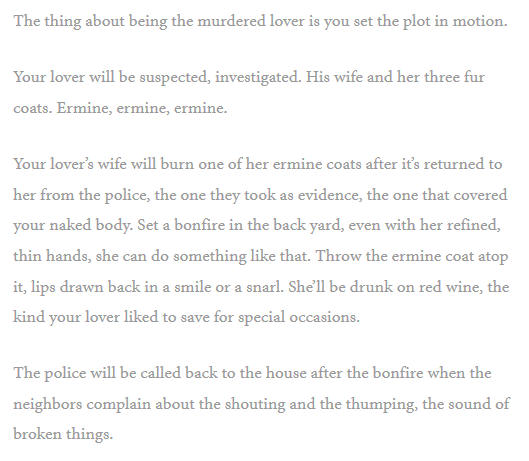
Cathy Ulrich has, again, an excellent short story in Cotton Xenomorph: Being The Murdered Lover. Here’s the start:


The story ripples out from the murdered corpse and reflects on the ways in which the murderer created a perception of the woman for his own gaze — an out of character photo that came to be the most seen image of her. There’s an implied victory on the part of the murdered, in that her death poisons the way everyone is seen around her — arguing somehow that even as a plot point there is still some agency.


I have a story in Burning House Press this week. You should read it, because it is very rare that someone actually publishes something I send them :)

I was going to make a joke at the start that this is what we’d be doing a reading of this week, but I didn’t think I could take the panic unsubscribes.


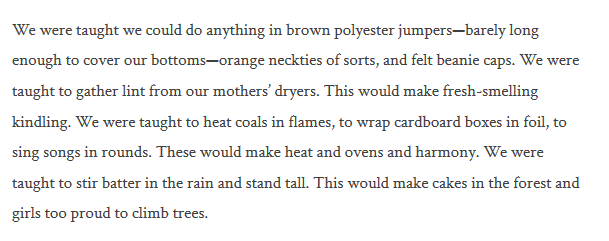
In The Offing we have a couple of micro fictions by Ruth LeFaive. Here’s We Were Taught To Serve God and Country


I enjoy the exploration of the domestication of the forest through some sort of Brownies organisation which is at its heart a fabrication — fresh smelling kindling from the dryer against the assumedly unfresh nature for example. I feel it’s a critique of the expectations set by such organisations — that the set of tasks are not directly related to the taught outcomes. A kick out against an unsatisfactory experience which is made ironic by its directly natural setting.


This week’s song is Sorrow by The National — and in trying to find a version for you to listen to (which doesn’t involve you popping on over for an evening of listening to depressing shit) I found something pretty magic. It’s the right song, but a live version (no, don’t leave) and it’s 6 hours long.

Apparently The National were asked to perform Sorrow for 6 hours straight, uninterrupted, at MoMa. They seem to have done a pretty good job of it — even on the 90th plus time of playing the song in a row.


It’s in my honey, it’s in my milk


Thanks for reading this week’s slightly shorter than usually Etch To Their Own. It was dredged, confused and humble from the chest of @CJEggett and proof-read by no one. I had a dream that was quite scary while I was in it but I woke overjoyed because it was was so rich and real and symbolic. Hey, maybe we should? What if my heart is unhinged from the weight of my lice ridden wings? For real. The third gender. Please try to enjoy your nationally enforced frolic time — even if that mean seeing your family, staring at a grey and wild sea from inside beach hut to reading my tweets. As always, it would be cool if you could tell someone about this newsletter. Some examples: approach people at the garden centre, slip the attractive waitress the sign up form in a way that suggest it might be your phone number, tell people you match with on Tinder before blocking them, get an index card and pay to have it put up in the post office, inform you clients they need to sign up to be GDPR compliant, have it tattoo’d somewhere obvious but tasteful, when buying beeswax to do the counter-tops ask if they have anything for poetry on a friday, call your mother, get down on one knee and ask your closest cohabiter whether they’d like to sign up, leave it on a post it in a passive aggressive fashion for your flatmate, break in to the fortune cookie factory and make me fortunate.

just two future corpses, about to fall in love

Etch To Their Own

With a perfect balance of darkness, silliness and threat, we have Elisabeth Ingram Wallace’s Our Black Comedy.

The piece has a kind of roving-eye view of a long relationship, dipping in and out of small, tender moments of memory to build into a larger image and a shared framework of understanding.


You can read all of it over on SmokeLong.
 
There’s a fight to domesticate darkness:

“I hold your hand under the high crime lights. The CCTV cameras are all smashed and we decide to buy an ugly dog.”

Here of the way that the undercutting comic language brings a safety to dark thoughts, ideas, moods. Or here, the safety in possessing:

“Rupert is your ghost. The ghost of a boy murdered by Catholic school priests.”

It’s your ghost (but naturally, not the one you’ll leave behind). Another pet, like the ugly dog. Something to care for, even if he slithers through the walls to play a game referred to as “stab-stab”.
 
That domestication through possession extends to the speaker too however — entangling with the concept of female power being monstrous. The caterpillars fall from trees at the sight of a woman menstruating, he falls into depression/mania when she directly approaches his mental health issues. Perseus was a slayer of monsters, she is meant to slay his monsters usefully, not draw them out.
 
Her answer is to do what she does to the dark things in the house. She domesticates herself by becoming an object, animal, other — a monstrous elephant foot and a soft-bellied shell-fish. To provide a kind of distancing through the darkness of comedy, the green-screen horror in making the darkness of a place easier to contend with by making it fun, a play.
 
There is an idea somewhere in this that the mutable aspects of the speaker is what makes them more mentally healthy, more resilient. The fact they can make fiction of the darkness around them, make comedy from it, is what allow them to exist fully — whereas the speaker’s counterpart is only able to be haunted externally.
 
You can find more of Elisabeth on her website.
 
(I reached out to Elisabeth to find out what kind of dog it was. I imagined a kind of lop-sided pug, or French bulldog. Apparently it’s quite possibly a Staffie, but she would prefer you to insert a dog of your own choice. Answers by reply to this email please.)


I have a short story about accidentally ending up with a rude lobster for a boyfriend going up on Burning House Press on the morning of the 30th.


This week I have also had the pleasure of reading Smoke Gets In Your Eyes by Caitlin Doughty. This is a book by the second best thing on Youtube — Ask A Mortician.
 
(NOTE: number one is videos of impossibly skilled people making sushi and sashimi)

While the videos are delivered in a bouncy sort of way that allows an open and honest interrogation of death, the book gives us deeper dives into the day-to-day of the death business. It’s got a similar speed that skims across ideas, occasionally diving down into individual concepts (cannibalism, embalming, witchcraft) and Caitlin’s experience — including the fear of death that was triggered from watching a child fall from the second story balcony in a mall.

I would like to show you a snippet of it, but because the whole thing relies on her style of long-punting the point of a story (starting a chapter with how to create your porn start name to then simply use it as a device to talk about her first experience of death in childhood, talking about ritual in witchcraft involving babies to then talk about that aspect for a crematorium worker’s job) would be showing you something shocking and upsetting. It is in this wonderful weaving on context that you manage to pull the life out of a book about death.
 
I have always thought that I was very open about death, but the book provides even further opportunity to interrogate your own feelings about the dead, death and dying. One side effect is the sudden realisation that it might be quite fun to plan your own funeral.
 
You can pick up the book here.


To continue the theme a little further, I would like to recommend everyone check out the Caring Into The Void podcast.
 
Each week they pick a story of strangeness and then find some way to provide a self-care message from it. It’s a self-care podcast, but metal. This week for example, in relation to a project where one twin was sent into space for a long time and began firing “space genes” because of the extra stresses his body was put under — the message is to embrace adventure if it is likely to change you, especially if you’re likely to grow wings.
 
Additionally, their sign off is something like:

“keep your hearts pure and dark, and your teeth innumerable and sharp”


Thank You For Shopping With Us by Anne Casey.


I have been treating my ears to the early-to-mid oughts this week. So this week’s song(s) are:
 
Dry Drunk Emperor by TV On The Radio & Last Night by The Strokes


Thanks for reading Etch To Their Own which has been ritually dumped onto the crematorium conveyor belt by @CJEggett, and proofread by no one. Please send flowers. We obviously need a millionaire matchmaker for this sort of thing. Hannah is in a book, I might have sent you here before, but if you didn’t buy it then I suppose you need to go again? It’s likely that I will have worked through all the philosophy and ethics I was supplied by my brother next week, so expect a subject line like “the only way is ethics”. Sorry. More burial ideas. The most embarrassing thing you did for love? Satre said “there is no love apart from the deeds of love” and I am going to start saying it too.

Flights of Fancy

Etch To Their Own

As you may have guessed from the stream of snippets that I have been throwing out on twitter, this week’s ETTO focuses on Flights by Olga Tokarczuk. I picked it up last week from the pile where it had been whimpering, and the next thing I know, it was shortlisted for the Man Booker International Prize. It just goes to show that sending me your book can do wonderful things.
 
Flights is a memoirish short story collection interspersed with fragments of philosophy and history all told with characters that recur theme that bob up and down and a sense that it is all very true.


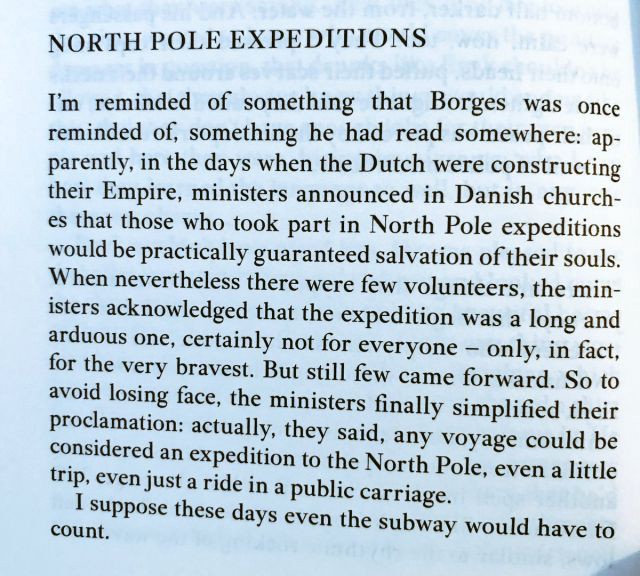
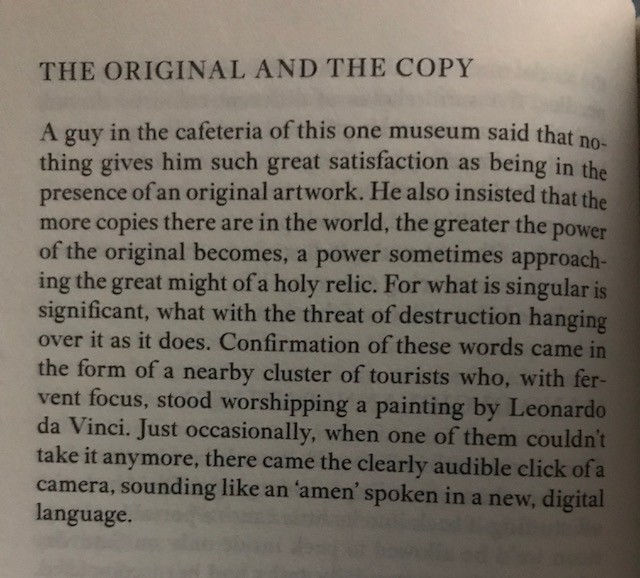
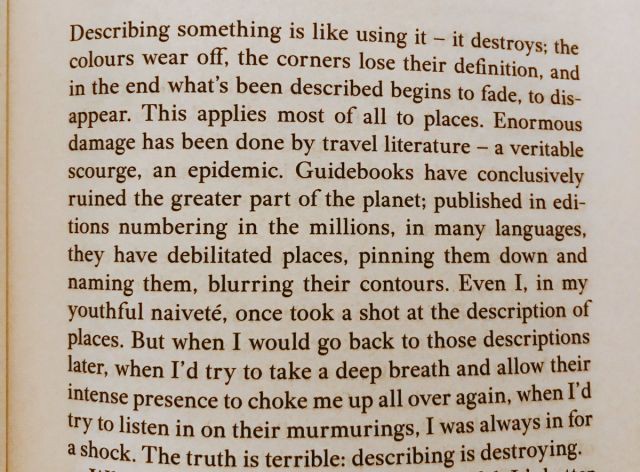
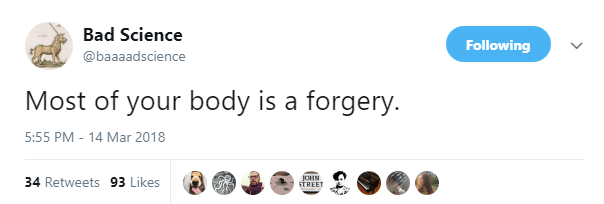
It’s obvious why I like it. It’s a constant roll of self-sufficient references, constantly setting out ideas and then returning to them from a slightly different angle. We move through the body, psychology of travel, and snippets of overheard and directly extracted philosophy. Like this, on copies:


and then moving on through a few short stories of being laid over at an airport voluntarily and meeting a woman collecting an exhaustive list of the world’s infamy’s, the unreality of maps, guidebooks, places that you expunge from reality because inelegancies or trauma occurred (but never telling the people who live there, who might find it upsetting).
 
 Short stories like a missing wife and child on a Croatian island, which the protagonist is constantly reminded that the island is very small and that you cannot be lost here. Or the story of Eyrk who reinvented himself as a sailor and obsessed with Moby Dick who spends time in jail before making an exciting choice of direction for his passengers on a ferry which he crosses between island and mainland 8 times a day. These provide the kind of lyrical backbone to the whole thing. 
 
 All the philosophical wanderings are set up for these main short stories — in each part there is a reference to the previous parts in a way that lights up particular parts of my brain. I feel I like it because it is the way I think — the joy of any thought is in connecting two things that should never fit, and finding them universal in some way.


Nothing is left unconnected — and the way that character reappear make it feel less like a collection but a novel or memoir which contains all of these other elements. It’s one of those books that makes you feel very alive and happy about your own writing because it’s clear you’re allowed to do whatever you want.
 
 Not only is all this wonderfully true, but I would also recommend it as an ideal book for travelling, unironically.


Feel free to enter ETTO for this please. I’m probably a reviewer. There are many good things that have become real in the last few months.


True:


Long term buddy of ETTO, Hiromi Suzuki, has a lovely looking book coming out. I have a review copy, so you’ll hear all about it.


Stephen Hawking going down hill very fast.


Great legs, one careful owner.


This is really good by Jenny Xie — Visual Orders


Sometimes, I feel like this newsletter is only read by very calm trees. If you every have something to say about these terrible newsletters, then please feel free to reply — because your thoughts and feelings will be read and fretted over. I was shown this by our Sam.


Thanks for reading this particular ETTO, I hope you found it as loveable as a pig in a nightgown — or one of great renown. This is what people voted leave for. It’s me. Size of this lad. I am feeling wonderful and full from the sunshine. I wrote this, but I did not proof read it. I saw this cat on my run, who seemed to be claiming that indeed, it was he who fell the tree.

On Violence

Etch To Their Own

On Violence, an anthology of short stories, poetry, experimental prose and essays, provides an exquisite variety gallery of violence while also carefully negotiating a way through each display with deft context and balance. The collection is impossibly well put together by Sharon Kivland and Rebecca Jagoe and the balance of pieces that really gouge at you and those that heal. Unlike recent books that are extremely violent, this one did not leave me feeling emptied of anything good, instead leaving you with the experiences without long term damage.

{ NOTE: this week’s subject includes sexual violence quite heavily, and quite a lot of general nastiness. AGAIN. I promise I will go back to writing about something like “cooking in Beowulf” eventually! }

In Candice Lin’s short story, Human Pig Corporation, takes place in a factory where human-pig hybrids are used to grow spare organs — and are routinely abused by the workers. Lin’s story explores the violence of othering, of making language dead to obscure violence and how economic essentialism is used as an excuse to commit further violence. The language is couched in a kind Human Resources lexicon and tone, distancing the rape of these half-pig-half human creatures, and expressing the violence over their powerlessness (which is explained, is part of the excitement). This obscuring of the violence, of the disgusting violations of the game with language is part of way violence is done — violence is difficult against a human being, but easier against an animal, easy against an object. The further they can remove the hybrids from human (reducing the human part of the hybrid through comparisons to less articulate forms, down-syndrome children, for example) and towards object, the easier and more normal the violence becomes.

These themes of sexual violence and the obfuscation of it are explored further in Tai Shani’s End of Paradise — here the story of sexual violence involves the separation of the violence from the person. Here however the penis in the coerced blowjob is separated from the body “Frankensteinian, bleeding, dying, brutes.” as well as the identity of the person being distanced as an act of protection “I will not be a woman any longer”. The deconstruction of the boys and men is part of the understanding of masculinity as partly monstrous, and that those monstrous parts have to somehow be subdued or defeated to earn civility. The work contains some un-bodied sections as a means of escape from a body which can only provide pain, even if you love it. (Quick note: Of Giants by J J Cohen is very good on this if it’s an idea you’d like to get into further.)
 
 While both of the above and other works like Cis-tem Bleed Out by Nick Mwaluko, where trans identity and black identity interact amongst horrendous violence and punishment, provide the gouging of experience viscerally told through violence of the body and soul — there are healing works in the collection. Snout, by Katherine Angel is an essay with a lyrical vignette at the start of many-masked animals, men, unattributable limbs of women — expressing a similar monstrousness that is then folded in on itself. This is a somewhat personal essay that takes us through Freudian understanding of sexuality as a folding of pathology into itself asserting:

“What Freud showed us is that we’re all perverts, and that this is perfectly normal”

Before moving through artistic depictions of rape and how that seeing/interpreting that happens during art makes it strange. Trying to qualify the artistic depiction violence depicted makes for distancing — which links to the submission of power/control as the goals of sex and how that then interplays with consent.
 
 The essay is healing, in the sense that it provides sense where the others provide sensation — helping explain the horrors you’ve read in parts already covered. In some ways, it is the opposite of the distancing language of some of the stories, instead helpfully labelling everything that you’ve seen and helping you arrange them thoughtfully.
 
 You can buy On Violence here.


Ian McMillan liked a tweet about this issue of ETTO, so you could say that I am a pretty big deal right now. It reminded me of this lovely exploration of being very early, and those who are late, by McMillan on Radio4.
 
 He must also then be scandalised about how power consumption in certain European countries has been making the clocks wrong by 4–6 minutes!


Hannah has a great story on the Fairlight Books website, which turns out, is also on violence.


Translation lads put lips on the sirens to make them more fuckable, apparently.


I really like the swimming-through-bric-a-brac feeling of this by Arielle Tipa.


Today’s song is Philosopher’s Stone by Tohru Aizawa Quartet. This is from a Japanese jazz album created by a group of medical students and a business man that has been a little lost to time. Originally it was used as a business card (which is novel, but not very practical) and has been a rarity for a long time. Tony Higgins had a really good write up of it here.


Thanks for reading Etch To Their Own, no animals were harmed in the making of this newsletter. It was written by @CJEggett and can be found online here, for you to send to your aunt who lives in Australia. Traditionally, flirting constitutes signing up to someone’s newsletter, but these days, this is how flirting happens. Oh, there’s a new issue of Underblong — especially like the two “send nudes” poems by Katherine Gibbel. Great snowman, even though we’re thawed. More nice looking keyboard keys. Human pig corp IRL. THERE IS A FIRE BENEATH THE EARTH MADE OUT OF TRASH AND HUMAN ERROR THAT HAS BURNT FOR 50 YEARS. I should be getting an Anne Carson pamphlet with issue 2 of the Well Review, which you can get too, right now if you’re quick.

When Every Single Truth Was Known

Etch To Their Own

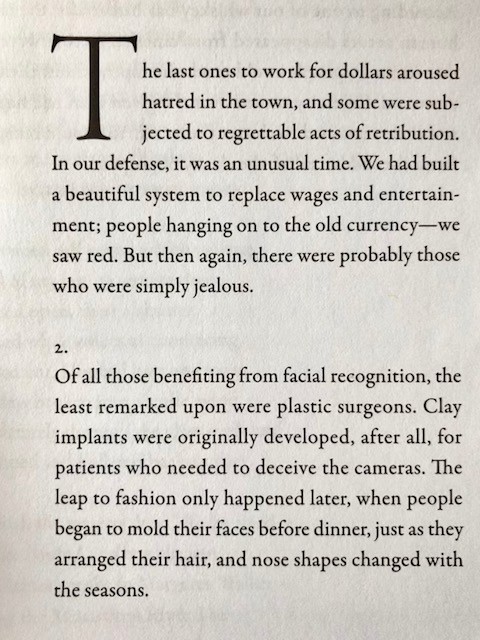
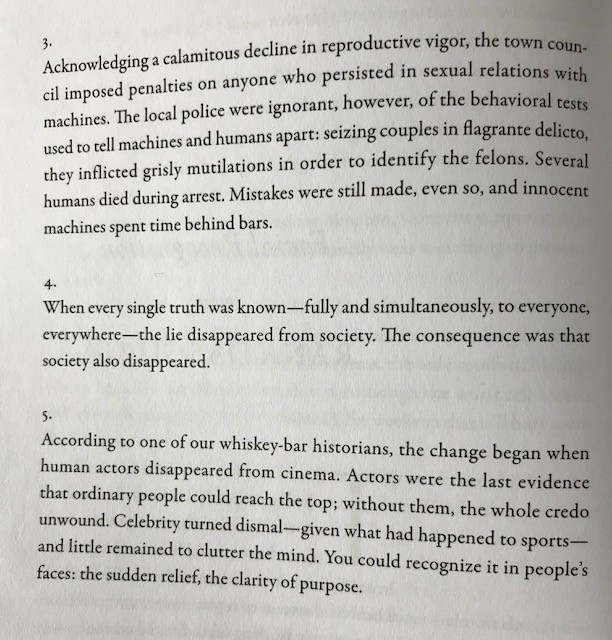
Facial Recognition by Rana Dasgupta is a collection of vignettes from a world where widespread facial recognition, surveillance and the accompanying replacement of humanity is explored. Clay implants into the face are used to avoid detection by facial recognition machines — the idea being that you could mould your face to avoid the cameras and detection. Later this is used for daily fashion tweaks, as you would expect. Sex robots cause a population crisis, and tools of the state impose harsh punishments for anyone having relations with a machine. Here police are unable to recognise whether people are people, or machines — maiming some people in the process. It implies that either both parties are unfortunately human or that one is a robot — but the law cannot comprehend the difference, and the only proof requires violence.
 
 Not only does this expression explore how power interacts with identity in an overexposed civilisation, but also the idea that people are no longer able to identify the difference between the desire between two people, and the desire between a person and an object/robot/machine. Initially this seems a problem for the police officers involved, but it may also be examining the idea that once the reality fades out there is little to moor yourself to in terms of normal behaviours.


Such as the work explores in the fourth part — when truth is known to everyone, at once, everywhere, the lie disappeared from society. Here I think the author is following the idea of the concept of lying disappearing — because it would no longer be a functional action. With the lie’s disappearance, society disappears too. Here we highlight the idea that binds society isn’t necessarily the lie, but the unknown, unsurety of the world is what provides some stability. There is risk when there are things that are unknown — every time you pull a societal lever there are some unknown weights on the other end, you are unsure of your effects on others, or on the system, or even yourself in the context of the society. We never know how much we are moving anything. Knowing all truth means there is nothing to move.


It is this pointlessness that gives way in the last part, where celebrity disappears along with sport. There are no human beings left in either, so there is nothing grand or enticing about them. Society here is expressed as a pyramid held together with the privacy of lies and unknown truths, and it has been destroyed by some great sharing of truths between everyone, all at once. It is hard to know if that is literal, or an expression of the way the general population experiences it — having to exist in an exposed world would feel the same and have the same effect.
 
 At the end, we are left with the profound hanging of what the purpose was that was discovered so naturally at the end of distraction. It feels evident that when you lose the desire to climb a ladder of society that you might find some simpler, fundamental, true purpose — but we don’t quite know what it is we’re meant to be doing here.
 
 Follow Rana on Twitter and read the piece as intended on the Paris Review website (subscription required).


I have also had the pleasure of reading a flash fiction anthology produced by Ellipsis Magazine this week. The anthology, Two, is a collection of 40 writers producing works of under 300 words each. The collection is excellent, and was a pleasure to skip through its well curated pages. Naturally there’s nothing longer than a page, so the experience of dancing between exciting realised ideas and locations is a thrill. It’s always funny with collections how you can blast through them a first time, and make judgements about a single story or idea, and end up returning to them after they take time to mature in the back rooms of your head. I’ve returned to the collection a couple of times to pick at it, and there’s always a little bit more. You can pick up a copy here.
 
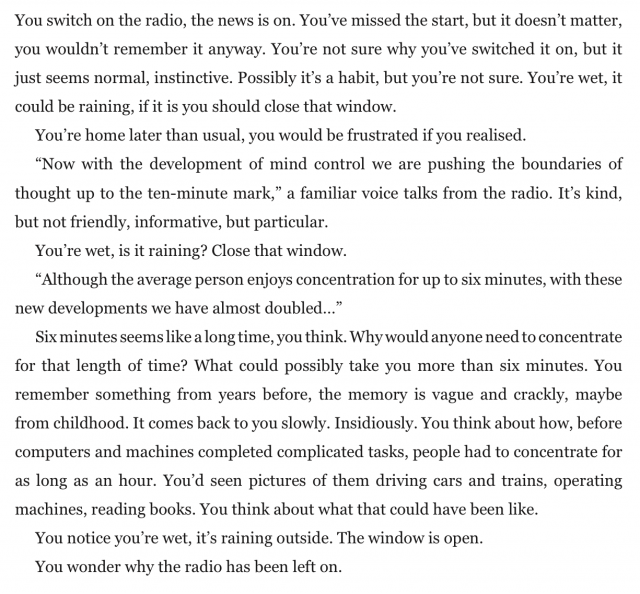
 Two Minutes by Luke Richardson is a great example of one I read and then returned to. Amusingly I am pretty sure that I stopped reading a couple of times to reply to tweets and messages, or write down a completely unrelated fact, line or thought. Here’s all of it:


It links nicely with the Rana Dasgupta above, the idea of a moving feast of information pulling away at structures of the world — or possibly the other way round. It is because of automation here that there is a lack of concentration, and there appears to be a power at work somewhere trying to improve the length anyone can concentrate for. The refrain of the rain and the window is cleverly utilised — it’s not a repetition of the same thought, it is the same thought being approached anew each time — the goldfish life of this person.
 
 Here the lack of concentration and context doesn’t just show a kind of mutilation of identity as the Dasgupta piece, but instead it shows the kicking out of the legs of basic survival systems. Not being able to concentrate long enough to secure your own habitat disables the entire hierarchy of human desires.


Rabbit fact.


That Anne Carson interview in The Paris Review which I wrote about here is now out, exposed and startled from behind the paywall, read it before it dresses itself in a subscription. There is a twitter discussion with Kaveh about Anne Carson to check out too.


Today’s song is: I Wanna Be Adored by The Stone Roses


Thanks for reading Etch To Their Own, everyone makes a mark somewhere. Whisper this url to your secret boyfriend, whisper this other one to your boyfriend’s secret. As always this was messily compiled and curated by the slack and lazy fingers, thumbs and retinas of @CJEggett. I very much like the look of these split and custom keyboards, aren’t they lovely? Hot log pics. Record one of your poems, have it read somewhere that might be very far away. I have had some nice rejections recently, which is better than my creative output being wrong for someone at this time. If you have had work accepted somewhere, please let me know and we’ll make some room for you :)

Much like god in the end.

Etch To Their Own

This week, I have been reading Lynn Mitchell’s The Red Beach Hut as a kind of palate cleanser to last week’s Amygdalatropolis.
 
 Last week’s novel did leave me kind of ruined by the absolute outpouring of filth that seemed deeply real — because everything/nothing is real/matters, the context dies and so does any way of rationalising it. It exposes you directly to the content because it removes the barriers; it’s an unreliable primary source that is all you have to go on. The idea of garbage in garbage out is explored in the book — i.e. what you become if you only engage with this hate is a hateful thing — and also by reading the book you experience some of it, you are changed by consuming this primary source.
 
 In fairly stark contrast, but with a few similar themes, The Red Beach Hut looks at Abbott, a man working in the young offender unit is targeted by a homophobic hate crime online at his workplace — which triggers fears about a data trail that might connect him to underage pornography purchased by a previous lover with his credit card. His paranoia makes him jump ship and make a swift exit to a seaside town where he strikes up a relationship with an eight year old boy, Neville, who Abbott already identifies as someone at risk
 
 The book opens in an unsettling way. Reading anything about a middle-aged man, a stranger, taking a young boy along the beach by the hand, fear and paranoia running through his mind, triggers suspicion in the reader. We’re culturally trained to think of this as a dangerous situation for the child, especially in the context of a novel where we are looking for the friction and conflict.
 
 The book is interesting to compare to B R Yeager’s work because the theme of persecution and assumption of the worst are there. Here it’s the tabloid mentality as the antagonist, the small-minded Daily Mail reader, looking for the scapegoat for every situation — developing their own kind of misanthropy through their media consumption in the way Yeager’s protagonist through theirs. 
 
 In Amygdalatropolis there is lots of discussion on the messageboards about getting “v&” — i.e. a government van coming to pick you up because you accessed something nasty, like child porn. Abbot has identical concerns, but in a world with context and where the threat of reality breaking is a threat, rather than a higher plane to be achieved.
 
 The child is well realised, and his reactions to his mother’s sex work feel real and underpinned with sadness in the same way the closing beach huts for the summer, the yearly death of seaside towns. There is a brokenness of community here, of the shutting down of the seaside town and the way that atomises people — those in the beach huts don’t generally know one another for very long, and this transience makes those that do stay feel more powerful in the sense that they’re happy to judge. Ultimately though no one here belongs, and those who arbitrate the belonging are those who don’t really want anyone to belong at all.


The Tenor of Your Yes by Mary Ruefle is lovely. I was going to take it apart, talking about that kind of building of your own world thing that is implied by the genesis similarities. But I think it’s better if I don’t:


This week’s song is a continuation from last week’s Andrew Bird obsession — which lead me to St Vincent, and this Tiny Desk of Loss Ageless.


and the much more electronic original can be found here, with its extremely good cake telephone near the end:


How can anybody have you?
 How can anybody have you and lose you?
 How can anybody have you and lose you
 And not lose their minds, too?


Thanks for reading Etch To Their Own — honestly it was kind of more weird to have read a normal (maybe even “commercial fiction”) book for once, I really don’t think I’ve read anything like it in a while. I didn’t die from it, which is a good start. ETTO — these very words that you are reading with your eyes — was written by @CJEGGETT and proofread by no one. Bonus song of the week for one particular subscriber: Nicolas Jaar on XLR8R. It’s a test. I’ve been writing a lot of short stories this week, which is unusual, but they’re quite nice to have around. I imagine it’s what like collecting Royal Doulton would be like.