Publicity, Gravity, Mortality

Etch To Their Own

We were all the first to invent poetry, weren’t we?

Some writing knows it is writing through it’s framing — writing that says “hey, look at me, recording something narratively” — a little like these Sketches by Nuar Alsadir in Granta.


Each sketch uses the framing of observing where you are not meant to (i.e. on public transport) and giving back some humanity to what feel like failings. Public spaces like the subway car, the bus, sometimes restaurants and bars, are places where people are seen and not seen at once. You know you must perform, for an audience that will see you but will not comment.

In Sketch 27 we get a bit of symmetry in the shamefulness of being caught by gravity — a universal force — and the shamefulness of being caught being caught by it at all. In public, we must always act as if a fair constant force would not effect us beyond our own wishes.

This moment is one which is judged unfairly, but known to be the only way it is judged. No one has time to think about minor follies, moments of silliness, and weigh them against the weights of a perosn tey don’t know. Not in public.

A little like a transformation of the caterpillar, which shed its skin, emerging from its own face, as grows in size before becoming a butterfly.


Apart from being a bit gross, Sketch 4 talks about the ahistorcity of the action — to emerge from oneself into public and for that to be canonical. It is when you’re out and about that you’re real.

This sits in contrast with the world we’re usually more used to being presented to us in literature, that while there is a real world, there is also an equally real one inside our head. The you looking out through the window is usually presented as more important, incorruptible and itself canonical.


“If I read a book and it makes my whole body so cold no fire can ever warm me, I know that is poetry. If I feel physically as if the top of my head were taken off, I know that is poetry. These are the only ways I know it. Is there any other way?”

My favourite expression of literature as a powerful, mind-blowing tool, by the ever quotable Emily Dickinson. I read about DIckinson’s letters again this week, in a very old issue of The Atlantic.


My dear friend @Writersamr, who runs Peeking Cat Poetry, has kindly put together an interview with me about my writing and process. It’s up here!

(as if this complete brain-dump wasn’t enough of a look inside)


This poem, by Natalie Shapero, returns to poetry’s favourite subject: mortality.


As always, it’s about having enough of everything but not feeling whole. The was we can find ourselves quantifying living things and mistakenly giving them greater or lesser value (think of how many mayflies have died today, while you did something banal like earned capital).

Which reminds me of that little diversion in a Terry Pratchett novel:

The shortest-lived creatures on the Disc were mayflies, which barely make it through twenty-four hours.
Two of the oldest zigzagged aimlessly over the waters of a trout stream, discussing history with some
younger members of the evening hatching.
“You don’t get the kind of sun now that you used to get, “ said one of them.
“You’re right there. We had proper sun in the good old hours. It were all yellow. None of this red stuff.”
“It were higher, too.”
“It was. You’re right.”
“And nymphs and larvae showed you a bit of respect.”
“They did. They did,” said the other mayfly vehemently.
“I reckon, if mayflies these hours behaved a bit better, we’d still be having proper sun.”
The younger mayflies listened politely.
“I remember, “ said one of the oldest mayflies, “when all this was fields, as far as you could see.”
The younger mayflies looked around.
“It’s still fields,” one of them ventured, after a polite interval.
“I remember when it was better fields,” said the old mayfly sharply.
“Yeah, “ said his colleague. “And there was a cow.”
“That’s right! You’re right! I remember that cow! Stood right over there for, oh, forty, fifty minutes. It
was brown, as I recall.”
“You don’t get cows like that these hours.”
“You don’t get cows at all.”
“What’s a cow?” said one of the hatchlings.
“See?” said the oldest mayfly triumphantly. “That’s modern Ephemeroptera for you. “ It paused. “What
were we doing before we were talking about the sun?”
“Zigzagging aimlessly over the water,” said one of the young flies. This was a fair bet in any case.
“No, before that.”
“Er . . . you were telling us about the Great Trout.”
“Ah. Yes. Right. The Trout. Well, you see, if you’ve been a good mayfly, zigzagging up and down
properly -”
“- taking heed of your elders and betters -”
“- yes, and taking heed of your elders and betters, then eventually the Great Trout -”
Clop
Clop
“Yes?” said one of the younger mayflies.
There was no reply.
“The Great Trout what?” said another mayfly, nervously.
They looked down at a series of expanding concentric rings on the water.
“The holy sign!” said a mayfly. ”I remember being told about that! A Great Circle in the water! Thus
shall be the sign of the Great Trout!”
The oldest of the young mayflies watched the water thoughtfully. It was beginning to realise that, as the
most senior fly present, it now had the privilege of hovering closest to the surface.
“They say, “ said the mayfly at the top of the zigzagging crowd, “that when the Great Trout comes for
you, you go to a land flowing with . . . flowing with . . .”
Mayflies don’t eat. It was at a loss. ”Flowing with water, “ it finished lamely.
“I wonder, “ said the oldest mayfly.
“It must be really good there, “ said the youngest.
“Oh? Why?”
“ ‘Cos no-one ever wants to come back.”

That is to say, mortality is all a matter of perspective, and that if we learn to quantify life in a way which in the end, leaves us feeling un-whole, it is probably not entirely in the life we are leading, only the way we are counting it up.


Today’s song:


Samba De La Muerte — You’ll Never Know When I Lie (Larry Gus Remix)


Thanks for reading Etch To Their Own. That really went all over the place didn’t it? I don’t know why I am feeling so philosophical (prefix a cod if you like), but I had my first ride home to the flatland of the year today, and I am back at home where the ground seems to welcome me and the air is the right sort to get into all the gaps in my lungs. You should defo check out Sam’s poetry journal as she gets some really great stuff in (and out) every issue and it’s entirely possible she’ll be your #wcw in the poetic sense at least. As always, Etch To Their Own was written by @CJEggett and proofread by no one that you would have heard of. If you have friends, please send them this as a token of your love. If you have family, send them here to sign up, and if you have a work based email, please send them all to this url: https://medium.com/etch-to-their-own telling them that it includes details of everyone’s pay-rises, and man, you’re really embarrassed for all of them.

Here I am Dying at an Average Pace

Etch To Their Own

I was struck by this, this week:


I love the collection of carefully collated images, presented in almost-prose — tabbed gaps to give space to suck a lungful while performing, or to create some kind of pause separation. Its collection of lamentable feeling, it’s regret for an average life — optimal without the interesting intestinal tract of a drowned tourist — nor the horrors of arson or infanticide, and the pain of feeling that life reduced by trauma being observed by others and that the plan: holding something horrible close and making it true only does on thing, which is to make it part of you.

I’m looking forward to @KavehAkbar’s debut Calling A Wolf A Wolf whenever it’s really coming out (there are conflicting dates!)


Dear reader, I ate him. I like this article because it’s a little, odd flight of fancy that doesn’t quite touch on the two missing horrible variables. One: how does mass cannibalism effect population growth (who want’s to bring someone in to the world where they might be dinner after all?) and, Two: the obvious fact that if there was demand for humans to eat, there would be farming. Would capitalism really let us eat ourselves (to its own detriment I mean, obviously it would otherwise).


I very much enjoyed this piece from lit.cat this week Notes On The Clandestine Symphony for its lovely nonsense-world-building:


I like this kind of faux-analysis as a style. It reminds me a little of Ben Marcus’s The Age Of Wire And String which, in itself, distorts meaning by reapplying it. There is something “true” about me suggesting that a box is the tone of any sound made while underneath a bridge in a boat — because I have used the structure of definition.

Although, that example is a little more like Douglas Adam’s The Meaning Of Liff, in which he and John Llyod created new meanings based on the evocative sounds of place names, mostly English. This mean you get joys such as:


And who are we to argue?


This chap cuts up his own records, sticks them back together, and makes quite odd remixes. It’s very jolly.


This lovely little thing by Kathy Fagan does the best with the modern style of lines left broken for effect:


Hey, did you hear that Getty have bought some Ian Hamilton Finlay? We talked about concrete poetry here, so I won’t repeat myself, although it’s worth noting that Finlay does this sort of contemplative work:


Have a wander round that if you have time!


Today’s song:


This is very arresting This Lamb Sells Condos by Owen Pallet/Final Fantasy. You can catch up on all the lyrics here, because yes, you did probably hear them correctly, and yes, they are a bit mad. I hadn’t heard it for years until this week, so please forgive this trip down memory lane.


Thanks for reading this week’s Etch To Their Own. It was late this week because of locational issues (I spent a little too long in Oxfordshire at a coworking space, instead of here, at the library). Etch To Their Own was written in quite a tiz by @CJEggett and proofread by no one. Naturally, I invite you to point out my typos, send me missives, notes and diktats through email or twitter. Or even, your poetry collections, should you have them. I have a very nice little chapbook to rummage through this coming week by @Judson_Hamilton. And remember: we are beautiful, we are doomed.

What Is Folklore For?

Etch To Their Own

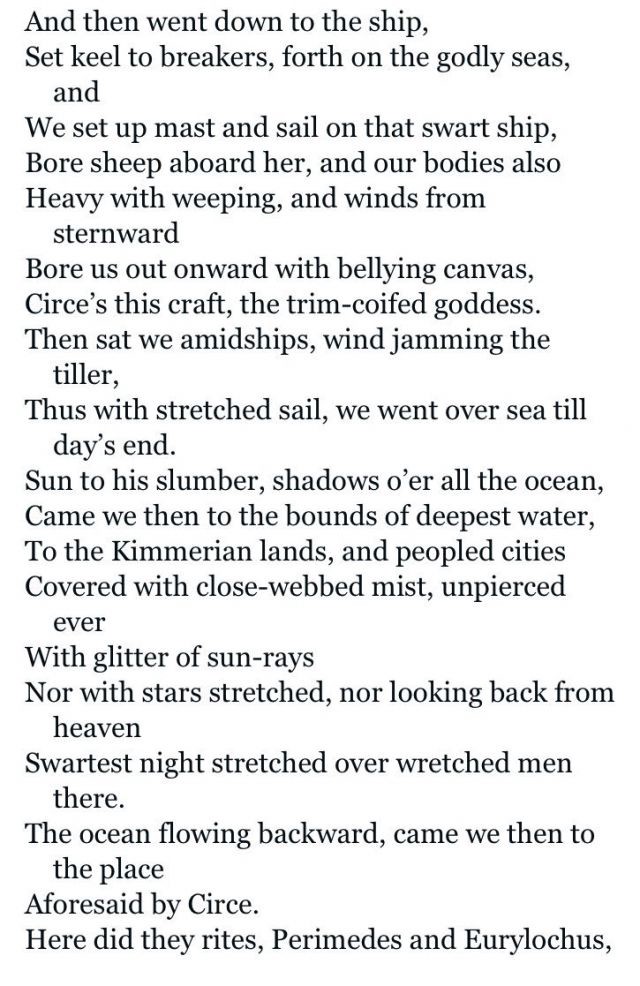
For #WorldPoetryDay I tweeted a snippet from Canto I, which is probably my favourite framing for any long work of poetry:


There is a something in the epic tradition where the poet sets their stall at the start, often by invoking the gods or similar. In Canto I we can see Pound providing us the context for the rest of the poem — Odysseus setting forth on his way home. This poem is the one that frames the rest of the gigantic work as a voyage, one which is about returning home — but fraught with the kind of tricks played by Circe, who plays the host but turns Odysseus’s crew into swine.

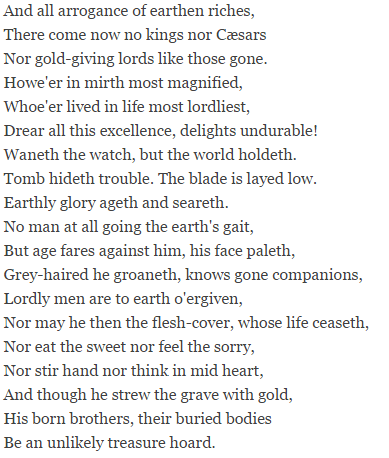
It reflects one of his earlier poems, which he translated from the Anglo-Saon, The Seafarer, and part of what he considered the tradition of the English — to be outgoing seaward folk. While the poem itself is a walk in the deep — discussing the hardships of the seafarer himself, there is a kind of expression that his life has purity for his hardship, whereas the rich men on the land make promises on their deathbeds.


Both the framing of Canto I and The Seafarer use the powerful connective tissue of folklore and myth to bind the work to a greater whole. And this is what I have always thought the future of folklore should look like — it’s the reference hooks with which we all build our art, artefacts and therefore understanding of the world, on.

Which brings me to #FolkloreThursday hashtag (and @FolkloreThurs). Every Thursday you can pop on to the hastag and not only find thousands of wonderful people talking about folklore and myth, but also the poetry, stories and art which form it’s basis. You can learn that cats’ eyes dilate and contract with the tides, that there is such thing as a Witch Bridle — presumed to stifle screams on their way to the stake, and that Jikininki are spirits of selfish humans who have been doomed to an afterlife as an eternally hungry corpse-eating beast. Amongst other things.

The common thread with all folklore is that it teaches, it tells us about humanity, and much of the time, it is a work of art — a story — which has lost all of its edges, so that only the central seed of the story remains.
So, how can we use it? If you’re Neil Gaimen you write American Gods, a story of what happens when our old myths start to lose their power, and new ones take hold of culture. If you’re Pound or Eliot or HD, you use it to frame your work, the Fisher King, Odysseus either as the structure of your work, or the reason for its fragmentation.

Tradition and ritual build folklore, and the only way to keep any of it alive is to retell it and to make it part of your life and your work.

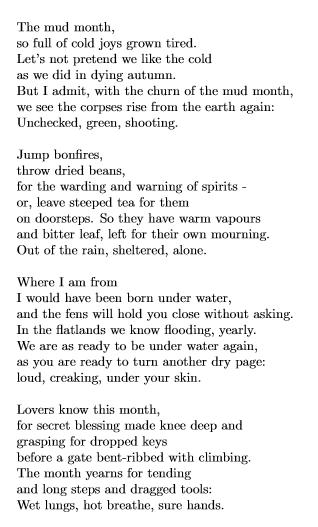
February is known as the mud month (I know it’s March), and has so much attached to it in terms of the kind of folklore, stories and rituals which all run together to say: “the end of winter, the start of spring, small thing crawl from the ground after frost and people let sunlight hit their bare skin.” Here’s a poem I had published in The City Quill (which you can buy here):


Spotted this lovely snip of Roy Fisher, who sadly died this week.


Today’s song:


The National — This Is The Last Time


Despite what you might hope, this will not be the last time you receive Etch To Their Own (unless you unsubscribe (please don’t)). I am very sorry if I didn’t tell you what Folklore is for exactly, I’ll try again another time, probably when I mean to write about something else – as seems to be the way. Etch To Their Own was written in the traditional sense by @CJEggett and proofread by no one. Please send this to a friend and ask them to sign up here, or read old issues here. (I recently tarted the archive up, so maybe you should have a look too!). Sorry this one is a bit late, the world is wild and full of beef brine and mortgage advisors.

Attrib.

Etch To Their Own

Have you ever driven down the motorway and passed a line of lorries — all different shapes and sizes, a heavy laden one at the back, a small one at the front, a variety of length and height to your left as you pass? Their order is a function of their speed — which is a function of their engine, limiter and their cargo. If they dropped something off earlier, they can go faster, despite the limiter. It is this which decides who can crawl in front of the other in the lane in which you’re passing. Sometimes it feels like large vehicles are endlessly overtaking each other. But occasionally you come across a long line of vehicles in the right order, who have sorted themselves out already. Do they know that they’re all running an optimal snake of cargo down the motorway, does it warm their cockles in their cabs? It warms mine as I pass, knowing that sometimes little things in the world form a perfect order.

Attrib by Eley Williams is a little like this. Something satisfyingly complete in the world, presented to you as a kind of puzzle of perfectly interlocking ideas through extending metaphor.

Every story, in some way, deals with the way that we all tell stories about ourselves to become real. Each is a negotiation with itself and the author, a hypothesis presented tentatively: a dream of a version of Timbuktu which can’t possibly happen, a Ortolan chef who looks for language to take the scalding of judgement out of the perception of his illicit work, or the finding of serviceable words for the aphasia sufferer of opening story Alphabet.

Attrib., the title story of the collection covers the musing of a Foley artist (hey, I did a tiny bit of field recording over here btw) developing the soundscapes for a gallery’s show of renaissance art is about the balancing of Adam and Eve — or rather, the imbalance. The story talks about the requirements of for The Creation of Adam — a specification which includes great fanfare, whereas Eve is only instructed to have some insipid, non-specific garden noises.

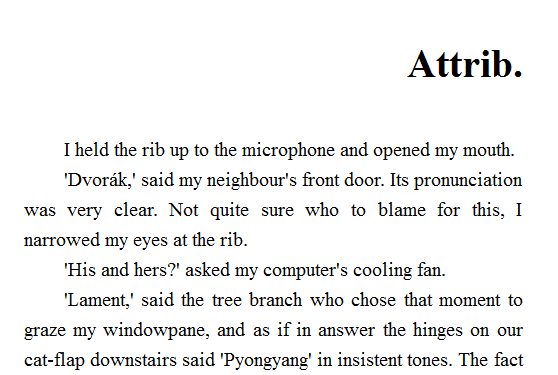
In this story the world around the artist talks to her incessantly, as things tend to:


Turning noise into language is the work of a Foley artist one assumes, and as Eve remains neglected and the artist unattributed. The frustration felt with the unfairness of the world is the kind of wavelength one finds themselves able to work out that the squeaky board says “Krakow” at night on the way to the bathroom. As the Foley artist makes something from nothing, a noise into language (or maybe, turning language in to noise) this mirrors the unfairness of Eve’s creation, she didn’t ask to be made, as much as the tree isn’t really saying “Lament.

But then, that’s the point, this joyous use of language, flexible, clever and somehow completely true is the beauty in this book. Much like in Alphabet, where words are reached for for objects, and a satisfying construction is made instead of a mundane, accurate one:

“I held the hairbrush in front of me and trialled scalp-tufter after a few seconds of concentration”

All of it is written in a way of performance, demanding to be read aloud. Rhyming couplets run throughout, and sometimes the language bursts it’s banks running away beautifully like this:


I always think that it is only those who truly love their language who are kind enough to it to set it free — to know there’s really no right word, not correct way to say it, just the way you want to say it. The meaning conveyed, however crassly romantic it is, through the combination and bending of expectation, rather than meeting it.

Attrib. fits on to my little shelf of books (although, only virtually currently) alongside like my favourite book of last year — Claire Louise Bennett’s POND (as well as David Mitchell’s Number9Dream and Autobiography of Red by Anne Carson to name a couple more) in a section I reserve for books to read to make you write. It’s a small, strange pile, but these are the books which I crack open again begin reading, and then end up putting down — as it occurs to me that I should be writing.

You can buy a copy of Attrib. by Eley Williams from Influx Press, who kindly provided me with a ebook copy to aide this review.


Meghan McClure has a couple of lovely poems in Split Lip magazine:


They’re sharp ornaments, the kind of thing you’d like to carry around in your back pocket for times you’re caught on unsafe streets.


Today’s song:


WeAreCastor — Train

Also, this mix for some reason: (warning, they talk about butts)


Shifra Rifka — Guest Mix for Thump


Thanks for reading this week’s Etch To Their Own — I was really nervous writing this one as it turns out @GiantRatSumatra is aware that I’m writing bad words about her book of good words. As always, Etch To Their Own was written by a really sleepy @CJEggett and proofread by no one. If you spot a typo, want me to read a thing you wrote, or just want to take moment to point out I am a lot taller than I sound in writing — please feel free to @ me or reply to this email. If you have friends who might like this sort of thing, please send it on, or get them to sign up here. If you missed the last 9 issues you can catch up with them over here. You’re all beautiful people and it is an honour to be cursing your inbox for another week.

Process Poetry Potions

Etch To Their Own

Twitter user @xtinarc has spent some time making up process poems from Wikipedia pages. They’re very cool little poems which gain meaning through the changing of the layout/form. In the context of Wikipedia, these words are just information, yet when broken into lines and stanzas, suddenly we have poetry.


You can see our mini-chat on popular bird-based micro-blogging platform, Twitter, here.

But the general rules applied were:

  • no editing text (punctuation is okay of course)
  • lines must appear in the order they appear in the article
  • each successive poem’s topic has to link from the poem/page before

Hey, now you can do your own!

The above poem is taken from the Sodium Carbonate page on Wikipedia, and rearranged (but not too much as per the rules). This is the kind of searching for meaning — or meaning by curation — that I talk about in this old essay that I love to link you to. It’s interesting how just the change of context, the addition of a few little marks (“for example”) change how we read it. I think this is because poetry, while written down, is still implicitly the oral tradition — to read it is to “present a reading” which implies that you might read it differently next time, every interaction with the poem-object would give you a different performance and meaning.

This is almost the explicit opposite of Anne Carson’s NOX— which as a grief document/object feels like it constantly attempts to grip on to something solid, and leave it with you. It contains endless definitions, which, in themselves, contain redefinitions and diversions. Each of these appears like a dictionary entry at first, but you soon realise these contain the heart of the work which is — “how to classify the death of your brother, who you didn’t know very well”.

Grief objects like this are partly about the process. His absence from her life (and her mother’s more painfully), makes her grasping of it an exercise in defining what is now missing. She discusses the idea that the news of her brother’s death wandering across the sea to her, slowly, from where he died in Copenhagen, and helps to join his dying away from home, their mother’s recent death and his death as a source of this pain thorough this definition:


This, combined with the re-framing of the work by using these facsimiles, fragmentation and obfuscation of the full facts to represent her own inability to grasp at it. We’re unsure if Carson used random number generation to help take the ordering of this work away from herself — but she has commented on doing so previously, and her newest release, Float can be read in nearly any order.

With all of this, we can see how processes can give us a way as poets and writers to “let go” of part of the process, instead gripping firmly to some other part — the joy of language say. It’s a useful for emulating that feeling of powerlessness, and it’s useful for engaging on a level which only requires our good taste, and not necessarily our muscle.


(and, a minor aside, anything written about Anne Carson’s work should really be prefaced in the way the Charlotte Shane does in the above article about Float:

“I love Anne Carson’s work dearly though I suspect I am too stupid for it.”


Helen McClory has a nice thread of lady-writers that is worth checking out. It’s especially interesting that she requested a list from men in particular — I suppose to remind us chaps of the excellent women writers we enjoy for international women’s day. My suggestion is, as always, that if you haven’t read POND by Claire-Louise Bennett you’ve missed the best book of last year.


Today’s song:


“Okay” by Tracy Chen


Thanks for reading Etch To Their Own #9 — we’ve nearly done ten of these, and it seems fine. If you think there’s something I could do better, I’d love to know what it is — tweet me or email me! Etch To Their Own was written by @CJEggett as a process as a function of the rule: put one word in front of the other until you stop. Next week is super exciting because I am currently working through Attrib by @GiantRatSumatra and there will be a review next week! Ask your friends if they need more poetry waffle in their inbox, then send them this, or this. If you do you can have this spoiler about how I feel about our little newsletter growing every week, and also a spoiler for the excellent music film FRANK.

Words To Avoid For A Happy Life

Etch To Their Own

Want this in your inbox every Friday? Sign up to Etch To Their Own here

Every word is part of a spell you are weaving around yourself and around others, it changes how you are seen and how you see others. You can hang up words on people, and they can become permanent fixtures which you’ll never quite shake — even when the tide of reality surges up against your perceptions to say: these labels aren’t right.

With that in mind, here is a scribble by Elizabeth Bishop on words to avoid:


I love the working out on this — and if what I remember from my exams holds true — she got extra marks for showing them.
In the document there are a list of words which can be broken down in to three categories.

One: those which are un-romantically scientific sounding — words which carry their own dry weight with them: “aspect” “basic” “specifics” and “selectivity” or indeed “- most ivity words”

Two: common phrase which alludes to something being innately known or within the world of the known without specifics: “kind of, sort of” & “gut reaction, gut feeling, gut anything except the word gut alone or cat gut, etc”

Three: words dressed up slightly used to distance us from the true experiential concepts, taxonomical terms which have crept into everyday life and are most often to again, allude to a grander concept which cannot be initially transferred: “life-experience” “relate” “relationship” “meaningful” “commitment” “negation” “life-style”

I heartily agree and probably use all of these word more than I ought to. Much like the addition of “basis” to any term of time: “daily basis” rather than “daily” they all attempt to move us away from our real meaning, and provide some kind of neutrality of language which is (honestly) neither helpful, or desirable.

Last year I worked on a translation project, where I dug up loads of my old poems, and translated them all into a single form. The rules were to:

One: use one strict verse — I chose that of Icelandic occasional verse, which is 8 lines of 6-syllables, and should contain some form of “kenning” — which is like a metaphor where you describe something by opposition, or what it isn’t.

Two: to somehow contain all of the previous poem’s meaning. This meant, especially for the longer poems, a great deal of chopping and condensing. I didn’t often use a line from the old poems, which in one way was saddening, and others quite exciting as they could be seen as some kind of key that leads through each poem to it’s predecessor.

I didn’t always meet these rules, but it was a good excercise. Here’s a not completely terrible one:

Home shrunk to engine-room,
My breath as mist inside.
She heats what she can heat,
I do what I can do.
Never meant to go cold
but slow tragedy leaks.
A family run a-ground
must build with what it has.


Lou Reed wrote poems, here’s one of the better ones:

Lou Reed — Waste

Please take a moment to explore a database of powerful runes.

And, once you’re done there, consider the future of the book as: the webbook. To be completely honest, we’ve been trying to talk about this for a long time, but we’ve never fully come to terms with the fact that the future of books doesn’t look very book like.


I smashed my phone (and myself) up at the weekend while running. Don’t worry, I wasn’t run over exactly. So if you’d like to sponsor this very newsletter in the form of buying me an iphone that would be great.


Today’s song (well, mix, actually):

Shoeboxx Recordings — SBXX15: MUDCHUTE

This is a fun little mix that reminds me of when we were doing some kind of post-dubstep thing, rather than pretending it’s just it’s own thing and calling it glitchhop or vaporwave.


Thanks for reading this week’s Etch To Their Own, we made it to Friday, and then we made it here. Hold on for dear life to the weekend. Etch To Their Own was mashed out with broken paws by @CJEggett, and proofread by no one. I got some really nice replies to the last week’s issue, so you should feel free to get in touch by replying to this email — even if it’s just to point out a typo! In other news, I got snapchat and don’t know how to use it. Please feel free to add me: cjeggett.

Close To The Ground Reading

Etch To Their Own

We can talk about the distance between neighbours now, and the strange, cold curiosity that comes from us walking that line between friendly, and unobtrusive. We don’t want to get too close to our neighbours, because we don’t want to take them on as friends — because if we did we’d have to share their burdens, and expose ours to them.
It’s strange, a border, whatever it might be, makes us very nervous about what we have and what we have to lose.


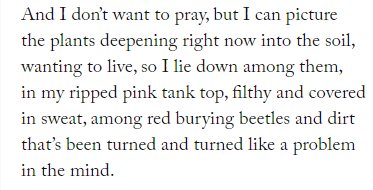
The Burying Beetle is that kind of pastoral which is less like Blake’s use of lambkins, and more to do with an exchange of energy with your allotment. Mucky hands and love of the land. People die, parasites consume the plants from the inside out and comfort is far away — she puts her love into the dirt and, in tidying for their physical freedom, her own sense of what she cannot control is enhanced.

The poem is full of guilt of what you have, of having the chance to miss someone and spend time in the garden giving energy back to the land. As the distance between neighbours talks about who we keep out, here we look at what we want to return to us: “a physical need to be touched by someone decent, a pulsing palm to the back.”

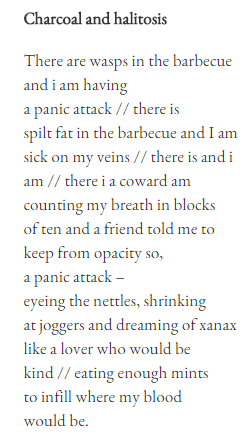
Alison Graham’s shoplifting abroad & other poems in 3:AM magazine this week are in that new internet style that exists only of itself — that is to say it’s filled with slashes and ampersands in the way that Carson uses them. I am never sure how to read them other than the // is taken to mean a pause but also a connected thought, a little like a semi-colon, and the & should run the two words closely together as a single item, rather than the expression of and which can suggest two separate things are connected, but not the same.

Looking for desires of being whole through medical (and minty) consumption — a similar protective desire to keep yourself from giving it all away, and the guilt of what it is to have anything at all.

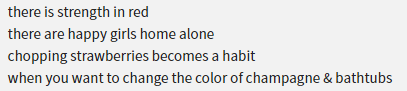
Ruby Brunton’s there is strength in red is a homage to the colour rituals we all use — but that women use in particular. Red concealing, altering, and of the earth.


Here, there is the negotiation of the masculine, destructive invader, upstart, and the resourceful feminine curator of the universe. The desire for change comes from the power of red, and it is a free woman’s thing to wield it.


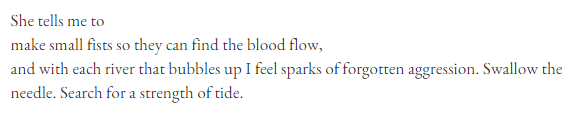
Katie Fanthorpe uses her colour for blood, and the swirl of the riverbed in her chest. She asks, what’s your excuse?

This week was filled with these things — sad longing poems and fictions about lost land, the fear of it; not belonging and not being yourself. Each it’s own offer of a challenge — whether to be more empathetic, to covertly alter the state of being, to withdraw.


Fancy an out of print chapbook to go with your modernist magazines from a couple of issues ago? You’re in luck — Ugly Duckling Presse has put together and archive of out of print chapbooks

Archive of out of print chapbooks hosted by Ugly Duckling Presse

Some of them are really lovely, harsh art-objects, and it’s great to work through them.

Today’s Song:


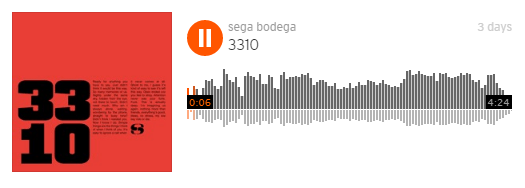
Sega Bodega — 3310


Thanks for slogging through Etch to Their Own #7 — I guess my close reading skills aren’t what they used to be? Or it could just be all the sleep I didn’t have. Etch To Their Own #7 was written by @CJEggett on a very boring, but loud, keyboard — and proofread by no one. Send your friends here for the next exciting instalment. Or here for the prior exciting instalments. Do you know what, I completely forgot to talk about the moon museum — which somehow I had only discovered this week!
Spreadsheet Poetry Light Show

Etch To Their Own

How do you write a poem? Sometime you might let a phrase wander in on the breeze from someone else, sometimes you take something you’ve heard before and knead it into something better, other times you might have a need to say something and it pours out.

And at certain points, you might start by developing a system, to building a list.

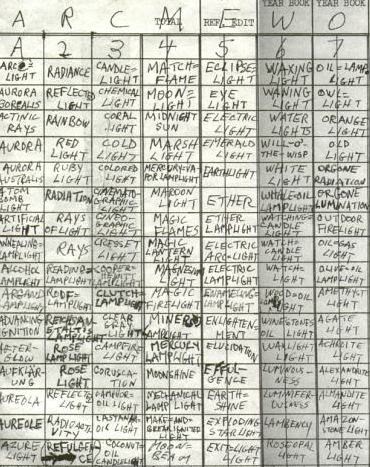
Jackson Mac Low created a kind of spreadsheet for his Light Poems. He started with writing down 288 names for light, and then linked them by letter of the alphabet. He then spent the next 22 years build this spreadsheet into the hundred of poems that went into this work.


This spreadsheet of sorts was the birth of many poems which bounce and shimmer along, as you’d expect from something made entirely of light. The entirety of the poems was published in early 2015, and it’s worth adding to your basket.

I haven’t read all of them, only those available online. But his work of repetition and the natural weightlessness of light makes the poems flash by as a series of lexiconic tastings.

I was introduced to it by taking up this offer on twitter:


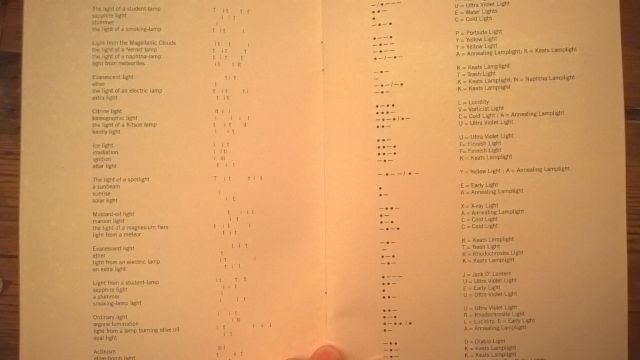
And it arrived a few days later. Many of the poems are clever reworkings or responses, such as Mac Low’s 1st Light Poem Transcribed to Morse. Script-Score for a Three Person Performance by Chris McCabe pictured below:


While others are more exploratory in their nature, making suggestion about how certain poems started their life, and in themselves work on the system Jackson Mac Low originally created, and produce their own translation. All translation is rewriting, and the translator never leaves without making their own mark on someone else’s canvas.


You know where I read about translation the most, Ezra Pound. I’ve recently been reading through a page-to-page translation of Pound’s fragments (the last Cantos) where one page is in the English (or multiple languages used by Pound) and the opposite is formatted the same, but in Italian.

As you may remember, this was picked up in the Hay poetry shop. At the time there was a full translation which I thought would be wasted on me. Every Canto, side by side with the Italian translation. This week, after spending time with the page-to-page translation of the fragments, I decided that it indeed, would not be wasted on me at all. After all, while I can’t read Italian, I can read Pound, and it might be a fun way to learn.

Alas, dear friends, it has already been sold only days before I called. It now lives in my mind alone with other nice things I didn’t buy at the time — like that Our Legacy suit in donegal tweed. Never forget.

(Sorry for talking about Pound again. I’ve just been wandering back on myself with him in recent weeks. Next week: no Pound, I promise)


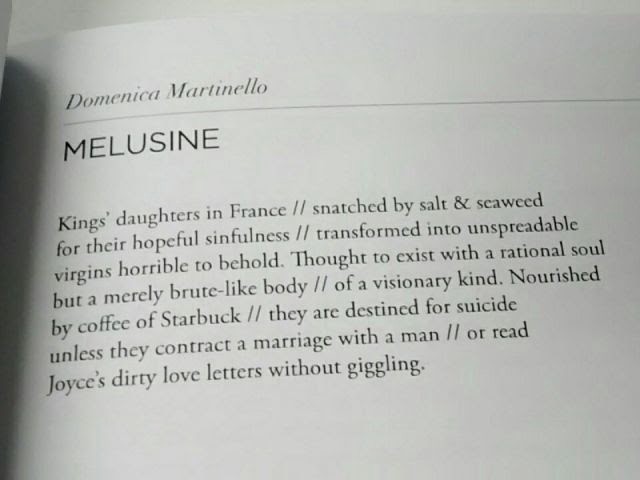
I saw some other good poems this week. Such as these by @domenicahope in @prisimlitmag:


And If you are an ancient Egyptian pharaoh by @HeraLindsayBird, here:


Today’s song:


Jorge Andre — Prologue


Also I am a fan of Joan Cornella’s fairly twisted works


Thanks for reading. Etch To Their Own #6 was written sober for once by @CJEggett, and proofed by no one living. If you have a spreadsheet of words, let me know all about it by email or in the tweets. Sorry I was late sending this today, I was hurriedly putting the final touches on a submission for the lovely Granta magazine. If your friend has just email this to you, thanks! You can find old issues here and sign up for future one here.

Pouring Concrete Poetry

Etch To Their Own

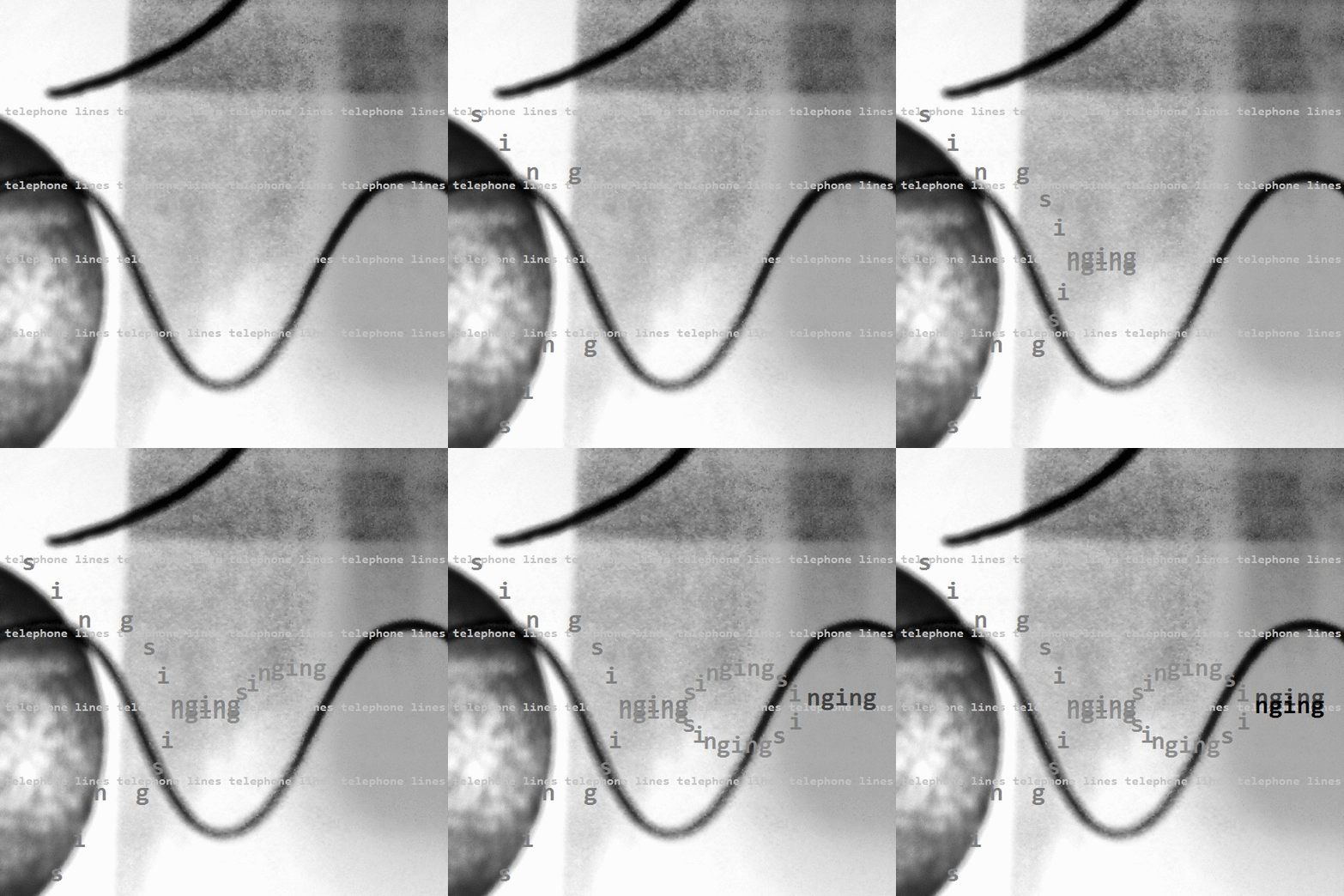
I stubbed my toe on some visual/concrete poetry this week. Hiromi Suzuki makes visual poetry which obscures and opens up options for meaning. The below .gif works by representing both the telephone lines, and the undulations of singing. Reading between the lines (sorry) finds the play and the enjoyment in the image. It’s a kind of pun.


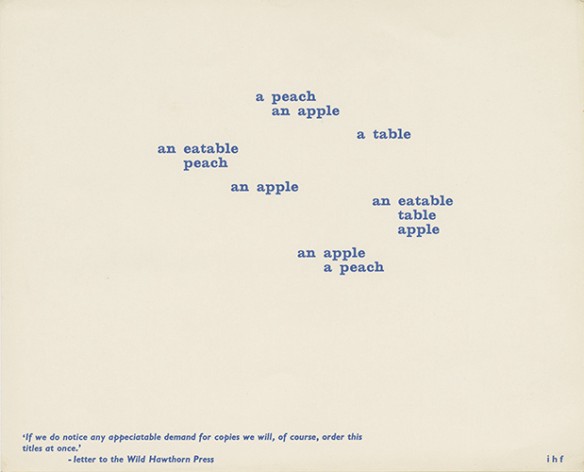
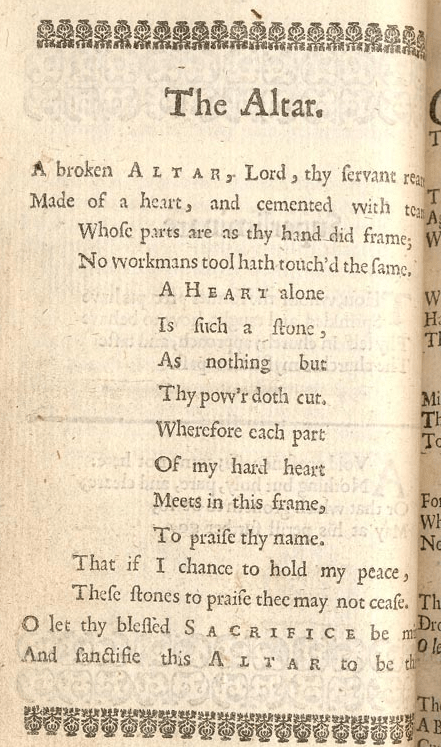
Concrete poetry’s genesis is often credited all the way back to The Altar, by George Herbert. The idea is that the poetry changes in it’s mean by being presented in a different way. At one end of the scale there is the oral tradition, at the other, this visual tradition.

It is the attempt to turn the poem into an object.

In Herbert’s poem, it is novel because it is the shape of an altar, while also containing the metaphor of functions of the altar and how Christians offer themselves as not only a sacrifice to god’s will, but also as a method of performing these sacrifices.


We ascribe additional sentimental value to anything that makes us feel something while being something. An object-poem gives us context and a sense of permanence — in the same way that the tall hat-stand used by your short grandmother has a little bit of her using it attached as memory, concept, sentiment.

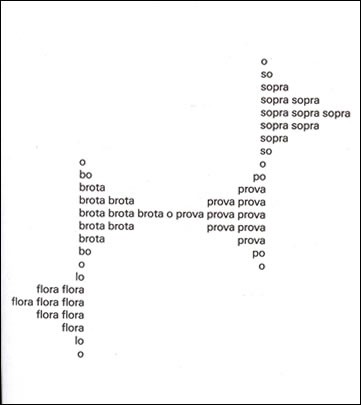
In the halls of my university hung a few pieces by Eugen Gomringer:


This is something like: flowers, spring, test, above — somehow the shape of spring and the blooming ebb and flood of nature is meant to be represented here.


As with this, mercifully in English, you’re not only asked the question — but then you begin to interrogate the idea of how the question is asked. The joke folds on itself neatly. The object is like a kind of puzzle that you can feel, move about, reconfigure — put down, and then re-approach another day.

Much like when you live with art, these poems are ones you can live with in the same way — to wander past, see it in all light at all times in all moods. You change the object a little in your relationship with it.

In December last year I went to see the Rauschenberg retrospective at the Tate modern. It was excellent, especially for someone who hadn’t really engaged with him before. A key feature of a lot of Rauschenberg’s work is to mix media, to make what he termed “combines”. These often include texts (whether found, foraged or created) and give you a way to engage with it that’s exploratory. You peer at the work unpicking the text from the sculpture, the paint from the found objects.

Rauschenberg and the concrete poetry above creates meditative objects which encourage a kind of exploration through form which you can’t usually gather through traditional presentations. You are not always invited to explore a poem which is to be consumed in a linear form, and visual mediums can be equally as transactional. To get more out of either, you need to apply the context of the world — whereas the combines of Rauschenberg and the concrete poetry above provide tools for engagement within themselves.


Gerhard Ritcher, more famous for his abstract paintings drawings, seemed to like to a little bit of cartoon drawing. These drawings have been found, and they’re lovely.


To follow on from last week’s Etch to their Own, go download editions of DADA magazine, over here.


Today’s song:


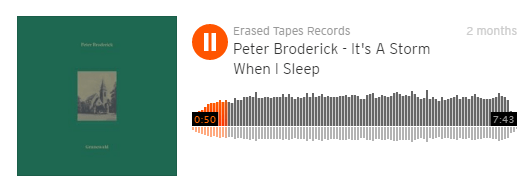
Peter Broderick — It’s a Storm When I Sleep


Etch To Their Own #5 was composed in the normal fashion by @CJEggett and edited by no one. If you want to get in touch to tell me about a typo, tell me I’m wrong, or tell me to have a look at your poetry — reply to this email, or @ me. You can read old issues here which are free to print out, remix and publish on your own domain to produce great wealth for yourself, and your family. Except for the parts which I do not own.

sign up for Etch To Their Own in your inbox

Hyperwitch Manifesto Simulation Magazine

Etch To Their Own

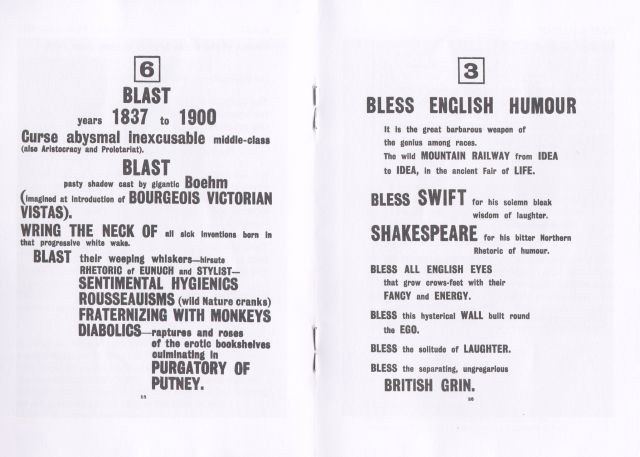
It seems to be a good time for manifestos, in the old style. The last five years hasn’t been the only time in history where little magazines (or just ‘zines) have existed with great abundance. One of the greatest periods for little magazines was at the turn of the (previous) century — the little review, BLAST, The Owl, The Tyro etc all represent small modernist magazines which almost all came with a manifesto of some kind. My favourite is of course the one which was put together by Ezra Pound and Wyndam Lewis — BLAST:


Naturally, the first thing you need to ask is what the Post Office did wrong. Some of it was tongue in cheek, but really it’s an expression that they’re done with the previous lump of culture, as it stands, and want to move to their new classicism. The modernists of London (principally an American and a man born on a Canadian barge) had fun with their typefaces, and aligned themselves with the somewhat fascistic futurists. You know, that love of the power of machines and destruction (God, can you imagine a world where people mistook their fetishization of automation as a philosophy?).

Anyway, this fertile ground of exciting modernism only arrived in the UK in 1908 (when Ezra stepped off the boat) and sadly, much later than our continental cousins. So, while we had our moments of joyous modernism, it was cut short by a world war. And fetishizing progress through the power of machines and the glory of metal destruction doesn’t seem so appealing to the masses, once those machines are tanks rolling over your family members.


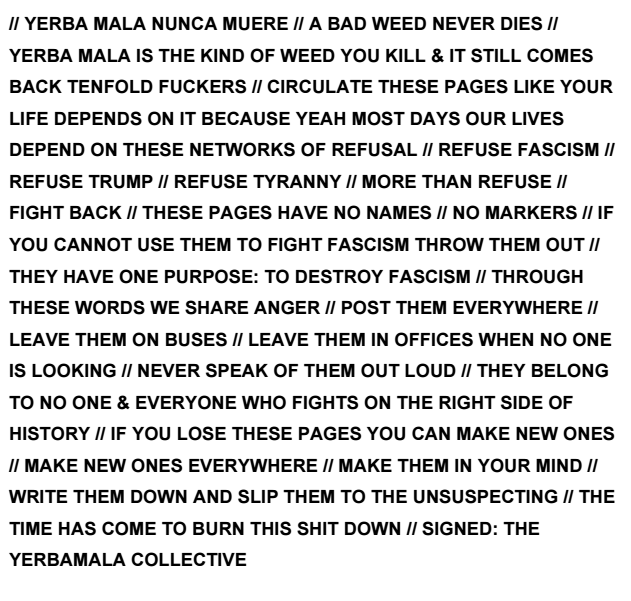
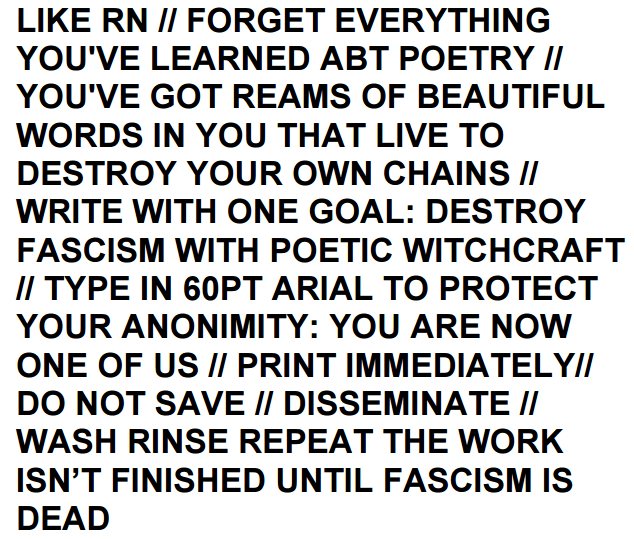
The reason I am talking about this is because I bumped into a witch manifesto, and I think that the lads should stand with the witches. They sound like the revolutionaries we need, in these strange times. Remember, your mother was a witch.


Your sister, too. Not that I should need to remind you of these things. Naturally, a witch is a woman who exerts power without it being given to her. Remember your literary witches.

What I love about a manifesto is that it presents a kind of magic future to you, one full of the energy and anger promised in the document before you.

It promises that you will be back in the driving seat of your own life. It presents a simulated world that doesn’t really exist, but if you propel yourself forward hard enough with it, it might exist.


And for some reason, the wild typography of these is important. You need to say it very loudly, take over the page — create an artefact that is indisputable as an artefact. It’s real, and only needs to reference itself to exist.


I did say that I would talk about Baudrillard a bit this week, but I don’t think I have time to break away from the simulated power of the world to do so.

But it is worth saying that we’re currently living in world where what is real is not what is understood as real or authentic — and we are a long way from from it now. The simulation only requires itself as a reference point. The more people push back against the inauthentic world with another inauthentic one, the better.


While speaking a little of myth-making (what better way is there to enjoy a Friday evening?), this David Leham Poem Mythologies is a pretty good time. Built out of an appraisal of oppositional approaches to life, love, the bus and what to do in summertime — but who with? It’s a long one, so settle in and read it all here.


Today’s song:


J Dilla — Don’t Cry (I know it’s old but it’s still good. To be honest I’ve been listening to a lot of Mouth Moods — which is not news, but good. If you’ve not seen the @tinysubversions interactive essay on how J Dilla builds his chops up, do yourself a favour.)


Etch To Their Own #4 was written by @CJEggett and proofread by no one. If you spot a typo, let me know. If you know someone who might like this sort of thing, then please get them sign up or get them to have a read of old issues over here. If you have a suggestion as to where to go next, please drop me an email by replying to this one. I promise I will leave Ezra out of the next newsletter, but will now tell you that I’ve recently learnt of his own translation of his first work A Lume Spento which he transposed in his usual fashion as: Tapers Quenched