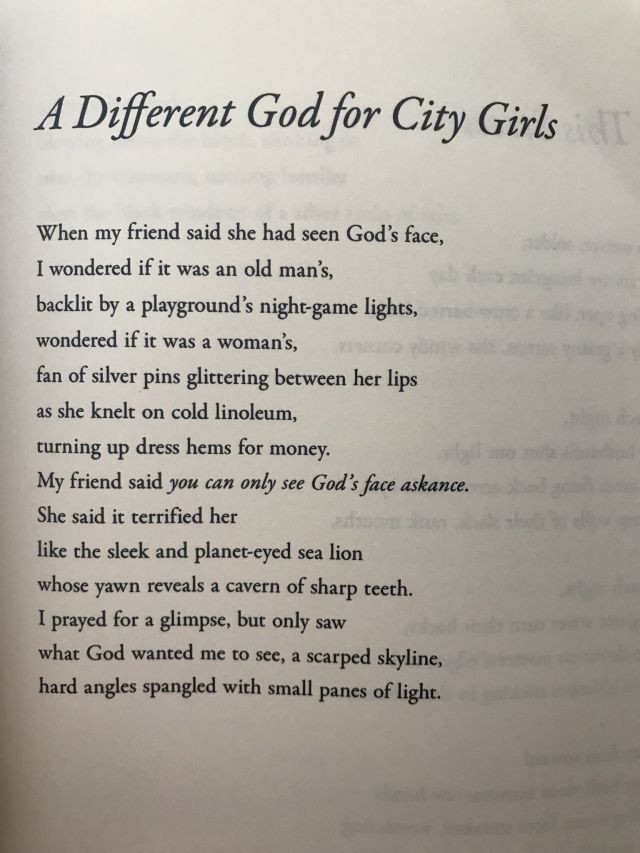
I’d just like to point out there is no such thing as absolute identity through time

Etch To Their Own

Before we go anywhere, I’d just like to point out there is no such thing as absolute identity through time. Which apart from just sounding good, I feel is entirely true. Raymond Ruyer, the chap who said the above also contributed to the concept of panpsychism which is the idea that all matter has consciousness, which can lead us to believe that all matter, matters.


Rachel Mennies’ poem Rapture popped into my timeline today, a fruit salad of sex and god. Although it is mostly peaches, the pits. The poet modulates the obvious link of sex and fruit, hunger/desire, to that of god and religion. The rapture, a climax, who is looking forward to the rotten bodies of the dead under the sun — which seems to have something to do with the way sex is linked to the idea of being beheld.
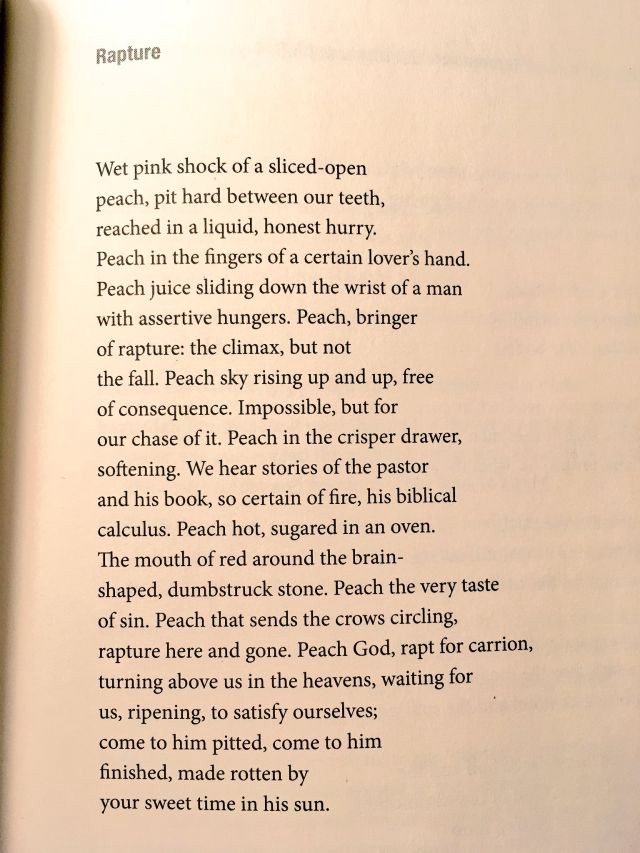

A little like last week’s flash fiction Religious Experience the poem uses the idea of an experience of god that’s all consuming and links it to the unchaining of sex, the dumbstruck stone brain, free of consequences.


The New Yorker shared this recently, it’s from May 2015: Someday I’ll Love Ocean Vuong by Ocean Vuong.

I’ll share the end of it, but you should go and listen to the whole thing.
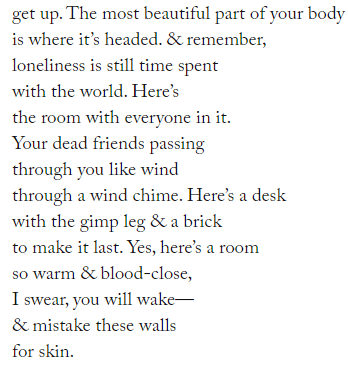

The poet is talking to themselves, this is a poem about seeing the self and talking onesself through the fears that it is okay to exist in the world. The quiet, slow tone of the reading is consolution. The poem is about the reassurance the that world exists as it does — with those who die around you, the annoyance of terrible objects, war, the need to escape terror.

The body is the running theme because it is the thing that exists in the world whether you want it to or not. You can wish the world out of existence in your head, but your body will remain a mucky reality. It is this changing of the body context with compliments like:

“The most beautiful part
of your body is wherever
your mother’s shadow falls”

and

“The most beautiful part of your body
is where it’s headed.”

and the passing of ghosts through the self as a wind chime that make the body context one that is irreconcilably true, and not something that can be forgotten. From it, that fact of existence, is where the speaker encourages the strength to be drawn.


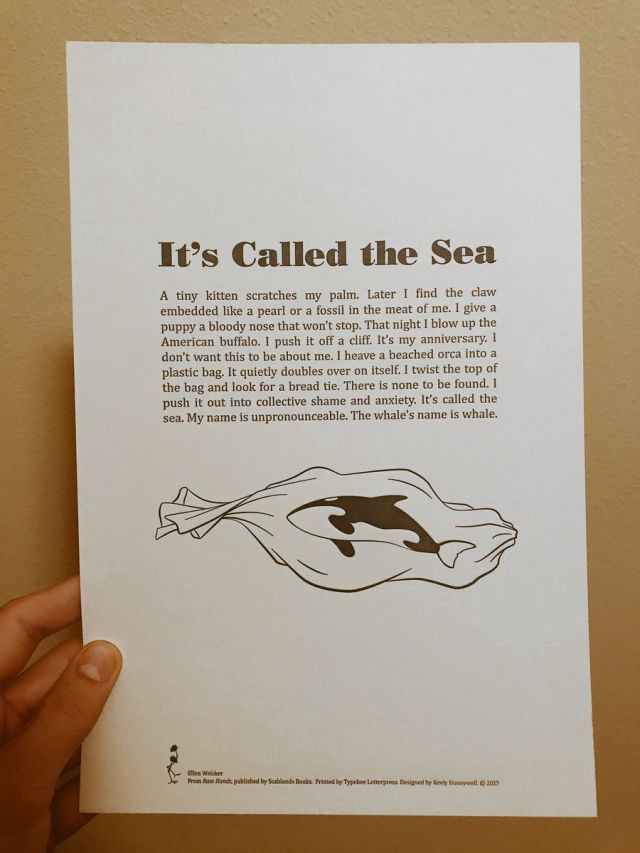
I feel I have shared this before, but It’s Called The Sea by Ellen Welcker, is a prose poem about the act of naming, and how we supply the reality of our world with the names that we give to things.


This week’s song is Tom Waits’ Asylum Years, and in particular Step Right Up and The Piano Has Been Drinking.


Thanks for reading Etch To Their Own. As always, it was written by @CJEggett, and proofread by no one. We’re coming up on a year of this newsletter, and I hope that you still find it a pleasure to have in your inbox, or in whatever feed you have strapped directly to your eyeballs. Aurvi of Guernica Magazine wrote in her newsletter this week that it has been a year of their newsletter. They were writing and reading as an act of resistance to Trump’s ascension. Me, I started writing as part of a project to rehabilitate my brain against the horrors of modern capitalism. It’s kind of the same thing, it kind of isn’t. At the core of it however is the will to have a richer interior life than the one that slips out of the factories and from our screens in our lazier moments. There is something important about leaving a big brain full of colour and flavour in the ground for the worms.

The Long & Short Of It

Etch To Their Own

This week we start with an extreme religious experience with, er, Religious Experience by Paul Luikart in Wiskey Paper:


Quite unusually, I am able to show you all of something this week. There is an obvious magic to this lovely blast of flash. The story of a man lost in the desert, who in his moment of desperation, looks for relgion and finds it in the cactus cross (which is not a Catholic cross, without the JC) and the rotting desert pig farting a putrid incense.
 
Talking to Paul on Twitter DM he spoke about how this flash is a reflection of what he considers to be the American approach to religion — and in particular the christian megachurch. This approach is one that only finds god in moments of complete desperation, that is to say, only being able to find god in death and delerium.
 
I like the balance of it, the idea of a godly immolation in the end — a complete wiping out of the self under the brightness of the light of a celestial omnipotence, and, the fearful self-preservation in the first half — fear of being pricked by the Christ-cactus.
 
The language in it — the brain-spoken thoughts come with the strangeness one gets when they are tired, or a little dim. That repetition— “like how the actual Jesus might actually say it” and “way way more light than a human brain can handle” — brings us closer to the average man who has wandered in the desert. This isn’t a lost poet, but someone who is having their first truely trancendent experience at their moment of expiration.


I dug out some diaries this week. My grandfather spent a little time writing up my great grandmother’s diaries, which run from something like 1935 to 1991. I’ve decided I ought to do something with his unfinished project — and some of it is quite exciting as there was occasionally a war on and my great grandfather, Horace, was a firefighter.


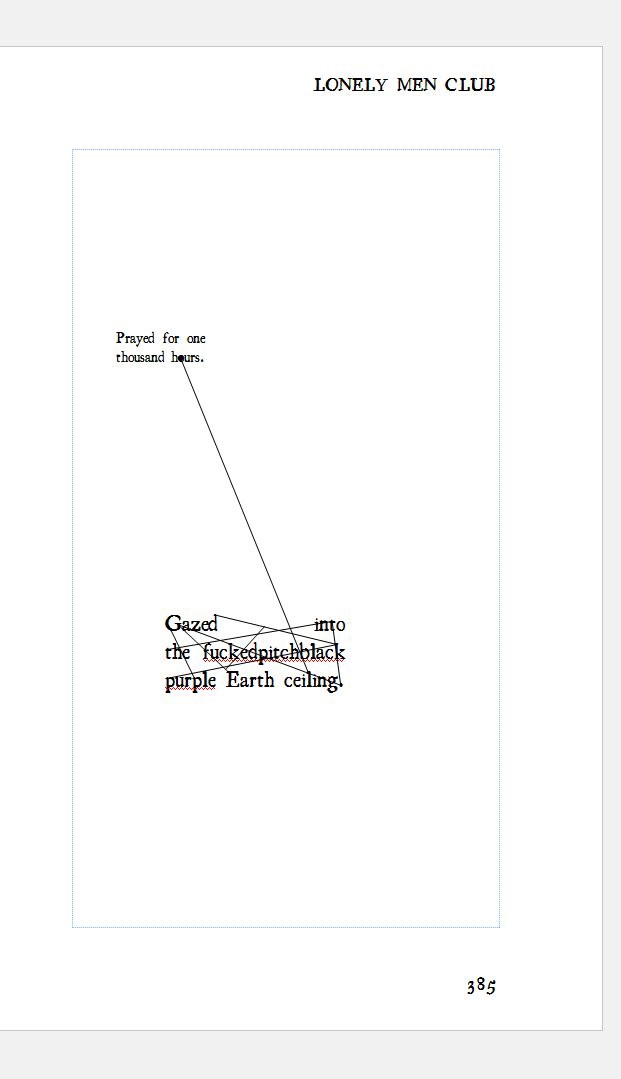
There is an exciting project in the works from Mike Kleine. He wrote a book in 5 days, of 100k words. It’s an experiment with generated texts — on the subject of the zodiac killer. And it looks brilliant:


as you and see, this is extremely up my street:


Mike explains to the work as a kind of experience, rather than a narrative. That kind of layering of ideas until the katamari ball of the idea is so vast and complexly layered that is can no longer be contained in our heads.
 
 It is intended to be read in a trance, to be incanted, to scar you into taking part in the work itself. Mike’s goal was to be able to create a novel that really could be read from any page. So far, with the making-text-an-object of the examples we’ve been shown, this is likely to be true.
 
 I like to engage with the idea that the language we use can effect us directly — reading a spell is the same as saying the spell, and you will get some magic out of it, some transformation, even if it is not the intended one. In the same way that the envionment that you’re in dicatates the range of actions you can take, so too does the language you surround yourself with create a structure in which your boundaries are set.
 
 I’m really looking forward to Lonely Men Club which I believe will be published by Inside The Castle.
 
 I’ll leave you with this snipped from out conversation, which is the closest thing I think we’re getting to a plot summary:

It adheres to a four-dimensionalist/eternalist interpretation of time as the character of the Zodiac Killer is depicted as that of an outsider & itinerant entity. He exists as a temporarily trapped(?) figure within the confines of our (forever) shape-shifting universe, until he is able to depart from this realm & conquer/acquire another (his true)(?) form. It is an extreme fable. More than anything, I am interested in spiritual truths and obfuscated memories.


I caught up with Inside The Castle, the publisher who will be bringing Mike’s work to the world, after the newsletter went out.

The publisher talked about their attempt to find work that could be read in many different ways — while they “aren’t interested in teaching computers to write the perfect short story” they are happy for “the computer being a tool to mine deeper perceptions of our culture by revealing our own language to us”.

Naturally, they are unconcerned with the obvious criticisms of inauthenticisty in generative work — and that “This endeavor exists in a family tree with the automatic writing if the surrealists, Burroughs’ cut-up, Michaux on mescaline, or Butor or Metcalf and their text collages. In a sense this is far more authentic than someone writing and publishing what they think the world is waiting to hear.”

This approach is one that allows reader to reapproach a work as they read it. A way to find a new surprise and fun in a work because it challenges them in it’s structure, form or otherwise. I offered that texts like this could be seen as museums, in that they are curated and one object effects you understanding of the object in the next room. ItC considers it more of a city:

I still like to think of a text as a city. It preserves the curation you are talking about but opens it to a lot more chance, competing values, contradiction, noise. I think as long as the “enhancement” you are talking about is activated in the reading process more than it is in the writing process.

So we can look forward to a flaneur around a city filled with versions of the zodiac killer looking for his final form.


Oh, and a song — this week it is, ahem, just this piano cover of Your Hand In Mine by Explosions in the Sky. Which I feel is probably the most basic of my song choices for a very long time.


Thanks for reading Etch Thier Own. It was written by @CJEggett, and proofread by no one. I’ve recently been rereading Ben Marcus’ collection Leaving The Sea — and I don’t think I finished it the first time. Honestly, can someone just let me know what they thought of the brutality of the last story The Moors? I don’t really know what to feel. Oh, also, there’s a story about a great writer who tries to finish his great work, but realises the first volume is fading, the ink is lightening — and so he goes back and tries to transcribe the old words. Then his son comes to help, when he gets too old to type, and soon, he cannot speak and only blink out the words in morse code — they have a system, and soon the son gets old and his son takes over from him, and once he gets old he translates the blinks into his own language of tapping or something and this goes on and … how does anyone get anything done? I mean, can anyone remember this story, and where it was published?

I Guess We’ll Have to Be Secretly in Love with Each Other

Etch To Their Own

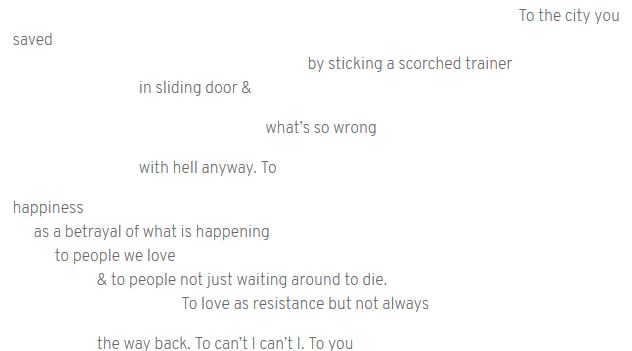
Rosebud Ben-Oni provides us with a little equine bonding in I Guess We’ll Have to be Secretly in Love with Each Other & Leave it at That in Frontier Poetry.
 
 Here’s snippet of the rich, giving, lyrical rush of it:


The poem is an arguement, a betrayal and then the justification of that betrayal because of the truth of it’s harmlessness. Breaking up lines into breathless fragments, in the motion of riding, in the motion of a canter of a walk lets us move between contexts.
 
 The horse might be a metaphor.
 
Speaking to Rosebud over Twitter DM, it’s a goodbye letter to her former lovers — and the lives that could have been lead. This gives us the lyrical context we need to understand lines like:

I think we & planting boxwood & snowdrop

for not our winter
 children, nor sweet box
 or winterberry.

To facetiming winter silence

(Sorry to mangle the layout)

The idea of white winter silences, and the running themes of argued things like children and sweet boxes next to the white christmas and post-christmas blossoms and berries. It’s a collection of boxes that you keep the things of past lovers in.

There’s something important in saying goodbye to previous lovers. It’s hard to do in the context of any current, positive relationship, because it might make a mark on where you are now. But it’s impossible to recognise the person you without the hoofprints made to get there.
 
Find Rosebud on her website, or on twitter. Her work appears or is forthcoming in POETRY, The American Poetry Review, Tin House, Black Warrior Review, TriQuarterly, Prairie Schooner, Arts & Letters, among others. Honestly, her current bio is what appears to be an enviable and unachieveable madness of various teaching, writing, and creative gigs.


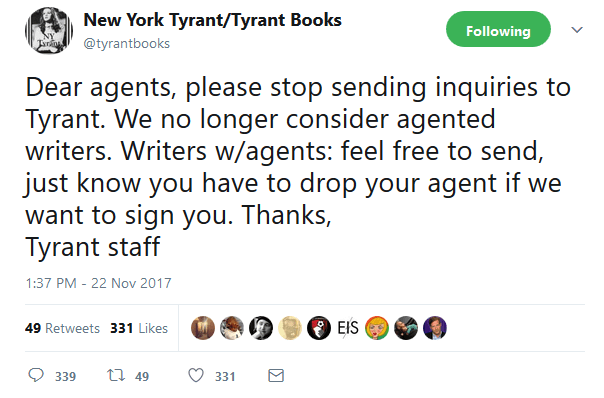
So there was that thing with Tyrant Books. The original tweet is here:


There seems to be a particular and nasty dispute between NY Tyrant and one of their writers, Darcie Wilder. I can’t really speak to this, but it is the centre of the ensuing storm surrounding the press.

The response seems a little mad to me. It’s not completely ridicious that a publisher might not want agented authors — it’s difficult to reconcile the middleman. The responses to that tweet make out like NY Tyrant is doing something illegal, perverse, digusting — but it’s simply a choice of business practice. One that says “no rent seekers”. Whether this is good or bad for writers would really depends on whether you would intend to work with this one particular publisher.
 
A great many of the replies involve people who seem to be simply churning what they’ve read in other replies, endless “this is a total red flag” and “predatory” come up so much you have to wonder how the news is spreading — and who to? We can’t assume everyone here has written something that would be suitable for NY Tyrant, a press who publish exciting and challenging work?
 
 NY Tyrant publish the excellent Blake Butler, writer of completely insane tomes, like SKY SAW which was a entirely abusive book to the reader. It really tore at you whenever you tried ot find ground within it. And yet, it was bodily-lyrical, it was an experience. I wouldn’t want to think someone would not submit that because they were worried about getting “ripped off”. The demand that all art should have to take the same path to the public seems strange to me.


This week’s song is Nicolas Jaar’s Against All Logic, and in particular Minesota 999.


Her face.


Thanks for reading Etch To Their Own, it was written by @CJEggett and proofread by no one. This week was too kind with poetry for us, and I wish we had more time for it. But my hear beats for the horses that have run me over in the past (true, although the horse is dead) and there are friends in the house who are yet to be sleeping.

This World Is Full Of Monsters, and We’re Fine Thanks

Etch To Their Own

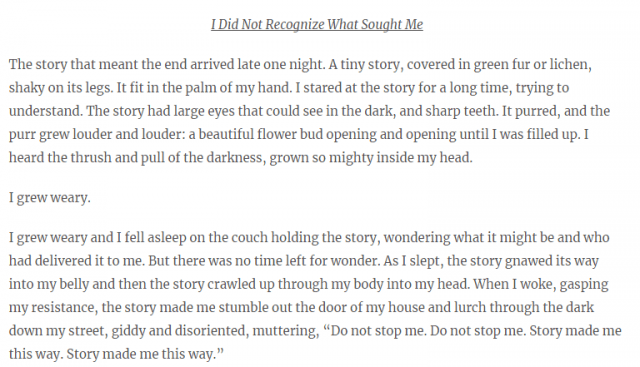
The biggest thing from this week is This World Is Full Of Monsters by Jeff VanderMeer. It’s an abstract story of a metamorphosis forced upon our protagonist unwillingly. There is a story on the doorstep, abandoned, orphaned — that is taken in. And like any small story, there’s a desire to nurture it.

But this isn’t just any short story left unloved on the doorstep — it was an alien using the form of a story to climb inside the brain of our hero, and being using him parasitically. Here’s the opening, it’s broken into chapters with excellent headings like I Did Not Recognize What Sought Me:


The story then continues to fall away into stranger and stranger translations and revisions to the body and the person — and the relationship with the alien story-creature.

Sometimes we get carried away by stories. When you write you can find yourself in a strange state of being where you’re not really thinking about the reality around you as the top priority.

In the excellent second episode of The Paris Review podcast, there is a line that outlines this kind of separation from reality that comes when you put the writing first. It’s from My Wife In Converse by Shelly Oria:

I can use this for my poem I thought, 
This is how I operate these days, like a thief

(It’s at 9 minutes 11 seconds onwards to get the sense of that part alone)

It’s a little bit of the magpie poet brain. The idea that you’re a thief, taking what you want from the world to add into your art. That maybe you’re not listening to the living but instead listening to what the dead or those in fiction would do with the world you’re in. A kind of passivity to the world, where you are one step removed from yourself.

The poem focuses on a relationship in a strange place, when something is maybe broken — and a undertow that you can feel. You can read it here if you have a Paris Review subscription (which I do not). The poem is interesting in it approaches the idea of approaching everything as an amateur, taking classes, being a test case, that the wife could never be anyone’s really because she’s always just trying things.

The moral that emerges, if there is one at all, is that the way writing grounds you is through its ability to take over your whole self.


It’s a game we play.


This is an amazing set of submission guidelines from spam.zine.


Please take a moment to look at this amazing object that has been created by C A Conrad, which is for sale for a number of dollars. C A Conrad is one of my favourite poets ever. The way the process is applied to the work that is created is wonderful, and obviously we’d expect nothing less than this when given a lunchbox to tart up!

Just look at it, a portable crystal grid:


This week’s song was going to be Four Tet’s excellent Planet. But then I got an email that there are some remixes of NxWorries kicking around now — so I’m going to give you that instead.

Sadly Suede and Lyk Dis aren’t quite as good as the originals (1 | 2) on first listen. But we’ll see how it goes over a few more plays.


Thanks for reading Etch To Their Own, I hope that I have improved your life in some way. Please tweet me if we have because, honestly, it makes me feel great. This has been a good week because I finished the long sad thing — you know, that silly thing I started as a kind of grief object — you know, the thing I don’t talk about — it’s 20k words now, when it started as 20 lines — hopefully it’s good. Reasons to get up. You should read this thing by my dear friend Sam. You should read this thing on friendship, which I like because it’s kind of about the art of the long conversation. Sometimes you end up having a conversation over decades, and sometimes these are the best kind. If you’d like to start a long conversation with me, drop yourself into my DMs and we’ll become notable persons of letters — later to be published in the Paris Review, we can hope.

Please Don’t Wait Too Long

Etch To Their Own

This might be another sad one today, so I apologise. It’s not a sad because of the publication in print of a non-fiction piece I wrote about writing eulogies in the excellent The Creative Truth. It’s sad for entirely another reason. We’ll come to that later.


If you have ever run a large enough website, you will be familiar with the kind of spam you get that has been through so many processes that, in many ways, it has become poetry. To that end, please enjoy this poem produced by the whirring of modern technology and the oppressive forward march of global capitalism.


Matthew Bevis held my attention for some time over here. This discussion takes us through the world of attention and distraction, and the ways in which distraction plays as a catalyst for the work that needs our attention. We know that it is moments of relaxation in which we find ourselves wandering to some of our greatest work — and that we are only the driver of our selves, we do not tend to all functions. There is an engine room somewhere where you can leave a problem when you become distracted, and someone helpful with take it away and fix it. You’ll return for it, and it will be there, but you’ll know how it can be fixed.

I like this little slice of it that I like:

More than a little. I’m writing this sentence as a distraction from a book about poetry that I’m meant to be writing, but also with a hunch that the book may get written via the distraction, that something in the book needs to get worked out — or worked through — by my not attending to it. Or perhaps the book was really always a distraction, and wherever the non-book resides is the place I’m supposed to be.

I like the idea of the non-book, a non-object that we will never get round to writing — and everything we do will be a distraction from it.

(Matthew goes on for a bit, it’s very good. Give it your time when you need a long stretch of something to be distracted from)


I enjoyed this in Black Warrior Review by Paige Lewis


I spent a little time this week going back to some of those really powerful pivotal books for me. Things like The Book Of Frank by C A CONRAD, Diary of Red by Anne Carson, POND by Claire-Louise Bennett. I just dipped in, it was nice, just to wander back to spots I remember from the books and reconnect with the permission that is provided when you read something kind of transcindental.

And of course, much of it is very funny:


It’s nice to remind yourself of what is it you want to do and those you consider having let you even attempt it.


Did you know that The Paris Review has a podcast? It’s brilliant. Car Crash While Hitchhiking is rendered in such a stunning way that does not take anything away from the language. Usually the dramatising of poetry in such a way makes me a little disappointed. This was not the case.

It also, to my entire delight, contains a reading of one of the most wonderful of Sadie Steins columns from the magazine, about dancing alone.


This week’s song is Post Requisite by Flying Lotus


The video is weird and… good? Worth a watch if you’re in the right frame of mind for something awful.


Thanks for reading Etch To Their Own. It’s been a funny week, but there has been good things in it. The sad thing, which I promised you at the start is this: I wrote to the hospital my father died in, to ask for his medical records. Why? I don’t know, really. But then, that’s it, I didn’t know. I wanted some facts, some figures, some record of it all. Something to hold on to regarding the way in which he died that an expert would understand. I don’t know if this makes any particular sense, but there is a desire. I got my response finally, from the kind people there that this information had been destroyed. They wait for 8 years, they they destroy the information. Anyway, if you have a question, I would say: don’t wait.

Dustsceawung

Etch To Their Own

Do you pick up stray books? If you saw a book unaccompanied on a bus, lonely, lost, would you take it home or would you hand it in?

Rajat Singh talks about “books out of place” in The Millions this week. The obsession with picking up good books that need a home is familiar to all of us, while it’s possible to leave a second hand bookshop without what you want exactly (because the good book is safe there), it’s very hard to leave a jumble sale, a market, or a general second hand store. Rajat associates this kind of yearning to make these homeless books safe by ordering them in some kind of system of his own devising, freeing them from a library sale or from the jumble of the sidewalk seller.

The Old English word “dustsceawung” means, literally, “a contemplation of dust.” It’s an understanding not of what’s been lost, or the transience of things, but of how the past persists in the present. To consider dust, however, is also to consider the work left to do with things that impinge on us. Dust collects because I haven’t circulated in a book’s ideas, or had a chance to let their words inhabit me.

As someone who has not had a more advanced ordering system in the last decade beyond read vs not read in piles and on shelves, I still feel like I am saving books, but not from disorder, more like into it. From world with it’s conventions and expectations, and into an interior where I’ll put no pressure on them besides occasioanally picking up for reference or one good read.


An empire of dirt needs a caretaker.


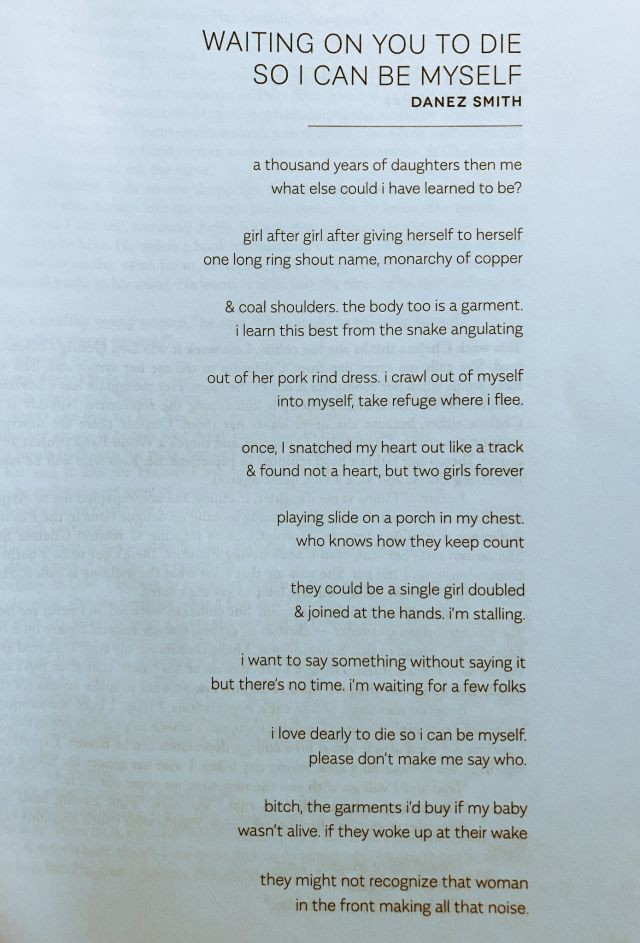
Have some Danez Smith for the rest of the weekend:


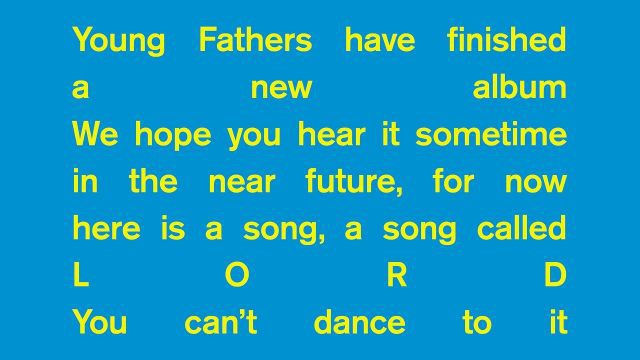
This week’s song is Lord by Young Fathers:


It’s a bit messy and all over the place, and I think that’s why I like it.


Thanks for reading Etch To Their Own #43. It’s me, @CJEggett, whom writes these words for you, whether you really want them or not. Please read my great dream tweet, and my follow up: is that a crow circling my lightbulb. I might manage to make some progress on this, this week, it’s very pretty. As are you, for reading these words — I treasure every moment you burn out your retinas on my slob-handed typos ❤

A Doll’s Dictionary

Etch To Their Own

This week has been lovingly consumed by Camilla Grudova’s The Doll’s Alphabet. A collection of short stories with a series of re-articulated and grotesque motifs concerning the strangeness of bodies, sewing machines and unappealing tinned food, and odd systems of oppressive society.

The stories feature characters who accept the world as it exists for them, there’s no rebellion against the systems they are trapped in, beyond minor and limited expressions of civic disobedience — even when they bring a tormentor to a violent end, it is presented as acceptable within the system that they exist within.

In Waxy our heroine lives in a world where women are put through school merely to work in a factory, while the men are educated until they are old enough to take Exams, and earn big Exam prizes. The men are generally coddled, and the society is built around their needs alone. When she finds Paul, an unregistered man, she finds herself happy to an extent. Despite their efforts they have a child, birthed with a bowl movement and soon they are blackmailed by their neighbours.

And so on.

It’s all presented in a very matter of fact way, to explain the way the world exists for these people. In Mermaid little is made of the capturing of a mermaid (who isn’t a romantic top/bottom half, just a general 50/50 spread of fishiness and humanity) to keep the protagonist’ very tall brother company.

A kind of body-horror abounds, but not one that sets and real expectations — there is no rightness in shape, but more a kind of obscure sculpture garden of persons that you wander through. For example, the protagonist’s father in Mermaid was so tall that when he died they wanted twice the amount of money for his coffin. In a fit of stubborness, the son donated his body to science and retained a finger, to be buried in a child’s coffin instead.

This is the flavour of the book. A kind of easy acceptance of the horrible compromise of peoples under strange circumstances. In Edward, Do Not Pamper The Dead — Edward’s parent’s die, but he and his wife keep ti a secret so they should not be assigned others to live with them. When the authorities find out, they are allocated a tiny woman referred to as The Child, and Horace. This unspoken of presence that invades their lives as a force of nature rather than an agreement made by active parties looms over all of the larger society elements in the collection.

They cannot be free of their oppression because they often cannot understand it to be oppression.

The book contains hundreds of tiny moments where something disgusting is switched for another disgusting thing. For example, Horace picks is nose and attaches the bogeys to the wall behind his bed. This is obviously disgusting, but Edward regrets buying Horace the present of liquorice because it turns those bogeys stuck to the wall black, as if it was swarming with flies.

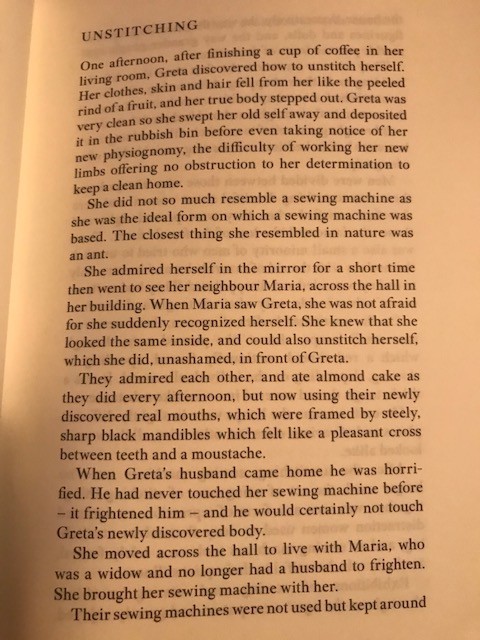
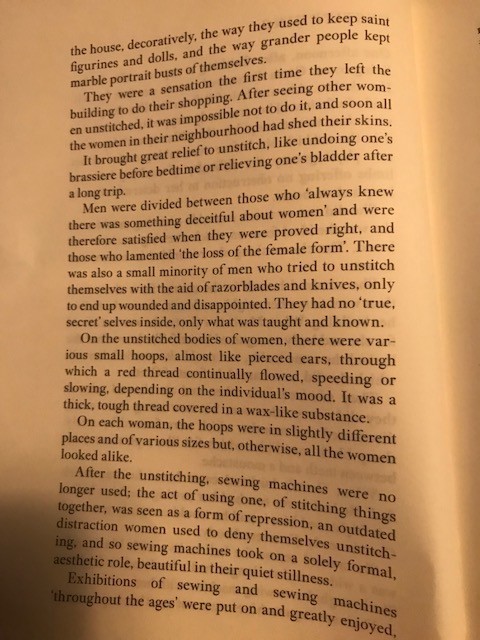
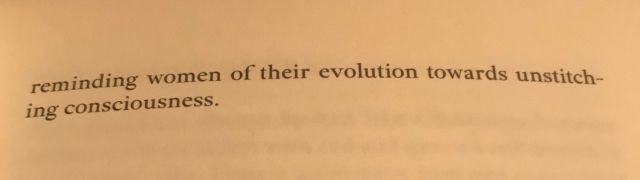
Aside from the powers that loom over the protagonists of the collection — there are the returning themes of women finding a kind of self, comfort, truth, or form. Like in the opening story, Unstitiching:


There are a few stories like this in the collection. Simply a telling of a history. A report on a movement. There’s a deft picking at the neurosis of the world seeing women who exist as themselves. The idea that there is a way to remove the oppressive systems around people, and unstitching can take place that is so fundamental it would be impossible to turn back the unspooling of the movement — a new reality that becomes obvious and in that replaces the old reality.

Pick up The Doll’s Alphabet over here from Fitzcarraldo.


I don’t know if I made it very clear that I loved the collection? To clarify: I loved it.

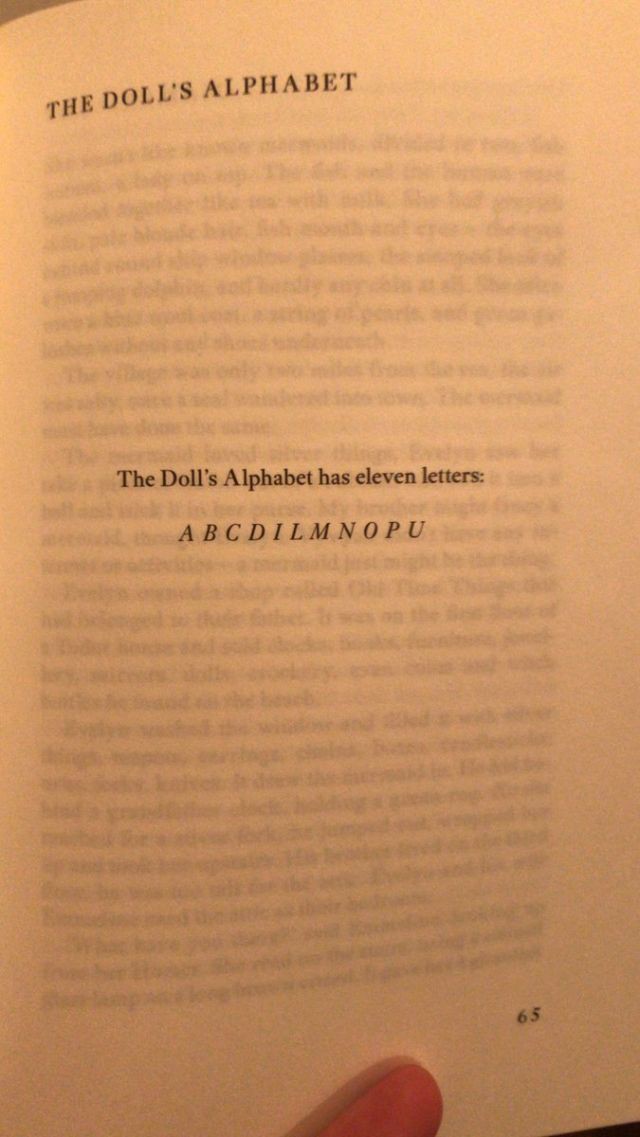
I do need some help though. I simply don’t understand the title piece:


Let me know what I’ve missed?


Please throw a like into this particular tweet.

Tim Clare is back with his particular brand of writing ramble.

Particularly interested in this.


Today’s song is 11 Ecm by Carsten Lindholm:


Thank you for reading Etch To Their Own. It was written by @CJEggett with a very full stomach. It was proofread by no one. Reply to this email to tell me your favourite strange birth in the Camilla Grudova collection, Tweet at me to tell me about a typo, join me on medium to let me know that kind of masochist your are. Remember, a picture a day will keep the thing from It Follows away because it mostly creeps up on you from behind and you’ll probably see it in your front-facing camera?

Theophany: I ask god to slide into my head quickly before I do

Etch To Their Own

Hello, have you ever considered letting god into your life? What about just one of the Greek ones turning up? They used to do it a lot, but I guess they don’t get out so much any more.

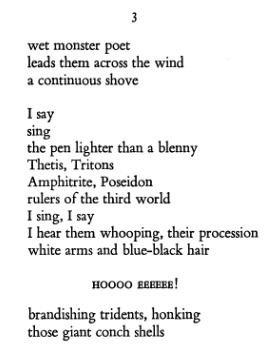
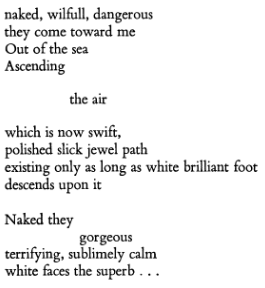
Today is Philip Whalen’s birthday, or would be if he were still alive. To celebrate, let’s take a peek at Invocation and Theophany:


The whole poem can be read here. The poem is about the invocation, the desire of a poet to bring forth a god to appear in front of him. The first and second verses are about his frustrations, his desperation to make something happen with his word. He’s in the right place, by the sea shouting for deities who represent the deep. And they arrive, in procession — undercut by a conch-honk.

And they ascend, without a glance his way.


This is a very natural way for creative people to approach something like writers block — to ask for some divine help, to experience something unseen to record, to give back “the absolute freedom of action / my own mystery and weight carrying / independent beings…”.

But there is something loose in this in wanting to be consumed by an experience — to be submitted to the sea, to see a god, to be possessed — to give over to someone else to drive what’s in you that your hands can’t ladle out.

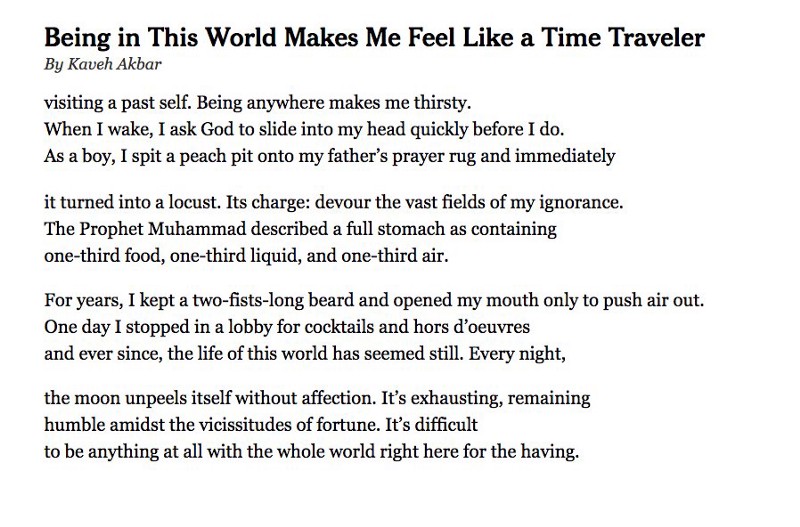
Which is similar to a poem published by our (and everyone else’s) fave, Kaveh:


Kaveh is, as always, the best. Here he’s talking about his letting slip of the reins, and hoping someone else with pick them up. Here the request isn’t to be consumed by a moment of divinity and to feature in their story which would tie them to some grand and cosmic point. Here, instead, is the request for:

“God to slider into my head quickly before I do.”

Which apart from be entirely perfect, is about a self in competition with a god to drive the poet. Kaveh is living the moment and not struggling for divinity, and instead this invocation is about a race to possess the body to tell the story.

After all:

“It’s difficult to be anything at all with the whole world right here for the having”

Both are looking for their place in the world to have some meaning and that for the stories they tell to have a weight beyond their own existence.


This week I discovered that there is new Four Tet:


Thanks for reading Etch To Their Own #41 — it’s my birthday today (20th October), I am becoming like a well worn pebble in the stream of life (perfectly spherical). Feel free to try and skim me across the lake, at your earliest convenience. You can read old issues of ETTO here. You can read about my life as a dwarf here. You can tell me about typos here. If you would like to climb inside my head before I do, or take me to the beach to see gods ascend, feel free to reply to this email.

The Helpful Dead

Etch To Their Own

Following on, it seems, directly from last week’s ETTO about having some time off to be dead, we have this by Leila Chatti:


Leila uses the structure of the poem to undercut initially presented meanings — “she fishes the black tongue” sounds portentous, until it is recontextualised into the sock. “Slipping coins in the mouth” references the ritual of placing a coin in the mouth of the dead (a payment to cross the river in the afterlife), and the lesson being taught here. It’s mundane, it’s simple, but these are the things where people left their marks through repeated steps and years of finding the right way, for a small thing.

Anyone who has lost someone important to them know the sentiment of them having so much to teach you — and that this isn’t over now that they’re dead. These ghost rattle around inside you after they are gone, or they wrap around you, a kind of headed pelt you can ask questions of as you go. They can answer with the leftover air in their skin. It doesn’t last forever, but it last a long while.

Read it in Breakwater Review.


I enjoyed this occult calendar.


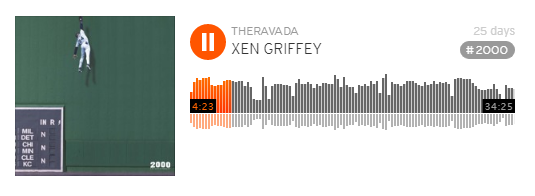
This week’s song (mix) is XEN GRIFFEY by THERAVADA


Thanks for reading Etch To Their Own, I have that Friday feeling we all know and love. Sorry it’s a short one, I have driven to Dorset to see the sea, I hope. This was written by @CJEggett and he only has eye for you.

Lazarus’ Lovely Red Gloves

Etch To Their Own

During a moment of quiet in a Northampton chain pub I found this poem by Martin Glaz Serup on the Zeno Press site. Here’s a little snippet:


The poem is a kind of jaded Lazarus poem — a wish-thinking of not only coming back from the dead, but being dead in the first place, and how that would change and free a person.

It presents the return from the afterlife (or just some nothingness state) as a place. He wants to come back as accessories — gloves, a phone case — frivolous items that add a small layer of pleasure on top of the normal engagement with the world. Coming back as such things would mean being beautiful but weightless — unencumbered with the mundane responsibilities of life and society which we all submit to in some fashion.

“But most of all I would come back because it was possible.”

The poem is about freeing yourself from these things by visiting death. It’s a holiday to nothingness.

In the third stanza he forgets himself — he forgets he is wishing to be back from the dead and instead, describes searching for a “death-like sleep” and the associated locations and places. This was possibly a chance to visit a person, but it is the sleep that stands out — the place has a sense of a holiday about it, a boat, bunks, strong beer. There’s the prayer for sleep and the self-destruction through drink that is that wishing to be elsewhere.


Naturally this flips back — the realisation that we’re not always able to be on holiday. That battle with wish-thinking.

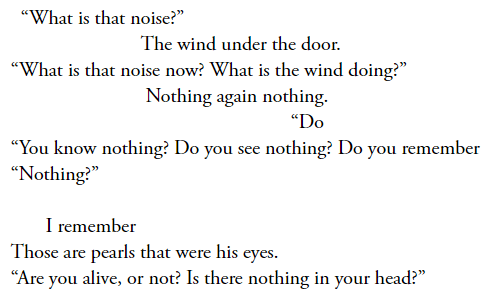
This is something we all do occasionally. We’ve all had our moments of wanting to do nothing, be nothing. And then we have those conversations with ourselves — those conversations seen in The Waste Land about nothing. After all, what is the point of us dreaming ourselves into nothingness?


What is the point of being alive if all you want is to be without anything? The practicality of life — the reality that you do generally have to go on and do something — comes to a meeting point. There is a negotiation that is gone through — you come to the point and ask — what is there to live for then?

BEAUTY! is made of leather, the smell of leather is the smell of beauty
and if I were to come back from the dead, I would come back for beauty
BEAUTY! gets along fine without its opposite
BEAUTY! gets along fine alone
BEAUTY! likes to receive guests on holiday, abroad, by appointment
though Sunday is a bad day

Beauty then! And, later, the act of putting in an effort. Beauty does get on fine without it’s opposite — although a holiday to the land of the dead is where the conversation starts, the freedom isn’t in having been dead and therefore free of your mundane chains of life. It’s in the choice to put in and effort now. Which of course, you can do without a boat trip.


As is so often the case, I wasn’t aware of this poets work in any meaningful way until they passed away. Susan Elbe:


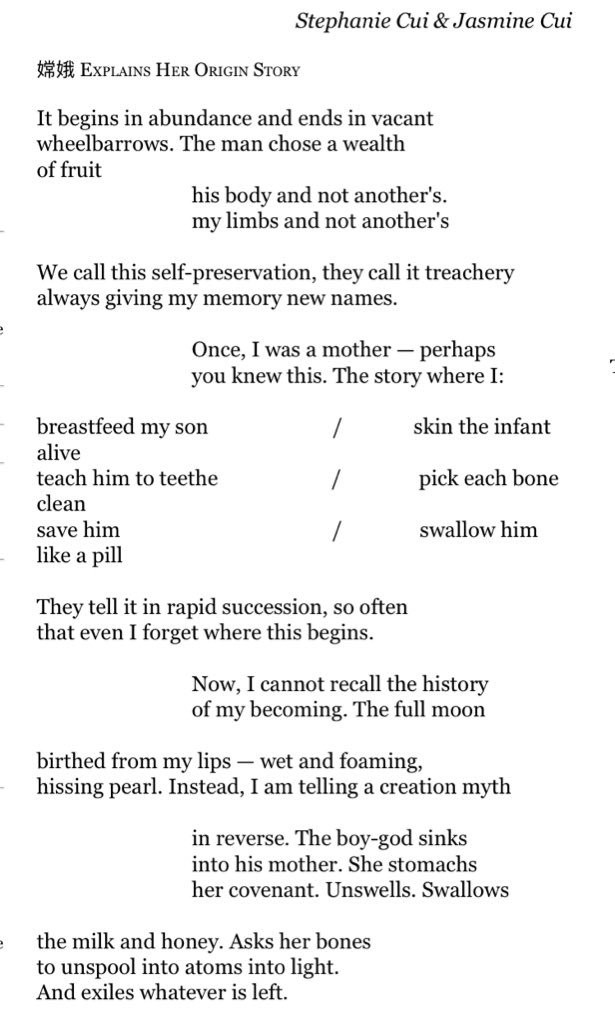
We also have this over in Glass, by Stephanie Cui & Jasmine Cui:


Today’s song is… this whole playlist — to my surprise:


I can also recommend returning to the WAC album, and in particular Time.


Thanks for reading Etch To Their Own. It was written by @CJEggett who isn’t tired, you’re tired, the whole system is tired! Your homework this week is to tell a friend about this newsletter, but only while looking them straight in the eye. If you thought this week’s ETTO was a bit depressing — then remember there are people out there really into recycling. You look lovely today.